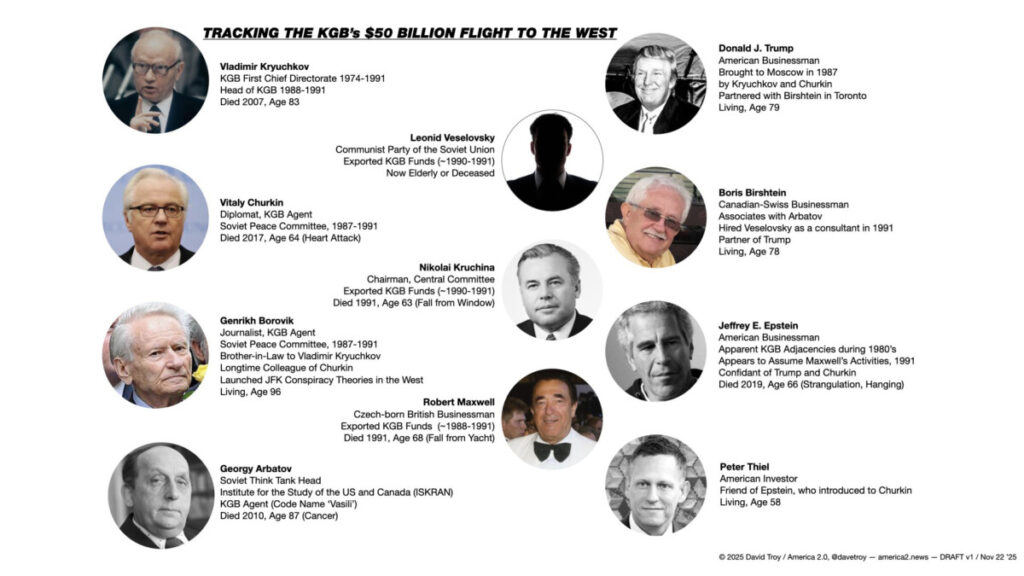


Investigative journalist Dave Troy is detonating the official Jeffrey Epstein narrative, arguing that the disgraced financier was not an isolated sex predator or lone “genius” investor, but a KGB cutout who inherited a $50 billion Soviet slush fund built to corrupt Western politics, culture and finance.
Troy’s research links Epstein and Ghislaine Maxwell to a blood‑spattered handoff after the failed August 1991 Soviet coup, when key party money men fell from windows and off yachts as KGB boss Vladimir Kryuchkov scrambled to exfiltrate Communist Party cash into the West.
Troy’s thread opens with a blunt claim: “Jeffrey Epstein was a cutout who replaced Nikolai Kruchina, Robert Maxwell, and Leonid Veselovsky in Kryuchkov’s $50bn+ KGB money laundering operation.” Kruchina, the Communist Party bureaucrat who managed party wealth, plunged from a Moscow apartment window on Aug. 26, 1991, just days after hardliners failed to seize power. Maxwell, Ghislaine Maxwell’s media‑tycoon father and a KGB financial asset, went overboard from his yacht Lady Ghislaine near the Canary Islands on Nov. 5, 1991, in what media called an “unexplained plunge.”
Troy argues this timing is the pivot in the entire story. The failed coup, he says, “was the tipping point that led to Kruchina and Maxwell’s deaths” and created a vacuum in Kryuchkov’s covert funding system. In the same window, public reporting shows Epstein and Ghislaine first connecting in summer 1991, with Ghislaine later testifying that she became much closer to Epstein after her father’s death that November. Troy says that overlap is not coincidence but “changing of the guard,” with Epstein stepping into the role vacated by the dead money men.
He also points to Soviet operative Leonid Veselovsky, who he says moved on to help “Trump finance building projects” as part of the same network, though he later corrects that Veselovsky worked with Boris Birshtein, who in turn partnered with Trump on Trump Tower Toronto, rather than directly overlapping with Trump himself.
Kryuchkov’s $50 Billion War Chest and the Grooming of Western Politicians
The core of Troy’s case is that KGB chief Vladimir Kryuchkov deliberately moved as much as $50 billion in Communist Party funds into Western channels in the late 1980s and early 1990s, building a “war chest” to buy influence and destabilize adversaries long after the Soviet flag fell. He cites a 1985 directive in which Kryuchkov ordered his service to become “more aggressive and creative” in pursuing Western assets, especially in business and politics, and says Donald Trump “fit the bill perfectly” given his “personality and weaknesses.”
According to Troy, Kryuchkov and diplomat Vitaly Churkin—later Russia’s U.N. ambassador and an associate of Epstein and Peter Thiel—brought Trump to Moscow in 1987 as part of this cultivation. At the same time, Kryuchkov’s brother‑in‑law Genrikh Borovik became head of the Soviet Peace Council and ran all U.S.–USSR “citizen diplomacy” programs, including the Burlington–Yaroslavl sister‑city exchange that brought Bernie Sanders to Russia for his 1988 honeymoon via the KGB’s Intourist travel agency.
Borovik, Troy notes, was close to Churkin and operated with him in the United States under Kryuchkov’s direction while the $50 billion exfiltration ran through figures like Maxwell—with Epstein “on deck.” Borovik still receives public birthday greetings from Vladimir Putin “in gratitude for his decades of service,” underlining that the Kremlin sees him as part of a continuing project.
The network also overlapped with American religious and conservative power. Troy cites photos placing Borovik alongside Fellowship Foundation leader Doug Coe and businessman Paul Temple at a 1988 U.S.–USSR “Citizens Summit,” noting that Temple helped fund Coe’s “Family” and was involved with the Institute of Noetic Sciences and, according to Troy’s earlier notes, may have intersected with the Council for National Policy. He flags that point as an area he is still verifying.
Disinfo, Cults and ‘Demoralization’: From JFK to Jonestown to TM
Troy emphasizes that the KGB campaign went far beyond crude bribery. He recounts how Borovik was implicated in Kennedy‑assassination disinformation, with KGB archivist Vasili Mitrokhin alleging that Borovik funded lawyer Mark Lane’s book “Rush to Judgment” and fed him leads that later shaped Oliver Stone’s “JFK.” Lane would go on to represent cult leader Jim Jones and was present at Jonestown during the 1978 mass murder.
The NotebookLM explainer video Troy released expands on this theme, citing KGB defector Yuri Bezmenov’s warnings that Moscow exploited spiritual movements like Transcendental Meditation to “demoralize” the West. Bezmenov said such groups taught people to seek “non‑existent harmony” instead of confronting real political problems, making them passive and easy to manage.
1/By popular demand and in the interest of speed, I’ve used Google’s NotebookLM to assemble this short explainer video about the thread I posted this morning regarding Epstein’s apparent ties to a large KGB money-laundering operation. pic.twitter.com/tJ0nFcMVDq
— Dave Troy (@davetroy) November 22, 2025
Troy ties this to Epstein’s 1988 visit to Fairfield, Iowa—home of Maharishi International University and the TM movement—and lays out how the same milieu produced figures like a billionaire hedge funder and major TM donor he says now pushes pro‑BRICS narratives that align with Russian objectives.
The Network Evolves Under Putin
Troy stresses that the operation did not end with Epstein’s 2019 death or with the Soviet Union’s collapse. “When Putin was a KGB shlub in Dresden in November 1989, Kryuchkov was his boss,” he writes, adding that it was Kryuchkov who led the 1991 hardliner coup. “Putin is following through on Kryuchkov’s designs, in an effort to save face and restore the dignity of the KGB.”
In his explainer, Troy maps a “next generation” of players: a former Putin youth leader turned venture capitalist who did PR for Epstein; the son of an Epstein associate from the Iowa TM trip who now runs his own influence campaign; and other intellectuals and financiers whose projects and funding sources, he argues, line up with Russian strategic goals. SEC filings for one venture firm, he notes, show 94 percent of its capital coming from undisclosed non‑U.S. persons, raising obvious questions about the money’s origin.
He also flags deals like a $100 million commission paid to a fixer in Moscow for a steel mill transaction backed by a Russian state bank that allegedly funneled money into Trump Tower Toronto, a project tied to Boris Birshtein, whom Troy identifies as close to both Coe and Borovik. When Trump opened that tower, Troy notes, the ceremony used Aaron Copland’s “Fanfare for the Common Man,” which Copland wrote after a Henry Wallace speech—Wallace being the “Stalin‑loving predecessor” Troy has dissected in prior work on pro‑Soviet American elites.

‘Follow the Money’: Subpoenas, Not Sex Scandals
For Troy, the sex‑crime horror of Epstein’s story, while real, also functions as a diversion. He argues that “sex, Democrats, Israel yada yada yada” is “noise and counterspin” meant to hide the financial core: a black‑hole war chest that has warped Western politics for decades. “Stop,” he writes. “This is the KGB manipulating the West.”
The path forward, he insists, is not more lurid speculation but aggressive financial transparency. Troy points to a Senate investigation led by Sen. Ron Wyden that has already flagged more than $1 billion in 4,725 suspicious transactions and calls that “just the tip of the iceberg.” He urges lawmakers and prosecutors to “subpoena everything you possibly can for the last ~40 years” and to dig into offshore structures in places like Jersey and vehicles such as FIMACO.
Troy acknowledges that almost no one in corporate media has the patience or freedom to assemble such a sprawling story. He says he devoted roughly 10 years to it, using data‑analysis tools and archival research to connect pieces that have “not been entirely hidden” but never pulled into a single narrative. He credits “dozens of collaborators” whose tens of thousands of research hours underpin his thread and promises several “deeply sourced original articles” to expand on specific nodes in the network.
“This is the story Putin and Trump don’t want you to know,” Troy writes, urging readers to “pester people about it until it’s on the front page of every paper.” In his view, only a majority consensus about this $50 billion heist—and the cutouts like Epstein who helped weaponize it—offers any hope of finally purging the KGB’s long shadow from the American system.