


The night of April 10, 2024, in Chile’s capital, Santiago, Lieutenant Emmanuel Sánchez spotted a car containing five men suspected of robbery. He identified himself as a Carabinero, one of Chile’s two main law enforcement bodies, and ran in front of the vehicle, raising his gun in the hope he could arrest the group. Instead of surrendering, they opened fire, shooting him 14 times.
A year prior, the night of April 5, 2023, another Carabinero, Daniel Palma, was shot dead after approaching a car while on duty in a different neighborhood of Santiago. The murder weapon had also been used in two previous shootings and a kidnapping, all connected to Tren de Aragua, according to investigators.

*This article is the sixth in a nine-part investigation, “Tren de Aragua: Fact vs. Fiction,” analyzing the truth about the gang, as well as its evolution, current operations and how it may change in the future. Read the full investigation here.
Chilean police were not used to being shot at, certainly not during traffic stops. But the Carabineros found that, in the eyes of newly arrived gang members, they had become legitimate targets.
“When a police officer is killed, and even more so in the circumstances in which it happened, it hits the hearts of the people,” one Carabinero who wished to remain anonymous told InSight Crime. “It’s a turning point for everyone.”
Venezuelan criminals’ experience with their home country’s trigger-happy police makes them more likely to unnecessarily escalate interactions with Chile’s more professional Carabineros.
“When we arrest a Venezuelan, his reaction is to safeguard his life,” the Carabinero added.
In Chile, elements linked to Tren de Aragua found a country that had not experienced anything like the transnational crime group, and the Venezuelan gang used that lack of experience to its advantage.
Sowing the Seeds
When Colombian police arrested Tren de Aragua co-founder Larry Álvarez Nuñez, alias “Larry Changa,” in a mansion in the department of Quindío on July 1, 2024, it marked the most high-profile apprehension related to the organization to date. While the Colombian Defense Ministry stated Changa had led the group’s expansion there, his influence was perhaps even more keenly felt thousands of kilometers to the south.
Changa arrived in Chile in 2018, and, unlike so many of the gang’s members who would later make the country their home, did so legally and with a regular migratory status. This was even more remarkable given he had escaped Tocorón prison in 2015.
He maintained a low profile, setting up small businesses, and even frequented central Santiago to sell arepas, a corn-based flatbread popular in Venezuela. Yet his plans were more ambitious.
“Surely he must have had a mission within the organization which was to analyze the context of the possibility of Tren de Aragua breaking into the national territory,” Ignacio Castillo, director of the Specialized Organized Crime Unit of the Attorney General’s Office, told InSight Crime.
SEE ALSO: Tren de Aragua Just Sustained ItsBiggest Leadership Blow
Changa, according to prosecutors, was responsible for overseeing what would be the first Tren de Aragua-linked cell Chilean investigators would identify, in the northern region of Tarapacá. Led by Carlos González Vaca, alias “Estrella,” this cell took control of border crossings and settled in the city of Iquique.
Changa fled the country in 2022 as pressure against him mounted, but by that point Tren de Aragua and its related cells had spread beyond Tarapacá and deep into the capital, Santiago.
Arica: A City Upended
Chile has long been one of South America’s safest countries, and compared with some of its regional neighbors, relatively untouched by organized crime. Yet that blessing is exactly what made it so ill-equipped to prevent Venezuelan gangs from spreading once they arrived.
“First, they had no competition; second, the market was attractive; and third, there wasn’t much difficulty in finding mechanisms to launder money or hide assets,” said Castillo.
As in Colombia and Peru, elements of Tren de Aragua followed the trail of Venezuelan migrants into Chile, making those migrants its first victims. It picked locations with minimal local criminal competition, such as Arica, around 15 kilometers from Chile’s northern border with Peru.
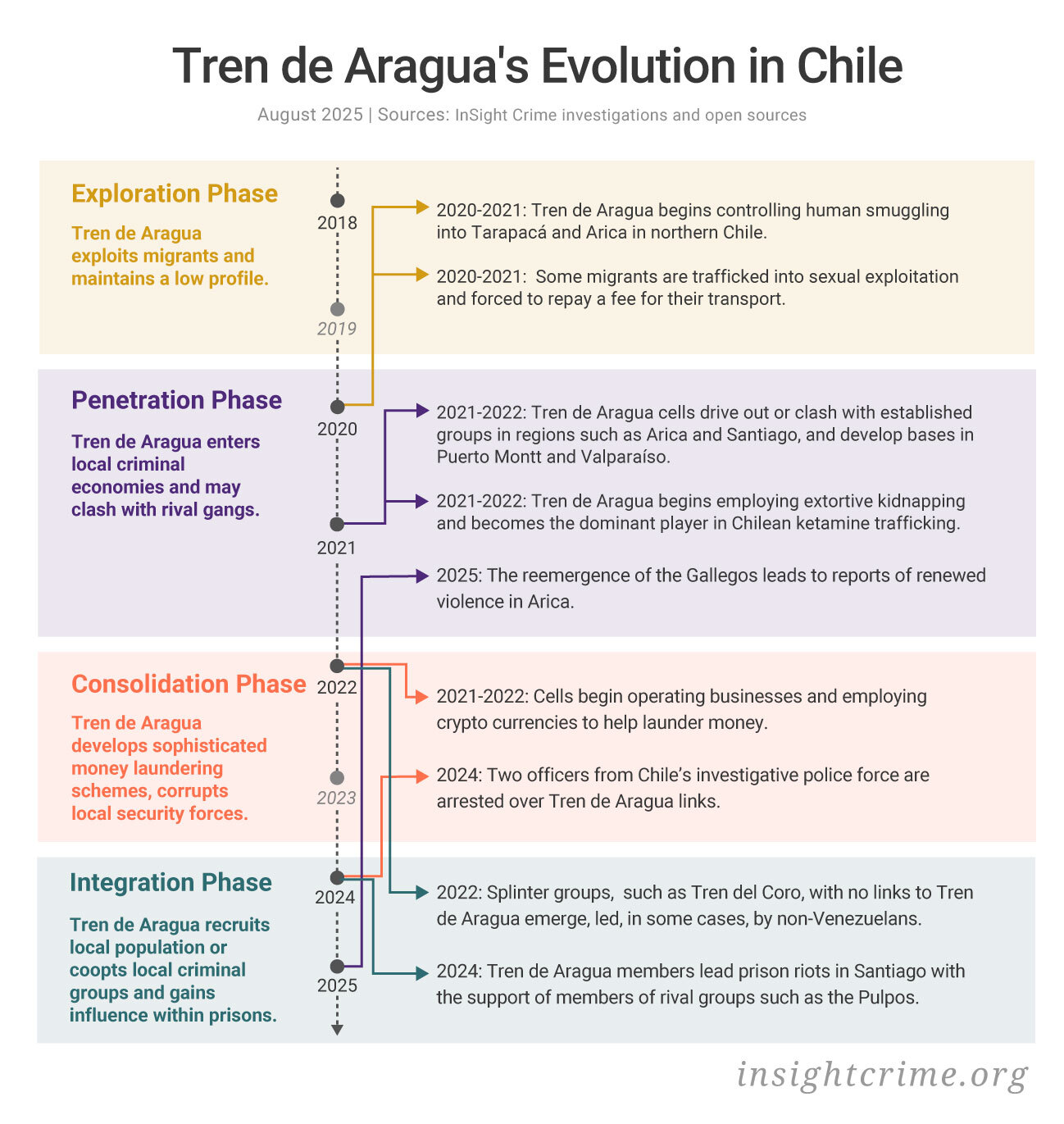
There, the Tren de Aragua-linked faction the Gallegos, which originated in Peru, employed the strategy adopted by Estrella’s group in Tarapacá: controlling border crossings and migrant smuggling in order to later dominate criminal markets. The group integrated its crimes, trafficking female migrants into sexual exploitation, and forcing other migrants crossing the border into carrying drugs.
The group reached the city of Arica in 2021, but it firmly established itself in 2022, forcing its way into Cerro Chuño, a makeshift settlement home to around 3,000 residents, and driving out some of those who lived there at gunpoint.
Members murdered inhabitants, mostly Colombians, but not because of a gang feud, according to Melissa Figueroa San Martín, regional lawyer for Chile’s National Institute of Human Rights.
“The sin they had committed was that they had not left when they were ordered to leave,” she told InSight Crime.
The neighborhood’s vantage point over the city made it sought after territory for the gang that wanted an operations center out of sight of the law. Sex workers who refused to pay extortion and anyone the group deemed its enemies were taken to a torture house there, according to Arica’s attorney general Mario Carrera.
One alleged member who had failed to follow orders was found dead in that house in June 2022. Eleven months later, police discovered the bodies of two men, hidden under cement in another house in Cerro Chuño. Investigators believe members of the Gallegos had buried the two alive five months prior.
The violence escalated when a splinter group, Tren del Coro, broke off from the Gallegos, leading to a feud that helped make Arica Chile’s murder capital in 2022. This attracted the attention of the security forces, who found themselves under immense political pressure. Multiple security force operations, which resulted in dozens of arrests, helped defang both Tren de Aragua-affiliated groups, bringing the murder rate down in 2023.
Thirty-four Gallegos members were sentenced for crimes including murder, human trafficking for sexual exploitation, and drug trafficking in March 2025. Felix Anner Castillo Rondon, alias “Pure Arnel,” the man Chilean authorities have identified as the Gallegos’ leader, remains on the run, although he was one of six prominent Tren de Aragua members who was put under sanctions by the US Treasury Department in July 2025.
For a while, it seemed the arrests had eliminated the Gallegos’ prospects in Arica. However, the region’s prosecutor blamed a resurgence of violence in 2025 on a continuation of fighting between the gang and Tren del Coro, El Mostrador reported, highlighting the Gallegos’ reluctance to abandon the territory it had so bloodily acquired.
Upending Chile’s Criminal Landscape
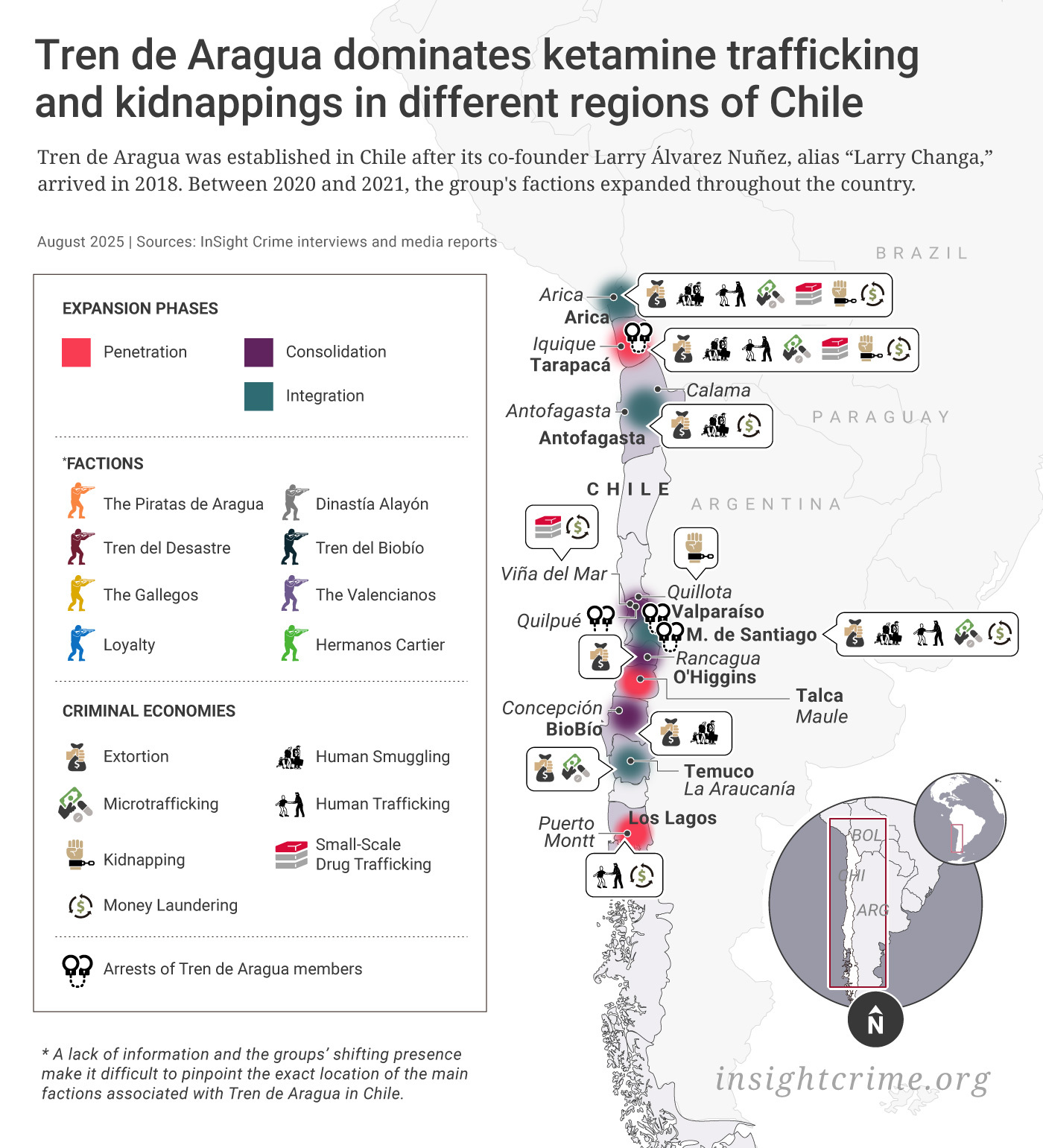
Tren de Aragua cells in Chile have developed a wide criminal repertoire, engaging in migrant smuggling, human trafficking, sexual exploitation, extortion, and drug dealing, as is the case in both Colombia and Peru.
Despite being involved in small-scale drug trafficking into Chile to feed the national market, Tren de Aragua has not prioritized drug trafficking.
“We’ve not seen them try to control spaces that are relevant to drug trafficking, over a port, for example,” said Castillo.
But the discovery in May 2023 that Tren de Aragua had purchased two buses with the purpose of transporting migrants and drugs from the north of the country to Santiago highlights the connection between the organization’s various criminal economies.
Certain cells have also adopted “extortive kidnapping,” where extortion victims who refuse to pay are abducted, or specific targets are forced to pay a ransom. Kidnappings increased 68% nationwide between 2021 and 2022. While many of these were related to family disputes, regions with prominent Tren de Aragua cells, such as Tarapacá and Arica, had among the highest rates of kidnappings linked to organized crime during 2023.
Perhaps the most infamous crime linked to Tren de Aragua in Chile was the kidnapping and murder of former Venezuelan military official Ronald Ojeda, who had fled Venezuela, where he had been detained and tortured by the authorities who accused him of involvement in an attempted coup.
SEE ALSO: High-Profile Chile Murder Shows Tren de Aragua’s Sophistication
Ojeda was snatched out of his Santiago apartment by individuals dressed as police officers on February 21 of 2024, and his body was discovered in a suitcase, buried under cement in another part of the city on March 1.
The absence of a ransom demand separates the kidnapping from others Tren de Aragua affiliates have conducted, and prosecutor Héctor Barros said three witnesses had claimed the Venezuelan government had ordered the crime, although these claims have not been proven.
A 17-year-old Venezuelan was arrested shortly after police discovered Ojeda’s body and police had arrested 12 individuals suspected to have been involved in the crime by mid August 2025. In January, police claimed to have dismantled the cell responsible for both Ojeda’s, and police lieutenant Emmanuel Sánchez’s murders, with a series of arrests, including those of the cell’s alleged leaders in Santander, Colombia and in Texas, United States, the month prior.
As elsewhere in the region, Tren de Aragua affiliates have made sexual exploitation a central pillar to their strategy and revenue streams in Chile.
“I think that the great economic shift Tren de Aragua brought that is going to be installed in Chile, was to revolutionize the prostitution market,” Matías Garretón, investigator from Center for Conflict and Social Cohesion Studies (Centro de Estudios de Conflicto y Cohesión Social) told InSight Crime.
The organization made sex workers, and particularly Venezuelan sex workers, their first extortion targets.
Yet beyond extorting those already working as sex workers, Tren de Aragua has also forced migrant women into sexual exploitation, often with false job offers, and revictimizing the same women who have already been forced into sexual exploitation in Colombia or Peru.
“They tell them, for example, that they can be models,” Carolina Suazo Schwencke, deputy prosecutor from the Attorney General’s Office’s Highly Complex Crimes Unit, told InSight Crime. “Sometimes they do tell them that they can supposedly work in prostitution, but they don’t tell them the conditions under which that will happen.”
As well as bringing changes to Chile’s criminal landscape, Tren de Aragua has adopted new methods such as employing cryptocurrency in laundering its criminal profits in Chile. Prosecutors and police discovered that one faction used shell companies and cryptocurrency to send $13.5 million abroad.
A Name Can Be a Blessing or a Curse
Limited criminal competition, coupled with a police force with little experience in dealing with hyper-violent criminals, and Chile’s status as being one of South America’s strongest economies, meant the country held obvious attractions for criminals migrating abroad from Venezuela.
Members have sought, and succeeded, to corrupt police officials, with two investigative police officers arrested over allegedly assisting the organization’s sexual exploitation operation in Santiago, according to an April 2024 investigation from Chilean news site MegaNoticias.
The shocking violence the Gallegos employed in Arica was not an anomaly either. Police discovered 17 torture houses belonging to Tren de Aragua-linked gangs in Santiago between 2022 and July 2025, Chilean news outlet La Tercera reported.
In cases where Tren de Aragua has run into disputes, it has largely been with other transnational criminal organizations, such as the Pulpos, a group of Peruvian origin, with whom Tren de Aragua has feuded in Santiago.
Tren de Aragua cells, or apparent cells, have been identified across the country, including in Tarapacá and Arica in the north, the central cities of Valparaíso and the capital Santiago, Concepción in the south, and even Puerto Montt, 3,000 kilometers to the south.
But a closer look at individual cells suggests Tren de Aragua’s growth in Chile may have been the result of mutually beneficial agreements, rather than a centrally coordinated expansion.
Investigators have directly linked a faction operating in Tarapacá, Santiago, and Valparaíso to one of the organization’s main leaders, Larry Changa, who has been locked up in Colombia since his arrest there in July 2024 and is currently awaiting extradition to Chile. Police in Valparaíso arrested Junior Misael Castillo Betancourt, alias “Junior Enano,” in February 2023. At the time he was living under a false identity but was later revealed to be one of Tren de Aragua’s leading figures in Tocorón prison. Yet other factions are not so clearly controlled by the group’s central leadership.
A cell in Puerto Montt, operated as a Tren de Aragua “franchise,” paying for the right to use its name and gain access to sexual exploitation victims who had been trafficked into the country, according to regional attorney general Marcelo Maldonado.
Chilean investigators have linked the Gallegos to Peru, but not Venezuela, and the belief among Peruvian authorities that the Gallegos have broken away from Tren de Aragua, means that cells’ ties to the larger organization may be merely historic. Tren del Coro’s breakaway from the Gallegos could also suggest future fragmentation of Tren de Aragua-linked cells.
Additionally, as in other countries, copycats have adopted Tren de Aragua’s moniker in order to inspire fear, making it more difficult for law enforcement to know when a cell is truly linked to this larger organization.
Tren de Aragua-linked cells, with a range of distinct names have proliferated, including some groups that originated in Peru like the Gallegos or Dinastía Alayon, but also others such as the Piratas de Aragua, Tren del Desastre, and Tren del Biobío that formed in Chile.
Tren de Aragua’s notoriety has put it firmly in the crosshairs of Chilean police and prosecutors, with more than 330 members arrested between 2021 and June 2025, according to the director of Chile’s investigative police.
SEE ALSO: Chile Court Bomb Threats Highlight Tren de Aragua’s War on the State
The attention the Tren de Aragua name brings, or the loss of prestige the name could have suffered as a result of copycats, may have driven certain cells away from adopting the moniker.
“It may be that at this point having the title Tren de Aragua may also be, rather than a virtue, it may be a problem and they prefer not to call themselves that, and they prefer to disassociate themselves from Tren de Aragua,” Ignacio Castillo said.
The name Piratas de Aragua first appeared in Santiago shortly after the Venezuelan government took control of Tocorón prison, Carlos Basso, a journalist who has extensively covered Tren de Aragua in Chile, told InSight Crime.
Whether this “rebranding” was an attempt at breaking away from the group by members who felt the organization had lost its leadership, or due to a perception that Tren de Aragua’s name had lost some value as a result of the prison takeover is unclear, he added.
Either way, Tren de Aragua’s structure does seem to have mutated from the more hierarchical organization it once was.
“I believe that the Tren de Aragua we have today has nothing to do with the Tren de Aragua that we had two or three years ago,” said Castillo in June 2024. “I get the impression that it is very fluid in terms of adapting to places and realities and losing connection with its origin.”
Tren de Aragua’s Defiance of the Chilean State
Tren de Aragua has not only upended Chile’s criminal landscape, but continues to directly challenge state elements on the streets, in the courts, and within prisons.
The trial of 34 Gallegos members, conducted virtually due to security concerns, began in April 2024 and was scheduled to last four months but did not arrive at the judgement stage until November 19, 2024. A bomb threat targeted the court while a police operation was underway in Cerro Chuño, and around the same time prison officers discovered a defendant to be in possession of a handcuff key.
“Here we see or notice a new criminality, a new organization, a new structure that obviously not only violates the legal system, but also the social legal order,” the trial’s judge, Sara Pizarro, told InSight Crime.
Another issue that impacted the trial was that some of defendants were involved in a riot at Santiago’s maximum security prison, organized and led by Hernán David Landaeta Garlotti, alias “Satanás,” an alleged sicario who had been a member of the Tarapacá Tren de Aragua cell.
Interestingly, the riot, which caused around $200,000 of damage according to the director of the Gendarmería, Chile’s prison service’s armed force, also reportedly involved members of the Pulpos, a group Tren de Aragua had disputed with on the streets of Santiago.
Criminal groups’ relationships behind bars with one another may differ from those they have in the streets, but this incorporation of rival groups could hint at a potential path for Tren de Aragua’s future evolution, while the arrival of Larry Changa in a Chilean prison could see him attempt to restructure the gang or gain more control over its fragmented operations.
Tren de Aragua’s expansion to Colombia, Peru, and Chile made its name ring out across South America. But by 2022, Venezuelan migration patterns were shifting. South America had already absorbed millions of Venezuelan migrants, but jobs were becoming scarce, and now the giant US market beckoned. And as migrants set their sights on the American dream, Venezuelan criminals decided to accompany them.