


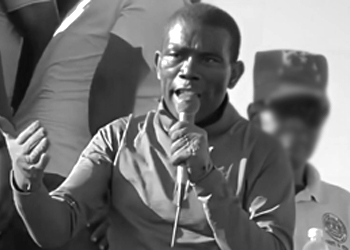
Guy Philippe is a convicted money launderer, former police commander, and politician, who helped lead the 2004 coup against Haiti’s then-president Jean-Bertrand Aristide. After serving a six-year prison sentence in the United States, authorities repatriated Philippe to Haiti in November 2023.
Philippe’s known criminal career started in the late 1990s as a commander in the Haitian National Police (HNP), when United States authorities accused him of using his contacts in the security services to traffic cocaine from Colombia to the United States via Haiti. Arrested and extradited to the US in January 2017, he pleaded guilty to one count of laundering proceeds from drug trafficking.
Despite his criminal history, Philippe has long-held presidential ambitions, branding himself as a freedom fighter against Haitian elites, corruption, and foreign intervention. His history, however, often clashes with the image he presents to supporters. Philippe’s coup attempt was in part financed by wealthy Haitian families and led by former military officials implicated in serious human rights abuses.
These days, Philippe is a wildcard who, with his underworld and overworld connections, may further complicate Haiti’s political future. Since his return, Philippe has held rallies nationwide, frequently flanked by heavily armed members of Haiti’s Brigade of the Security of Protected Areas (BSAP), a rogue government agency once responsible for environmental protection.
History
Philippe was born on February 29, 1968, in Pestel, a hamlet in Haiti’s southern Grand’Anse department. He studied medicine in Puebla, Mexico before starting a military career in Haiti. In 1992, he received a scholarship from the Armed Forces and trained in Ecuador, with part of his training provided by US Special Forces.
Soon after Philippe’s return to Haiti, then-president Jean-Bertrand Aristide disbanded the country’s Armed Forces. The institution was notoriously corrupt, and Aristide harbored particular animosity towards it, as his first presidency was abruptly cut short by a 1991 military coup that almost led to his execution.
Philippe joined Haiti’s National Police and was fast-tracked to become Chief of Police in Cap-Haïtien, Haiti’s second-largest city, and an important depot for drug trafficking. He maintained close contact with colleagues from his military training in Ecuador, several of whom also advanced through the ranks of Haiti’s police force. During this period, US authorities alleged that Philippe became involved in drug trafficking.
In 2000, Haitian authorities dismissed Philippe from the police force and accused him of plotting a coup against Aristide in coordination with other police commanders. Philippe fled Haiti, first to Ecuador and later to the Dominican Republic.
While outside Haiti, Philippe doubled down on efforts to overthrow Aristide. He formed a rebel army called the National Revolutionary Front for the Liberation and Reconstruction of Haiti (Front pour la Libération et la reconstruction Nationales). Many rebels were former soldiers who resented Aristide for disbanding the Armed Forces in 1995.
Prominent leaders of the Front included Louis Jodel Chamberlain, a former army officer who previously headed a paramilitary group responsible for killing thousands of Aristide supporters, and Gilberto Dragon, a former military officer who trained with Philippe in Ecuador and had suspected links to drug trafficking.
The coup began in early 2004, following a gang uprising in Gonaives, a coastal city about 150 kilometers north of Port-au-Prince. Soon after, Philippe’s rag-tag rebel army crossed the border from the Dominican Republic to Haiti and gradually took control of territory. On February 22, the rebels captured Cap-Haïtien and marched towards the capital, Port-au-Prince. They faced little resistance.
On February 29, 2004, Aristide resigned to appease the rebel army and was flown to the Central African Republic by the US military. Later, Aristide claimed he was kidnapped by US forces, an accusation that US diplomats denied.
Aristide was succeeded by the president of Haiti’s Supreme Court, and new elections were slated for 2006. Philippe turned his Revolutionary Front into a political movement and ran for president, but he lost spectacularly, gaining just 1.9% of the vote. During the campaign, the US indicted Philippe on drug trafficking charges, though the indictment remained confidential until 2017.
Following the 2006 election, Philippe evaded several attempts by law enforcement to capture him. In 2007, the Haitian National Police, supported by 12 agents from the Drug Enforcement Administration (DEA) and equipped with five helicopters, mounted a large-scale raid on his property in Les Cayes but failed to find Philippe, who allegedly fled and watched highlights of the raid on television from a neighboring town.
After the raid, he kept a low profile and stayed close to his hometown of Pestel. In 2015, however, he successfully launched a bid to become senator for the Department of Grand’Anse, a job that would grant him immunity from prosecution.
On January 5, just four days before being sworn in as a state senator, a joint operation by Haiti’s Anti-Drug Trafficking Brigade (BLTS) and the DEA arrested Philippe minutes after he gave a live radio interview. He was immediately extradited to the US.
Criminal Activity
US authorities charged Philippe with conspiring to import cocaine into the United States and laundering the drug trafficking proceeds. In an agreement with US authorities, Philippe pleaded guilty to one count of money laundering.
Philip also admitted to accepting between $1.5 million and $3.5 million in bribes from Colombian drug traffickers between 1999 and 2003 in exchange for protecting drug shipments from law enforcement. Some of these funds were used to pay corrupt officers in the Haitian National Police.
Philippe deposited funds in repeated batches of less than $10,000 to avoid triggering anti-money laundering alerts, according to the US Department of Justice. He also transferred funds through bank accounts in Ecuador and the United States to disguise the origin of the payments, and invested in property and assets in Miami.
The judge ordered Philippe to pay $1.5 million in fines and jailed him for nine years. From prison, Philippe broke the conditions of his plea agreement by filing an appeal against his ruling, claiming innocence, and requesting $100 million in damages. The appeal was denied, and Philippe ultimately served six years before being repatriated to Haiti in November 2023.
Geography
The Southern department of Grand’Anse remains Philippe’s stronghold and was the location of his successful 2016 bid to become a state senator. The southern coast is also a common entrepôt for cocaine from South America destined for the United States. Still, any politician, police official, or would-be government official must also manage contacts in the capital, Port-au-Prince, where gang leaders have their strongholds.
Allies and Enemies
Philippe has a murky set of allies. In 2024, he joined gang leaders, including Jimmy Cherizier, alias ‘Barbecue,’ in calling for a “revolution” against then-president Ariel Henry. Philippe also publicly mused about granting amnesty to Haiti’s gangs should he take power, prompting speculation that he was actively coordinating with Haiti’s formidable gang leaders.
In media interviews, Philippe described his connections with gangs as being “not deep.”
During 2024 rallies, Philippe was accompanied by armed members of the Protected Areas Security Brigade (BSAP), a rogue government unit officially tasked with protecting Haiti’s national parks. Analysts claim the BSAP has effectively become a paramilitary group. What’s more, many BSAP members are former soldiers who fought with Philippe during the 2004 coup, according to Jean Baptiste, a spokesman for demobilized soldiers.
Agents from the BSAP have repeatedly clashed with the Haitian National Police. The Global Initiative Against Transnational Organized Crime (GI-TOC) estimates that there are between 2,000 and 6,000 BSAP members, posing a sizable challenge for Haiti’s security forces.
Official numbers suggest there are 9,000 members of the Haitian National Police, though analysts peg the number of actual officers available for duty as low as 3,000. The source of weapons for the BSAP remains unknown.
Prospects
Analysts consulted by InSight Crime referred to Philippe as a wildcard for Haiti, straddling the worlds of politics, paramilitarism, and organized crime. In 2024, Phillipe called for a “revolution” against the former-president Ariel Henry, who has since resigned. He also has repeatedly signaled his ongoing presidential intentions.
Although not in power, Philippe maintains influence and has links to “Réveil National,” a political party in Haiti. It is not publicly known whether Philippe also maintains contact with drug trafficking networks or has significant ties to the country’s criminal gangs.
With his support base among Haitian voters, links to former military officials, and track record of leading coup attempts, Philippe could be a formidable adversary to any future government of Haiti.