


The U.S. Department of the Treasury has sanctioned 26 Mexican companies involved in fuel theft, signaling the growing importance of this alternative criminal economy in the finances of major organized crime groups.
On September 10, the Treasury’s Office of Foreign Assets Control (OFAC) imposed sanctions on nine Mexican individuals and more than two dozen companies based in Veracruz, part of a network dedicated to oil theft and distribution—an activity known as “huachicoleo”—with ties to the Jalisco Cartel New Generation (CJNG).
The network has generated “tens of millions of dollars” in profits for the CJNG, fueling the cartel’s trafficking of “fentanyl and other deadly drugs” into the United States and worsening the country’s opioid crisis, according to the Treasury report.
SEE ALSO: Mexico Oil Thieves Go Underground to Avoid Detection
Among those sanctioned are Iván Cazarín Molina, alias “El Tanque,” and his older brother, César Cazarín Molina, alias “Tornado.” Both are identified by authorities as founding members of the CJNG and close associates of its current leader, Nemesio Oseguera Cervantes, alias “El Mencho.”
“El Tanque” was detained on November 18, 2015, in the Hacienda la Candelaria neighborhood of Tlajomulco de Zúñiga, Jalisco. At the time, then Federal Police Commissioner Enrique Galindo described him as the “second in command” of the cartel and a “priority target.”
“El Tanque” is believed to manage oil theft operations across Jalisco and Veracruz from behind bars. He is also linked to other crimes, including drug trafficking, extortion, and homicide, and shares the fuel theft profits with his brother. César Cazarín Molina, who was arrested in October 2012, is serving a 60-year sentence for kidnapping, illegal firearms possession, and possession of military-grade ammunition, according to a statement from Mexico’s Attorney General’s Office on June 26.
The stolen fuel was stored near Veracruz and sold through a network of seemingly legitimate gas stations run by family members and associates, who were also sanctioned. The fuel was sometimes sold to third parties who resold it in Texas and parts of Central America, according to OFAC.
Oil theft is now the CJNG’s “most profitable non-drug-related criminal activity,” according to the U.S. Treasury. It has also inflicted significant losses on Mexico’s state oil company, Petróleos Mexicanos (PEMEX). In its 2023 annual report, PEMEX identified 14,890 illegal fuel taps and 473 arrests, estimating losses of $1.2 billion that year, according to Bloomberg. The energy monitor, Monitor Energético, projects that fuel theft will cost the company $1.12 billion in 2024.
InSight Crime Analysis
The U.S. Treasury’s sanctions on companies and individuals involved in fuel theft indicate that this activity has become a key revenue stream for the CJNG.
David Saucedo, a security consultant and political analyst, told InSight Crime that the operations were initially conducted by small groups of corrupt officials. They invited established criminal organizations to participate, and over time, groups like the CJNG absorbed or displaced them to take control of the business.
CJNG’s financial dependence on fuel theft continues to grow. In 2023, OFAC sanctioned Alonso Guerrero Covarrubias, alias “El Ocho,” and Javier Guerrero Covarrubias—both godsons of “El Mencho” and key CJNG members—for their involvement in fuel theft, high-caliber arms trafficking, and money laundering.
SEE ALSO: The Impressive Tunnelling Skills of Mexico’s Gas Thieves
The CJNG’s large-scale involvement in fuel theft has allowed the cartel to refine its techniques and professionalize the operation. This has turned it into a critical criminal economy that helps facilitate other illicit activities.
Despite the sanctions, oil theft is deeply embedded in Mexican society, and purchasing stolen fuel is “almost as common as buying pirated movies on the street,” said Saucedo.
“Many Mexicans unknowingly buy stolen fuel because criminals sell it to gas stations,” he noted. “Many transport, passenger, cargo, and construction companies prefer to buy fuel at half the price to cut costs.”
The U.S. sanctions may increase pressure on these criminal economies. “It’s valuable that the U.S. government is not just fighting drug trafficking but also peripheral activities that generate income, such as fuel theft,” Saucedo said.
However, the real impact of the sanctions remains limited. “This won’t fundamentally change the cartel’s dynamics,” Jaime López-Aranda, an expert in public security, criminal justice, and human rights, told InSight Crime. He emphasized the difficulty in prosecuting the numerous companies involved in selling stolen fuel.
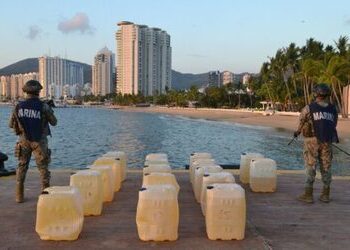
Featured image: Members of the Navy with seized fuel in Acapulco, Guerrero. Credit: Secretariat of the Navy (SEMAR).