


Paraguay’s penitentiary system remains in a state of emergency for a second year, yet without measures to tackle the root causes, the relentless grip of prison gangs, both Paraguayan and Brazilian, will likely continue.
Paraguay’s Congress first declared this state of emergency on December 22, 2023 after a riot orchestrated by the Rotela Clan, the nation’s largest criminal group. During the unrest, the gang temporarily took control of Paraguay’s largest prison, Tacumbú.
This declaration has provided the Ministry of Justice with additional funding for “infrastructure projects and the purchase of technological security equipment to meet urgent needs in the penitentiary system.” The stated objectives include building prison security, bolstering intelligence-gathering efforts, and strengthening measures to prevent prison breaks and organized crime activity behind bars.
SEE ALSO: Why Mega-Prisons Holding Tens of Thousands Won’t Make a Difference
“We know that during the penitentiary emergency important efforts have been made and more than valid achievements have been made, but there are still some shortcomings,” said Congresswoman Rocío Abed, one of the drafters of the bill, during an extraordinary session of the Chamber of Deputies called to extend the emergency measures by an additional year. “We trust this extension of the emergency will allow us to complete the processes initiated.”
The extension was later approved by the Senate and will run until at least December 2025.
Authorities have also ramped up efforts to break organized crime’s grip on the prisons. The first, Operation Veneratio, launched in December 2023, focused on isolating criminal leaders. The operation led to the transfer of Armando Javier Rotela, leader of the Rotela Clan, to a maximum-security prison where he remains under constant surveillance, along with the relocation of another 700 prisoners.
In April 2024, Operation Joapy shifted attention to international criminal networks. It resulted in the deportation of 25 inmates believed to be members of Brazilian criminal groups, including the First Capital Command (Primeiro Comando da Capital – PCC), Red Command (Comando Vermelho – CV), and Os Manos.
More recently, Operation Fine-toothed Comb, launched in December 2024, sought to prevent prison breaks. The operation aimed to counter organized crime groups repeatedly fleeing justice, likely with the help of corrupt guards. Cell raids led to the seizure of machetes, cell phones, and other contraband, highlighting the persistent circulation of illicit goods within the prison system.
InSight Crime Analysis
Paraguay’s emergency measures focus on increasing the state’s capacity to control prisons while ignoring the deeper issues of corruption and overcrowding that have pushed the system to the brink of collapse. Though the government may score short-term victories, this approach is unlikely to curtail criminal activity emanating from the prisons.
“The key is that addressing the problems, whether related to corruption, overcrowding, or other issues, must begin with solving the problems within the criminal justice system itself,” said Dante Ariel Leguizamón, a lawyer and executive secretary of the Human Rights Coordinator of Paraguay (Codehupy), in an interview with InSight Crime.
Corruption remains a persistent issue in Paraguay, infiltrating all levels of government. One stark example is the near-escape of drug lord Jarvis Jimenez Pavão from Tacumbú prison in 2016.
With the help of two guards, Pavão almost broke free during a transfer ordered by then-President Horacio Cartes. When authorities eventually relocated Pavão to a high-security facility, they discovered the extent of his influence: he had constructed a luxurious office and living quarters inside Tacumbú, enabling him to manage his international drug trafficking operations with the assistance of corrupt prison officials.
Although Pavão’s transfer and eventual extradition to Brazil severely damaged his criminal business, it failed to address the broader issues plaguing Paraguay’s prisons. His former partners, the PCC, seized the opportunity to expand throughout Paraguay. Exploiting the country’s overcrowded system, it recruited new members and solidified power, just as it had in its native Brazil. In June 2019, the PCC showcased its growing dominance by instigating a riot in San Pedro Penitentiary and executing 10 members of the Rotela Clan.
SEE ALSO: Rotela Clan
In response to the massacre, Paraguayan authorities declared a state of emergency and deployed the army, patrolling facilities like Tacumbú, San Pedro, and Pedro Juan Caballero with soldiers and tanks. But just months later, 76 PCC members escaped from Pedro Juan Caballero through a tunnel. The length of time it would have taken to dig the tunnel led the then minister of justice to conclude that guards must have been complicit, further highlighting the corruption at play.
At the same time, the Rotela Clan expanded its ranks, capitalizing on the dire conditions within overcrowded and neglected prisons to recruit and become Paraguay’s largest criminal group.
“In Paraguay, a state of emergency in the police should be declared due to the repeated abundance and seriousness of cases of police involved in different types of crimes, including drug trafficking,” Jorge Rolón Luna, a lawyer and professor at the Catholic University of Asunción, told InSight Crime. “It is useless to buy more patrol cars, buy better weapons, buy helicopters, whatever, because our police are absolutely corrupt.”
Paraguay’s failure to maintain control over its prisons partially stems from severe overcrowding. According to the latest official data, the country’s prisons house 18,524 inmates, despite being designed to accommodate 10,044 individuals. About two-thirds of those incarcerated are pretrial detainees who have yet to even be sentenced. In several facilities, this group alone exceeds the official capacity.

Overcrowding, fueled by the abuse of pretrial detention and a lethargic prison system, is a long standing problem in Paraguay. “The judicial system has collapsed,” said Rolón Luna. And the causes are manifest. He identified bureaucracy, the carelessness of judges and prosecutors, and the failure of mass incarceration to reign in crime as principal issues.
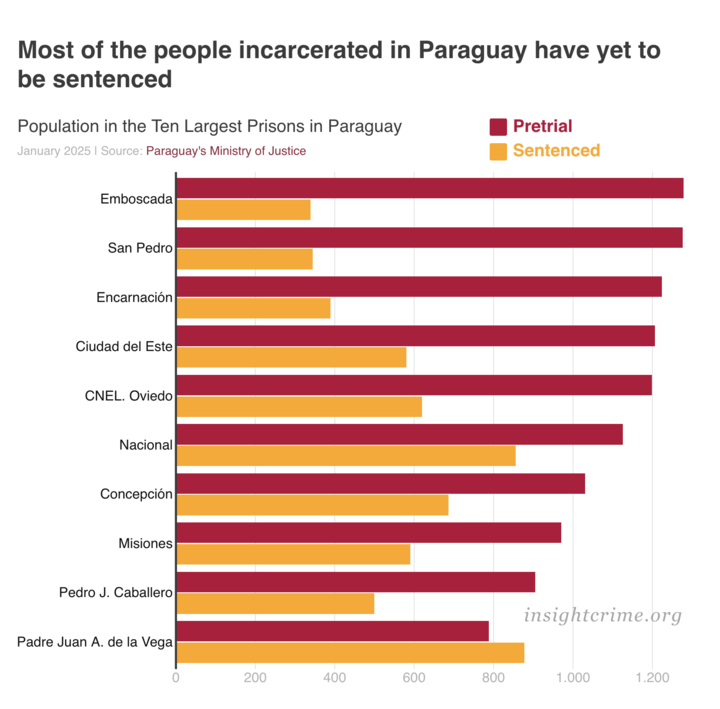
The government’s response has focused on increasing the Ministry of Justice’s capacity. But when a prison like the Emboscada Penitentiary houses 1,511 inmates despite being designed for just 408, maintaining control within its walls becomes nearly impossible. In such conditions, criminal groups thrive.
With so many prisoners awaiting trial—only 339 inmates in Emboscada have been sentenced—many find themselves trapped in an uncontrollable and indefinite limbo. According to Leguizamón, in such conditions, many seek protection from the only source they can find: the church or prison gangs.
“To ensure their security, individuals generally must get involved with a church or directly with a criminal organization,”he said. “In other words, the prison system in Paraguay is effectively outsourced, with different areas governed by actors other than the State.”
Featured Image: Soldiers enter Pedro Juan Caballero Penitentiary after riot.
Credit: Paraguay’s Ministry of Justice