


Venezuela held municipal elections on July 27 to mark the end of this election cycle, which the regime of President Nicolás Maduro used to consolidate its control over key territories where the country’s primary criminal economies are concentrated.
In a vote defined by low turnout and the absence of any meaningful opposition, Maduro’s ruling party secured control of 285 of the 335 mayoral seats up for grabs, while the opposition candidates that participated in the election won just 50, according to official election results. With this, the government won control of more municipalities than it had in 2021, when it won 212.
.button-container{margin-bottom: 10px;}.button-container button{margin-right: 8px;margin-top: 10px;padding: 8px 14px;font-size: 15px;cursor: pointer;}.map-container{width: 100%;}.map{display: none;}.map.active{display: block;}
After the controversial 2024 presidential election, the regime began planning to consolidate its power at the state and municipal levels by removing any opposition figures that could disrupt its corrupt criminal operations.
The regime took advantage of low turnout and a lack of confidence in the electoral system to move the legislative and state elections to May, although they are typically held near the end of the calendar year. The ruling party secured a majority in the National Assembly and won 23 of 24 governorships. This included Zulia, a key drug trafficking region that they had previously lost alongside four other states during the 2021 election.
At the beginning of 2025 in certain municipalities in Zulia, for example, the regime carried out a wave of arrests of both opposition and ruling party mayors, highlighting internal tensions between certain factions of the regime.
InSight Crime Analysis
Local opposition leaders long represented a key obstacle to the Maduro regime’s efforts to consolidate power, but in the absence of these structures at the state and municipal levels, the ruling party has managed to redraw the country’s political map and is now one step closer to tightening its grip on certain criminal economies.
A number of municipalities and states have become key pieces in Venezuela’s criminal landscape. Amazonas and Bolívar, in the south, are now epicenters for illegal gold and coltan mining; certain coastal cities play key roles in moving drug shipments towards Central America and the Caribbean; and states along the Colombian border like Zulia, Táchira, Apure, and Amazonas, have long facilitated contraband flows due in part to their extensive networks of “trochas,” or informal crossing paths.
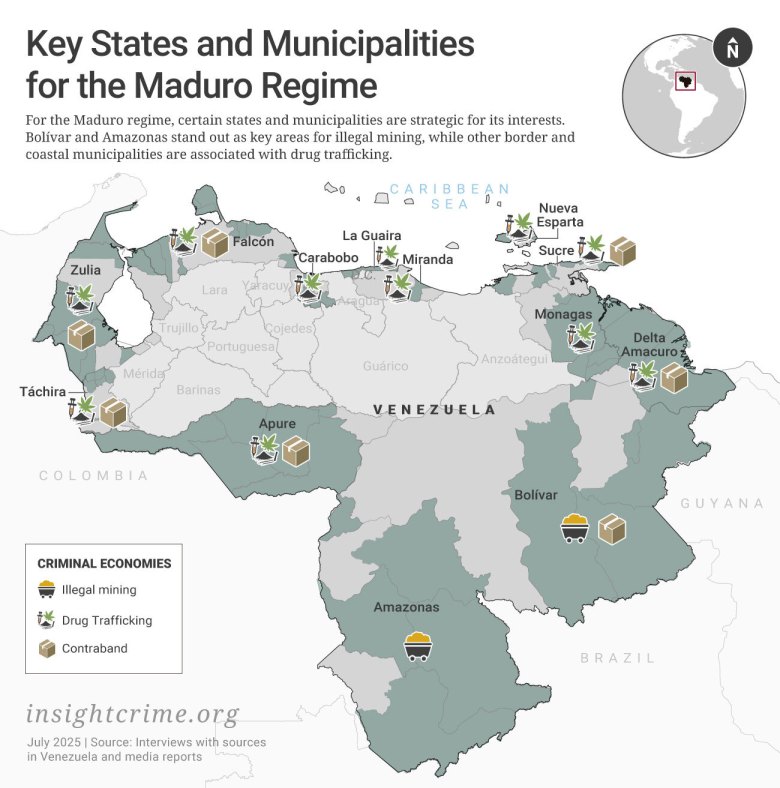
Local political power and organized crime have long co-mingled in Venezuela. In the border municipality of Jesús María Semprún, in Zulia, political authorities and international organizations consulted by InSight Crime accused the late mayor Wuyhsmans González of having ties to the National Liberation Army (Ejército de Liberación Nacional – ELN). Anti-drug officials also accused another former mayor of the same town, Keyrineth Fernández, of facilitating drug trafficking from Colombia to Venezuela.
For the regime, it is essential to control these strategic territories, according to a source who for years maintained close links to the regime and spoke to InSight Crime on the condition of anonymity for security reasons.
SEE ALSO: Maduro Inauguration to Consolidate Criminal Regime in Venezuela
The fact that the ruling party assumed power in several municipalities in these regions further paved the way for the Maduro regime to consolidate political control, as well as influence over drug trafficking flows and illegal mining, which are two essential sources of illicit funds.
In this context, the outlook looks bleak. “What comes after the elections is that there won’t be any authority, there won’t be an opposition mayor in that area where the drugs pass through in Zulia. It’s a case of ‘get out of the way so I can take over,’ a substitution of bosses,” said an official in Zulia who asked not to be identified for security reasons.
InSight Crime has received several complaints about local political candidates with alleged links to organized crime groups and other illicit activity. The dismantling of any political opposition will only deepen Maduro’s so-called “hybrid state,” in which the state operates alongside criminal networks to control illicit economies.
Featured image: Following municipal elections, the Maduro government concludes an electoral cycle aimed at consolidating its control over most of Venezuela. Credit: AP