


The recent involvement of Chile’s air force in protecting a drug shipment has sparked an unprecedented corruption scandal in the South American nation, raising questions about the institutional resilience that had until now stifled the spread of organized crime.
On July 15, a judge ordered pretrial detention for five Chilean airmen accused of transporting 4 kilograms of ketamine smuggled from the Cóndores Air Base in Iquique, the regional capital of Tarapacá in the north of Chile.
They are accused of taking advantage of their positions within the force to coordinate at least three other drug shipments in 2025, according to the regional prosecutor’s office in Tarapacá. They reportedly used official aircraft that traveled from the north of the country towards the metropolitan area around Santiago, the capital city.
Ketamine is an anesthetic drug often used in the veterinary field which criminal groups in Chile have also used to produce “tusi,” a synthetic drug also known as pink cocaine. Authorities have sounded the alarm about this substance after an uptick in seizures in the northern part of Chile and the role of transnational crime groups in its production and trafficking.
SEE ALSO: Ketamine Trafficking Rising in Chile’s Thriving Synthetic Drugs Market
In addition to the case implicating the airforce, seven non-commissioned military officers were arrested in June 2025 in Iquique. The group allegedly trafficked 161 kilograms of cocaine and 30 kilograms of cocaine base in trucks from Bolivia.
However, that was not the first drug shipment transported by members of the armed forces. The corrupt network of soldiers had operated since at least last year and moved as many as 10 shipments of drugs that had crossed Chile’s northern border, Trinidad Steinert, regional prosecutor in Tarapacá, told Radio Universo.
Beyond their involvement in drug trafficking networks, other members of the armed forces and the police have been implicated in everything from arms trafficking to extortion. In 2022, both soldiers and police were alleged to have stolen official weapons and sold them to criminal groups in northern Chile. Later, in 2024, more than a dozen police officers were accused of extorting Bolivian truck drivers as they crossed the border.
InSight Crime Analysis
While Chile has been seen as a relative success story in its fight against organized crime, its geographic proximity to Latin America’s top cocaine producing countries and the failures of militarization in the north have undermined its institutional strength.
The country’s geographic and logistical conditions are attractive for transnational criminal groups. Its borders with Peru and Bolivia – two of the world’s top cocaine producers – as well as its modern port infrastructure and access to the Pacific Ocean, make it a perfect launchpad for drug shipments sent to international markets.
Chile’s northern region also sits along a key migration route. Criminal groups like Tren de Aragua, Venezuela’s most notorious gang, have capitalized on these irregular flows in places like Tarapacá, Arica, and Antofagasta to expand their operations and exploit the vulnerabilities of those crossing the border.
SEE ALSO: Chile Militarizes Drug War, Ignoring Dangerous Regional Precedent
In response, the Chilean government has relied on a militarized strategy to try and mitigate irregular migration and the expansion of foreign criminal groups.
However, this approach has been heavily criticized for its limited effectiveness and the risks of official corruption. A number of academics and international organizations cautioned that the country’s institutions are not prepared to confront such complex dynamics like transnational organized crime. In fact, their involvement may instead exacerbate the problem, as it has in other countries around the region.
“The armed forces are trained for a war-like scenario. But in our country, organized crime doesn’t necessarily mean a war scenario,” Pablo Zeballos, a former police officer and security consultant, told InSight Crime.
As opposed to countries like Mexico, Colombia, or Brazil, which have a long history of soldiers being co-opted by criminal groups and pulled into their ranks, there is still a positive perception of security forces in Chile and they still have the ability to slow the advance of organized crime groups.
The previous investigations of corrupted security forces in Chile, according to Zeballos, had a lot to do with their in-house capacity to detect the issue. “The work of both institutions caught warning signs that were recognized and addressed,” he said.
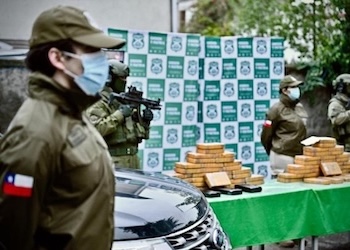
Featured image: Security forces in Chile have been implicated in a recent corruption scandal. Credit: Chilean Police