


Despite the widespread use of states of emergency, the increasingly militarized response to organized crime, and the growth of criminal economies, the murder rate in 2025 across Latin America and the Caribbean declined.
While murders in the region dropped last year as a whole, a number of countries, including Ecuador and Haiti, saw homicide rates hit new highs, spurred by criminal dynamics.
In total, at least 108,838 people were murdered in Latin America and the Caribbean during 2025, putting the median homicide rate at around 17.6 per 100,000 people, over 5% lower than in 2024.
InSight Crime analyzes the organized crime dynamics behind the violence in every country in the region. All homicide rates are victims per 100,000 people, unless otherwise stated.

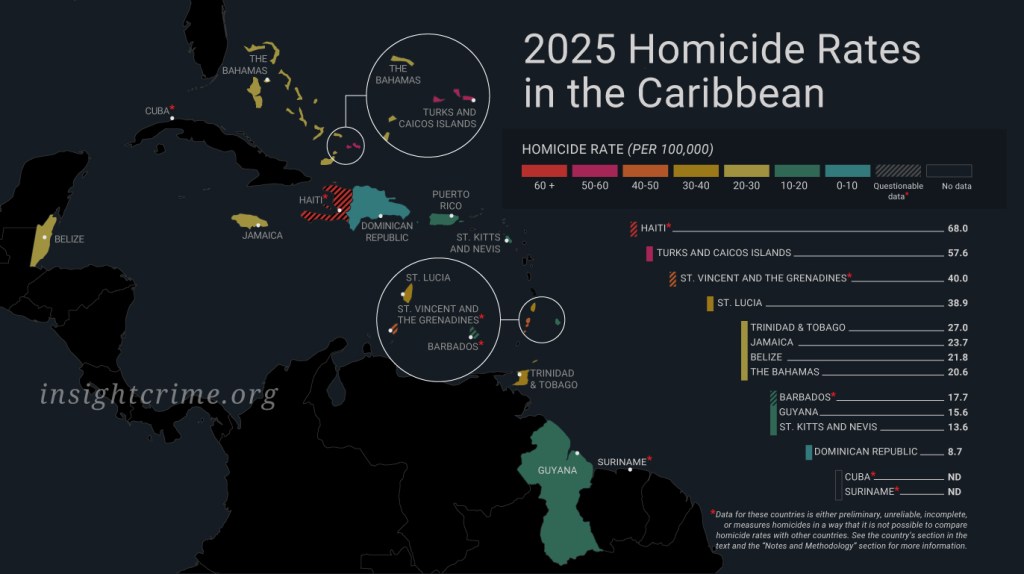
* Data for these countries is either preliminary, unreliable, incomplete, or measures homicides in a way that it is not possible to compare homicide rates with other countries. See the country’s section in the text and the “Notes and Methodology” section for more information.
Read by Country
Murder Rates on the Rise
Ecuador (+31.2%)
Ecuador’s homicide rate increased 31% from 2024 and reached a record high in 2025, growing to 50.9 per 100,000. President Daniel Noboa’s militarized offensive against organized crime has sought to dismantle criminal organizations by arresting group leaders and rounding up rank-and-file gang members. Dozens of high-profile leaders were captured in 2025, including Adolfo Macías Villamar, alias “Fito,” leader of the Choneros and one of Ecuador’s top drug trafficking groups.
But these arrests sparked a new wave of violence. In Manabí, the traditional heartland of the Choneros, their main rival, the Lobos, gained significant territory. After Fito’s capture, violent clashes between the two groups accelerated, pushing homicides there to a record high in 2025.
Prison massacres, which left 459 dead between 2021 and 2023, also factored into the record violence seen in Ecuador last year. At least 75 people were killed in four different riots behind bars.

Guyana (+10.5%)
Guyana’s homicide rate grew to 15.6 in 2025, up from 14.1 in 2024, with a total of 130 victims compared to the 117 recorded the year before. Organized crime is not to blame for most murders, according to the government, which says arguments and brawls that get out of control are the main cause. The rise of illegal mining and drug trafficking may be contributing to insecurity in strategic regions like Essequibo, where some murders have been linked to the illicit gold industry.

Haiti* (+9.7%)
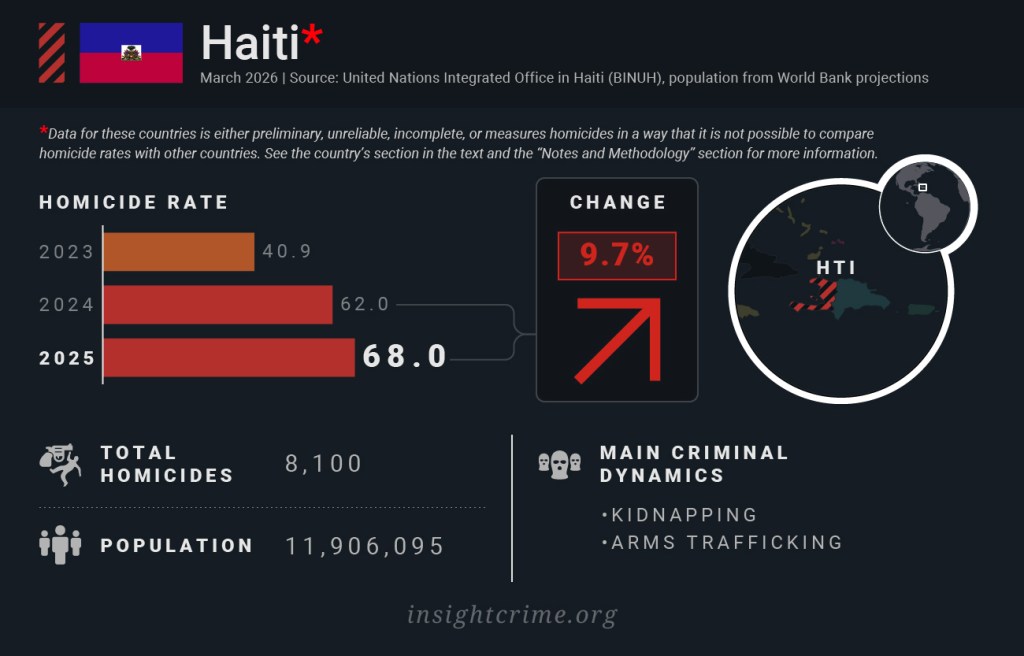
There were 8,100 killings in Haiti through November 2025, according to the United Nations Integrated Office in Haiti, making it the most violent country in the region with a homicide rate of 68. Even with a month missing, the violence broke Haiti’s previous record for homicides set in 2024. Worse still, the United Nations warned that significant gang control over parts of Haiti limited their access to certain territories, meaning other murders might have gone unreported last year.
Murders increased significantly outside the capital, particularly in the Artibonite and Centre departments, where gangs expanded their operations. The government doubled down on anti-gang efforts in 2025 as an international peace mission struggled to stabilize the country. This included drone strikes and hiring private military contractors. But Haiti’s chronic corruption remained a key factor inhibiting security and stability.
Peru (+9.0%)
Peru registered a murder rate of 6.5 in 2025, up slightly from 6.0 in 2024. One of the biggest drivers of violence is the proliferation of extortion, especially in the transport sector. An extortion network called the Northern Cone Grafts (Los Injertos del Cono Norte), for example, caused several driver strikes in Lima between 2024 and 2025. The group has also been linked to cases of kidnappings and contract killings.
Cases of other types of extortion, such as gota-a-gota (“drop-by-drop”) loansharking, have also been on the rise and are major drivers of insecurity. Recently, criminal groups have also started to extort sex workers.
Environmental crime has also increasingly been behind violence in the past five years, with gang killings of environmental defenders, Indigenous leaders, and mine workers.

Guatemala (+8.0%)
Guatemala’s homicide rate rose to 17.4 in 2025 from 16.1 in 2024. The increase is likely linked to a resurgence in gang violence due to rivalries between the Mara Salvatrucha (MS13) gang and local criminal actors. The MS13 extorts bus routes and transportation networks, maintaining a significant presence in Guatemala.

Steady Murder Rates
Colombia (+1.9%)
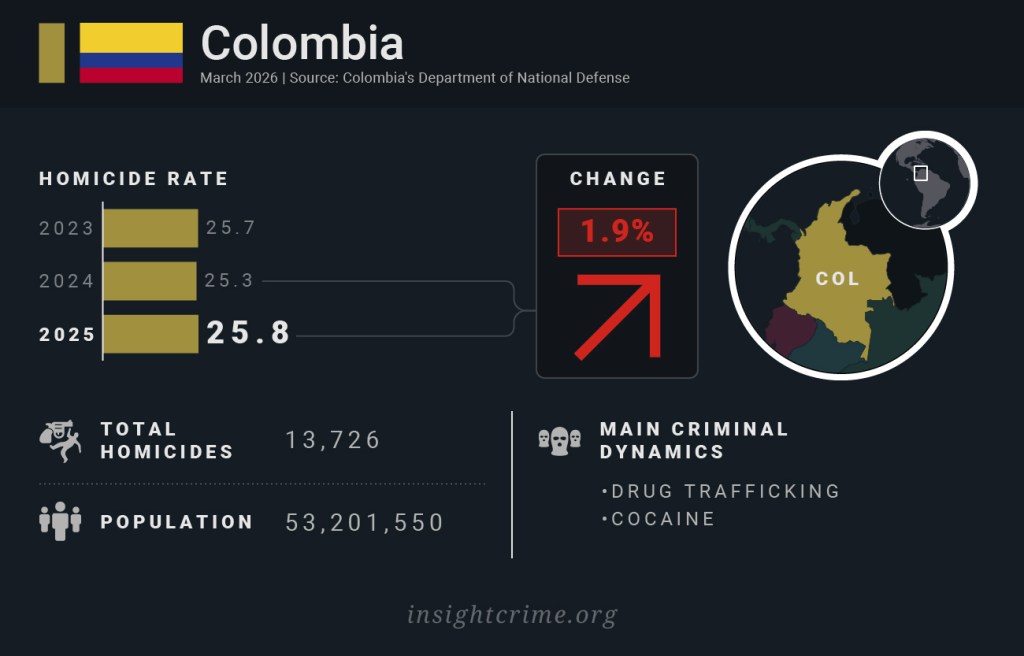
Colombia’s homicide rate increased marginally from 25.3 in 2024 to 25.8 in 2025 – a difference of 385 homicides. But although levels of murder remained relatively stable in the country, armed confrontations between criminal groups rose. In at least half of Colombia’s departments, there was an increase in clashes between these groups in 2025, compared to the previous year, according to data from the United Nations Office for the Coordination of Humanitarian Affairs (OCHA).
One of the year’s major criminal conflicts came following the breakdown of a non-aggression pact between the National Liberation Army (Ejército de Liberación Nacional – ELN) and the 33rd Front of the General Staff of Blocks and Front (Estado Mayor de Bloques y Frente – EMBF) in Norte de Santander. At least 117 people were killed between January and April 2025, in addition to more than 64,700 people who were displaced and over 12,900 who were forcibly confined.
The departments of Chocó, Nariño, Cauca, Valle del Cauca, Antioquia, Arauca, Meta, Putumayo, and Guaviare also saw territorial clashes last year, particularly in strategic corridors essential to criminal economies, including drug trafficking and illegal mining.
Panama (+0.0%)
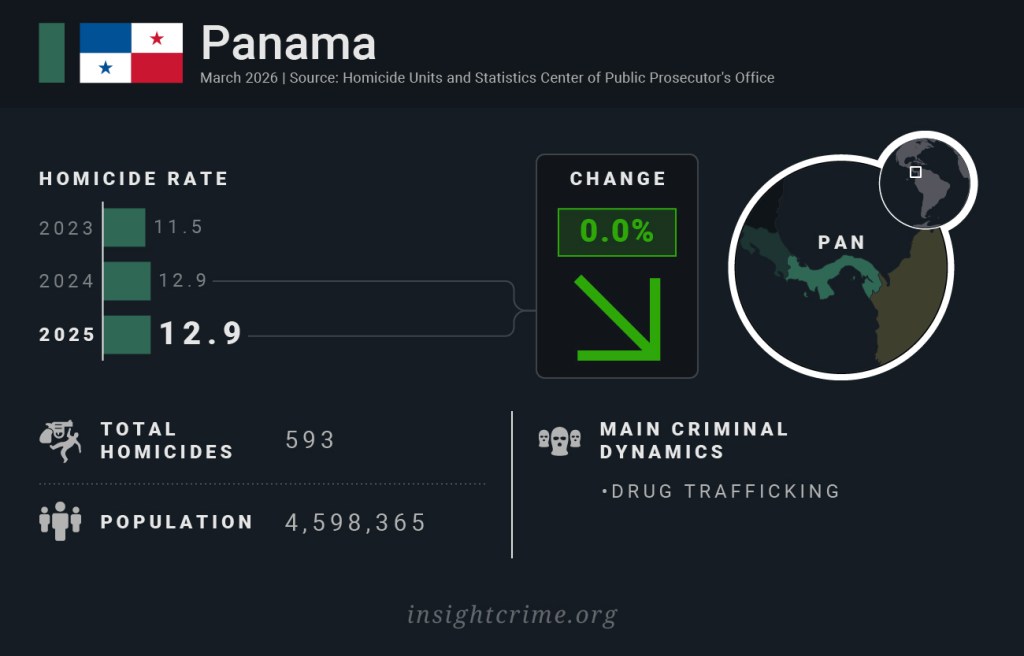
Murders in Panama rose slightly to 593 in 2025, but the increase was not enough to affect its homicide rate, which remained at 12.9. Over 40% of the cases were registered in the province of Panamá and 20% in Colón, one of the main trade hubs in Latin America and a key entry point for cocaine that gangs fight over for control.
Barbados* (-0.1%)
The murder rate in Barbados stayed static at 17.7 last year, with 50 murders reported. However, this figure was more than 2.5 times higher than the 2023 rate of 6.7. Researchers raised concerns about the persistently high levels of major crimes that continued to plague the country throughout the year. Cheryl Willoughby, the director of the Criminal Justice Research and Planning Unit (CJRPU), warned that urgent intervention is needed to bring homicides back down to previous levels.

Costa Rica (-1.3%)
Costa Rica’s homicide rate remained roughly consistent in 2025 at 16.8 compared to last year’s 17. That said, it has turned into a logistical hub for the cocaine trade in recent years, which has coincided with a surge in killings around key trafficking zones. Authorities dismantled what they believe to be Costa Rica’s first homegrown transnational criminal group, the South Caribbean Cartel, last year.In response to gang operations, the country’s recently elected president, Laura Fernández, promised a hard-line approach towards public security and organized crime, even when evidence from elsewhere in the region suggests the impacts of such approaches are very limited.

Belize (-2.7%)
Belize had one less killing in 2025 compared to 2024, putting its homicide rate at 21.8. The small Central American nation has recorded substantial decreases in homicides over the last decade. That said, it continues to suffer from spates of gang violence. In May 2025, regions including Belize City, the Belize District, and parts of the Cayo District went through a month-long state of emergency due to spikes in gang violence.

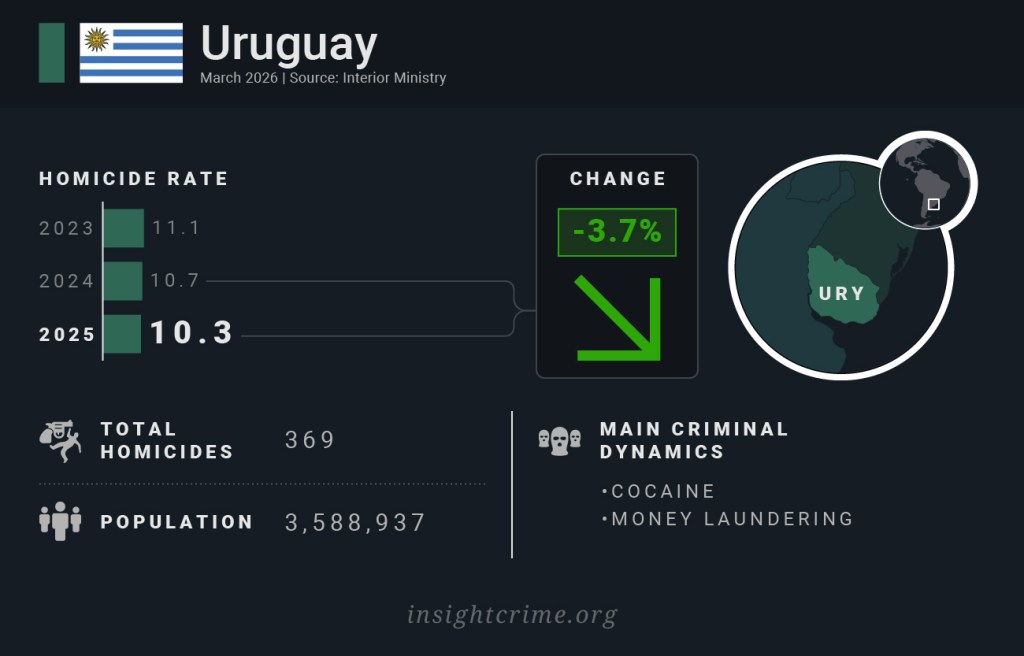
Uruguay (-3.9%)
Puerto Rico (-4.8%)
Puerto Rico registered 463 murder victims and a homicide rate of 14.5 in 2025, down from 15.3 in 2024. Gang violence, disputes between criminal groups, and the use of firearms remain common dynamics behind murders there.

Murder Rates Trending Down
Saint Kitts and Nevis (-77.1%)
Saint Kitts and Nevis recorded its lowest homicide count in 23 years, with only seven victims in 2025, putting its homicide rate at 13.6. Its murder rate is inherently volatile due to its small population of only about 50,000 people.
The government has responded to violence with a public health approach to crime, prioritizing social determinants like poverty, unemployment, mental health, and education, which the government has credited with reducing homicides in the nation. This model is also thought to be effective in reducing violence in other Caribbean countries, such as Trinidad and Tobago.

Turks and Caicos (-44.1%)
Turks and Caicos registered a homicide rate of 57.6 in 2025. Though a massive decrease from 2024’s rate of 103.1, Turks and Caicos’ homicide rate is the second highest in the region, behind only Haiti. This is in part due to the country’s population of under 50,000 inhabitants, which explains large fluctuations in rates even with relatively small changes in the number of victims. There were 27 murders in 2025, down from 48 in 2024.
Police Commissioner Fitz Bailey credited the 2025 decrease to sustained operations against gangs and illegal guns. In September 2025, Turks and Caicos formed a partnership with the Bahamas to enhance collaboration and build capacity to face increasing crime threats.

Trinidad and Tobago (-40.9%)
After seeing record murders in 2024, Trinidad and Tobago saw its murder rate drop to 27 in 2025 compared to 45.7 the year before.
The historic reduction is widely attributed to the states of emergency that were in place last year, academic Randy Seepersad told InSight Crime. However, the sustainability and effectiveness of this measure in the long term remain to be seen. Organized crime is the main driver of homicides in Trinidad and Tobago, although the influence of crime groups does appear to be decreasing. Gang-related homicides, for example, dropped from 43.7% in 2024 to 33.1% in 2025, according to official data disaggregated by motive.

Jamaica (-40.8%)
Jamaica closed 2025 with a homicide rate of 23.7, nearly half of 2024’s 40.1. With 673 victims, the total was below 700 for the first time in 31 years. The government has combined states of emergency with other security measures like Zones of Special Operations (ZOSOs), which place a sustained militarized presence in specific communities alongside social intervention programs. Norwood, once one of Jamaica’s gang hotspots in northwestern Jamaica, did not record a single murder in 2024 or 2025 after implementing a ZOSO in the area.
The police have also undergone intensive human rights training to reduce police shootings, which decreased 30% in 2025. However, the country still faces major challenges, including the presence of at least 100 gangs and arms trafficking. In late May 2025, authorities seized 233 firearms and 40,000 rounds of ammunition, one of the largest seizures in the country’s history.

El Salvador* (-32.2%)
With only 82 murders registered in 2025, El Salvador broke its record for the lowest homicide rate ever recorded in the country, reaching 1.3. That said, the government uses a much narrower definition for homicides than other countries. Bodies found in unmarked graves – a method gangs in the country regularly use to hide victims – killings by police, and murders in prisons are excluded from official data. As the government of President Nayib Bukele has cracked down on NGOs, independent media, and political opponents, a lack of transparency has made it extremely difficult to verify official data. Still, the extreme crackdown has been effective in dismantling the country’s two main gangs, the MS13 and Barrio 18, which have thus far shown no signs of making a comeback.

Bahamas (-30.5%)
The homicide rate in the Bahamas fell to 20.6 in 2025 from 29.7 in 2024 as the country’s police ramped up efforts against gang violence.
Authorities believe the vast majority of murders are gang-related, and in January 2024, Prime Minister Philip Davis introduced new anti-crime laws and a five-pillar crime-fighting plan. His government has also created laws focused on preventing youth recruitment and stopping the flow of illegal firearms coming into the country. In September 2025, authorities also forged an alliance with Turks and Caicos to enhance collaboration and build capacity to face increasing crime threats.

Saint Vincent and the Grenadines* (-25.5%)
Saint Vincent and the Grenadines’ homicide rate remained near the top in the region at 40, even though it registered a large drop from 2024’s rate of 54. The country saw 14 fewer murders compared to 2024, but its population of only around 100,000 inhabitants makes its homicide rate highly volatile.
Killings remain linked to gangs and gun violence, with five or six criminal groups battling against each other. The islands are also a transit hub for cocaine trafficked to Europe and the United States, with local gangs violently competing to control the local drug market.

Mexico* (-19.8%)
Mexico saw 20,677 murder victims in 2025, representing a 19.8% decrease in killings and a homicide rate of 15.4. But fights over drug markets, especially methamphetamine, caused violence to spike in some of the most important criminal corridors, such as Ciudad Juárez in the state of Chihuahua. A wave of murders there in July left 22 dead in two days.
Fuel theft was another driver of homicides. The oil-rich state of Tabasco faced a growing security crisis due to local conflicts driven in part by the expansion of the Jalisco Cartel New Generation (Cartel Jalisco Nueva Generación – CJNG) in the region. Although the drop marks seven years of decreasing homicide rates, Mexico’s statistics lack consistency due to methodological limitations and a lack of oversight in the data collection process. Independent organizations, for example, have reported data manipulation by authorities to mask homicides as disappearances or accidental deaths. And while homicides drop, authorities have reported an increase in forced disappearances in states like Sinaloa.

Paraguay (-18.6%)

Chile (-10.4%)
Murders in Chile fell from 1,209 in 2024 to 1,091 in 2025, bringing down the homicide rate from 6.1 to 5.4. Insecurity has become a major political issue following several years of rising crime. Brazen violence linked to Venezuela’s Tren de Aragua has stoked fears of international criminal organizations migrating there and the possible infiltration of security forces. However, Chile remains one of the safest countries in the region in terms of killings, suggesting authorities have managed to keep a lid on organized crime – at least for the time being.

Saint Lucia (-9.2%)
While Saint Lucia’s homicide rate of 38.9 puts it among the most violent nations in the region, murders are trending downward, with 70 victims in 2025 compared to 77 in 2024. Despite the decrease, gang violence persists. Law enforcement officials said that most of the homicide victims were known by the police for their involvement in criminal activity.

Dominican Republic (-8.9%)
The Dominican Republic’s homicide rate of 8.7 in 2025 marked the fourth consecutive year of decline. Disputes among local gangs over territorial control and retail drug dealing are one of the main drivers of violence in the country. About half of these cases are registered as social conflict, which includes personal disputes and domestic violence, while 29.2% were related to crime.

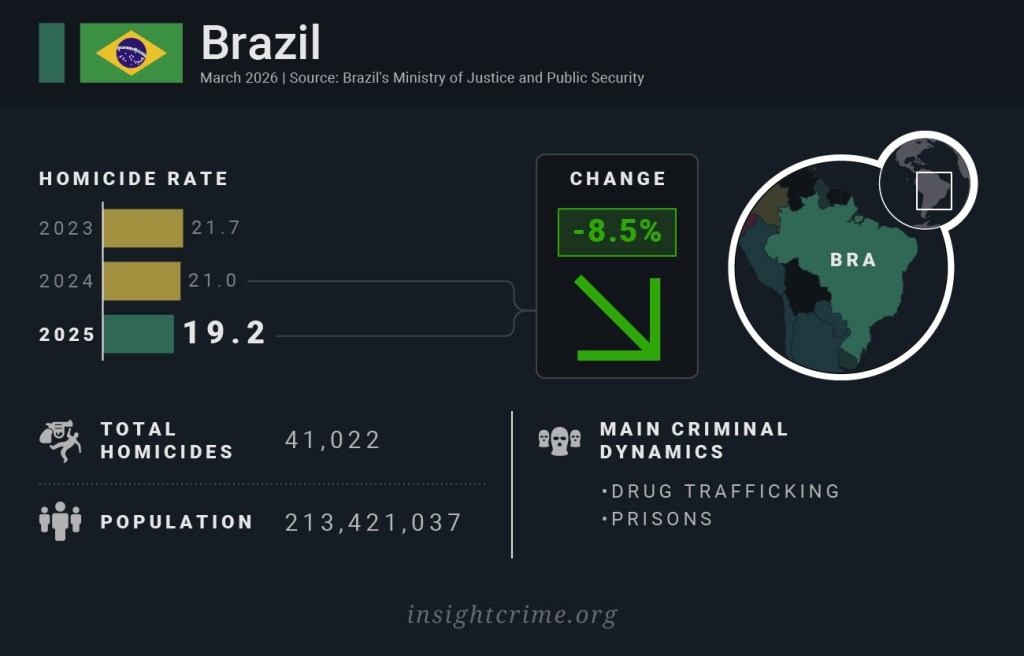
Brazil (-8.5%)
Brazil’s homicide rate dropped from 21 per 100,000 in 2024 to 19.2 in 2025, continuing a downward trend that started in 2019. The decrease means 3,615 fewer people were murdered in Brazil last year compared to 2024, and the data includes homicides, femicides, police killings, robbery followed by murder, and manslaughter.
Despite the high levels of crime, the drop can be partially explained by the consistent movement of criminality towards technology and cybercrime, which involves less physical violence while still causing significant harm to its victims.
Some states did see increases in violence: Acre, Rondônia, Roraima, and Rio Grande do Norte in the north of Brazil; Rio de Janeiro in the southeast; and the Federal District in the center-west. Northern states reported high levels of violence due to fighting between Brazil’s two biggest gangs, the First Capital Command (Primeiro Comando da Capital – PCC) and the Red Command (Comando Vermelho – CV), and local gangs. Meanwhile, the Red Command frequently engaged in shootouts with other gangs and the police in its home base state, Rio de Janeiro.
Police killings increased by 4.5% in Brazil in 2025. In October, police killed over 100 people in Brazil’s most lethal operation to date in Rio de Janeiro. The country is known for having one of the most violent police forces in the region, with only 17% of residents in Rio’s favelas saying they trusted the military police, according to the latest survey by Brazilian research institute Data Favela, which specializes in collecting data on Brazil’s most vulnerable neighborhoods.
Brazil has also registered a record number of disappearances since 2015, suggesting the drop in its homicide rate may be due at least in part to undetected murders.
Honduras (-8.2%)
Ending the year with 2,332 murders, Honduras’ 2025 homicide rate of 23.2 marked a decline from 2024’s 25.3. It has long been plagued by high levels of gang violence, exacerbated by corruption at the highest levels.
The government has tried to corral gangs through a hard-line approach featuring an expanded state of emergency. But while the homicide rate did decrease in 2025, Honduras was still among the most violent countries in the region.

Argentina (-5.3%)

Bolivia*
Bolivia did not respond to InSight Crime’s request for official data as of the time of publication. One government report recorded 774 reports of “crimes against life” as of September – a stark increase from the 453 logged in all of 2024. This is a broad category that includes homicides and other violent crimes. That largest increase was in the department of Santa Cruz, where international cocaine trafficking organizations like the PCC have fought to carve out territory. But as these data represent just reported cases, not confirmed victims, and only cover part of the year, they cannot be compared to the homicide rates of other countries or previous rates for Bolivia.
Nicaragua*
Nicaragua did not respond to InSight Crime’s request for official data as of the time of publication. The authoritarian takeover of Nicaragua hollowed out civil society and eliminated transparency in the government. There were no available, reliable data on homicides in the country for 2025.
Suriname*
Homicide data was only available through November 2025 at the time of publication. According to these figures, homicides decreased from 27 victims to 20 during this same period the year before.
Venezuela*
Venezuela has no official data available and did not respond to InSight Crime’s request for homicide statistics. Our investigators previously relied on information from reliable non-governmental sources, such as the Venezuela Violence Observatory (Observatorio Venezolano de Violencia – OVV), but with NGOs shutting down throughout the country, we found no reliable data for 2025.
Some of the main drivers of violence in the country include extortion, kidnappings, illegal mining, and drug trafficking.
Notes and Methodology
Sources
InSight Crime attempts to get the most rigorous data possible for its annual homicide round-up. That means prioritizing official data through freedom of information requests and official datasets. For countries that ignore or deny these requests and do not have updated data, we look for secondary sources as part of our systematic daily monitoring. Besides that, we try to find reliable data from intergovernmental organizations (IGOs), such as the United Nations, or non-governmental organizations (NGOs) with unofficial data, for countries where official sources are unreliable.
Countries update their data as cases are resolved, so even though all data is accurate at the time of publication, official counts may change over time.
Calculating Homicide Rates
To report homicide rates, we consider the measure of , as it is the most recognized and accepted, to standardize the comparison across countries and time. This method means that in countries with very small populations, slight changes in homicides result in large variations in the local homicide rate.
For population values, we also prioritize official data, asking for demographic information in our freedom of information requests. If authorities don’t provide it, we look for updated official censuses. However, population is very difficult to measure and is often estimated, which can lead to variations in homicide rates.
If no reliable official data exists, we next look for information from the World Bank, United Nations, or other accepted estimates and projections, comparing them to previous years to find the most accurate one. Barring this, we do our own estimations or calculations based on partial data that we have, such as the population of previous years.
Country*
Different countries have different legal definitions of what is considered a homicide, and what is included in a count of all homicides. To make the data as standardized as possible, we follow the definition laid out in the Bogotá Protocol, which defines homicide as “the death of a person caused by an intentional assault by another person or persons.” The definition excludes unintentional, accidental, and attempted homicides; and includes deaths from war, civil disturbances, prisons, and at the hands of authorities. It is standard for many countries and, for others, disaggregated data can be used to calculate homicides fitting this definition.
If the data do not conform to the Bogotá Protocol, are incomplete, preliminary, or show obvious signs of manipulation, we include an asterisk by the country’s name and provide further information. Below, we add more details about why each country is marked with an asterisk in the text.
Haiti
InSight Crime did not receive an official response to the freedom of information request sent to Haiti, and the available data we had only goes up to November. InSight Crime relies on data from the United Nations Integrated Office in Haiti, which clarified that its count of homicides up to November 2025 is likely an undercount as gang control of parts of the country barred the UN from being able to register homicides that may have occurred in those areas.
Barbados
Barbados did not respond to InSight Crime’s freedom of information request. We instead relied on the Barbados Homicide Database, which makes clear that “while based on publicly available data, it does not reflect official figures or classifications.”
El Salvador
Since 2019, the country’s methodology for collecting homicide data has diverged from the Bogotá Protocol by omitting killings by police of alleged gang members, killings in prisons, and bodies found in unmarked graves. A lack of transparency has also made it difficult to verify official figures or obtain unofficial data.
St. Vincent and the Grenadines
For St. Vincent and the Grenadines, InSight Crime used data from unofficial sources, with no official confirmation. Bogotá Protocol adherence unclear.
Mexico
Mexico’s methodology for collecting homicide data has been debated for several years. Collecting homicide data falls to local Attorney General’s Offices, whose methodologies are inconsistent and may lack transparency. For example, data often does not include bodies found in mass graves, deaths in confrontations, or collateral victims as homicides, according to local media. At the national level, Mexico’s methodology has changed several times over the past years, making year-on-year comparison difficult. In addition, several outlets have covered the rise in disappearances as homicides have fallen, which are not included in official homicide data.
Nicaragua
Nicaragua has no transparent homicide dataset. The country offers no disaggregated counts, no methodological detail, and did not respond to data requests. Besides that, InSight Crime could not verify its population coverage and adherence to the Bogotá Protocol.
Bolivia
InSight Crime did not receive an official response to the information request sent to Bolivia, and the available data we had in cases, not victims, was only updated through September. The use of “crimes against life” (delitos contra la vida) which includes homicides, femicides, infanticides (killing of one’s children), patricides (killing of ones parents), and assassinations.
Suriname
InSight Crime did not receive an official response to the freedom of information request sent to Suriname. While open data is available, it is only updated through November 25.
Venezuela
Venezuela did not reply to a freedom of information request and has no open data available as of the time of publication. Official statements on homicides in the country could not be confirmed. In past years, InSight Crime has used unofficial data from the Venezuelan Violence Observatory (Observatorio Venezolano de Violencia) but as they are no longer publishing their annual reports, we had no reliable data for this year’s Round-Up.
*Amanda Rocha contributed to the research for this Homicide Round-Up