


By Michael O’Neill
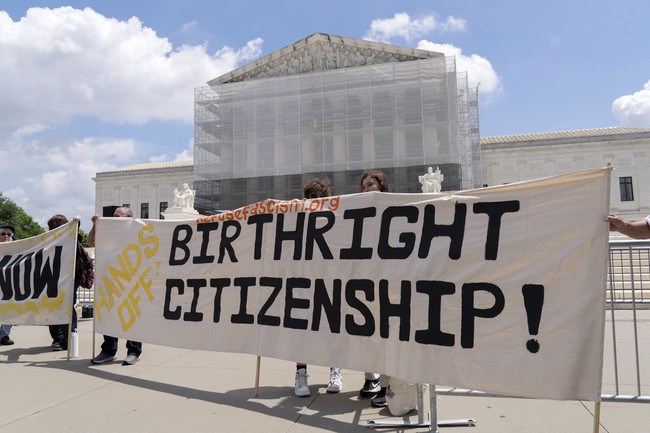
Solicitor General John Sauer presented a strong case in defending President Trump’s executive order on birthright citizenship before the U.S. Supreme Court in early April. Arguments on both sides primarily focused on what the litigants believed was the “correct” interpretation of the Fourteenth Amendment’s citizenship clause — specifically, whether children born to illegal immigrants are “subject to the jurisdiction” of the United States and therefore citizens.
Advertisement
Sauer presented ample evidence to support the administration’s argument that the drafters and ratifiers of the Citizenship Clause never intended to apply to the children of illegal immigrants. It may not be enough, however. Several of the Justices, including Justices Amy Coney Barrett and Brett Kavanaugh, expressed skepticism about the President’s authority and signaled that they would strike down the order.
What remains to be seen, however, is not only whether the order is struck down, but how the Court rules. One path closes the door to any political solution to our birthright citizenship problem. Another path, while a loss for the Trump administration, preserves a process whereby Congress can close loopholes that our adversaries exploit (such as birth tourism) and that most Americans agree are problematic.
In the first scenario, the Court engages in an extensive constitutional analysis and concludes that the Citizenship Clause in the Fourteenth Amendment contains a right to citizenship for any individual born within the territorial confines of the United States. President Trump’s executive order is declared unconstitutional. Any attempt to limit birthright citizenship going forward via law or executive order is presumptively invalid. Thus, a law enacted by Congress limiting birth tourism, for example, would be out of bounds. The door is now open to birth tourism, chain migration, and anchor babies. It would be difficult to stop a Chinese billionaire from having dozens of surrogate children raised abroad, but maintaining American citizenship. Those children could claim citizenship via their territorial birth.
Advertisement
RELATED: Supreme Court Will Hear Arguments on Crucial Case Wednesday — and Trump Says He Will Be There
A Chinese Billionaire Has Over 100 American Citizen Children, How Is This Even Legal?
In the second scenario, a controlling plurality (most likely including Chief Justice Roberts) uses the “canon of constitutional avoidance” and declines to interpret the meaning of the Fourteenth Amendment’s Citizenship Clause. Surprisingly, the justices spent little time at oral arguments on this issue. They acknowledged that Congress passed a law in 1952 that essentially codified birth citizenship based on territorial presence, but they didn’t extensively discuss whether the order violated that law. Not spending a lot of time at oral arguments, however, does not mean that this scenario is less likely to occur.
Some would invariably consider the second scenario emblematic of the recent Supreme Court decisions to punt on making tough decisions. Not so fast. Employing constitutional avoidance has its merits. Namely, it preserves the ability of the politically accountable branches, specifically Congress, to address issues and doesn’t foreclose legal remedies for solving problems with birthright citizenship.
Simply concluding that President Trump’s executive order is illegal (not unconstitutional) preserves congressional authority to regulate birth citizenship. It means that Congress can pass a law requiring an individual to maintain a domicile in the United States before their American-born children can be citizens. It means that Congress can recognize the obvious national security interests at stake and outlaw birth tourism. A decision from the Supreme Court declining to rule on the constitutionality of the Order but concluding that it is illegal will be a loss for the President (and the American people), but the damage will be limited. It will be incumbent upon Congress to fix the issue.
Advertisement
Michael O’Neill is Vice President of Legal Affairs at Landmark Legal Foundation, a public interest law firm in Leesburg, VA, and Kansas City, MO.
Editor’s Note: Do you enjoy RedState’s conservative reporting that takes on the radical left and woke media? Support our work so that we can continue to bring you the truth.
Join RedState VIP and use the promo code FIGHT to get 60% off your VIP membership!