





Amid record production levels, the cocaine business is entering a new age, driven by diversifying markets, global networks, and new technology.
Every year, InSight Crime gathers as much data as it can about cocaine seizures and maps them across the globe, looking to determine what patterns they reveal and what, compared with other sources, they can tell us about the global cocaine industry. Coca cultivation and cocaine production continue to rise, led by Colombia, but prices are not falling as increased supply would suggest. The cocaine industry seems immune to normal market pressures.
Here are five of the principal takeaways from our seizure data, the full version of which will be published tomorrow:

1. Record seizures in East Asia and Oceania signal a shift in the cocaine trade
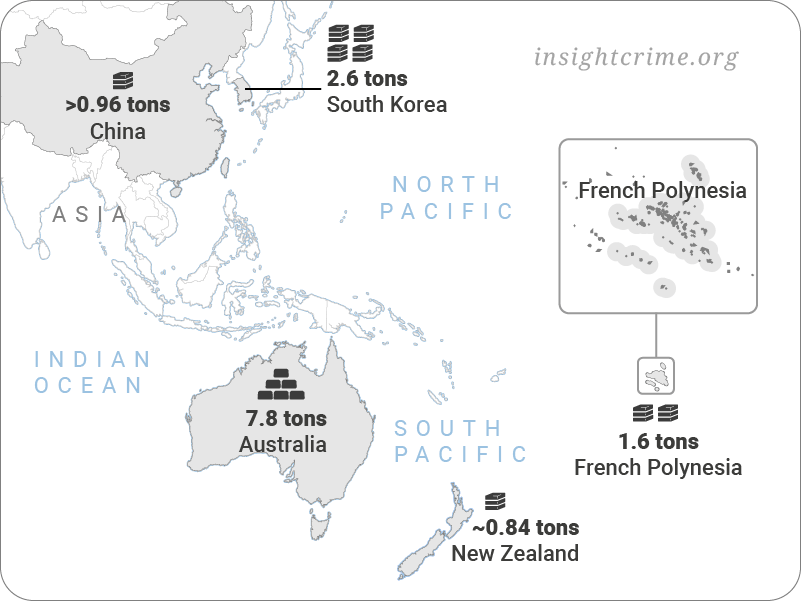
As the traditional markets of the United States and Western Europe get saturated, drug traffickers are looking to develop new markets where prices are higher and risks are lower. South Korea saw its biggest cocaine seizure ever of two tons in April 2025, with overall seizures up 300 percent on 2024. Australia registered 7.8 tons of cocaine seized in 2025, a 40 percent increase compared to 2024.
2. Traffickers are evolving their transportation methods
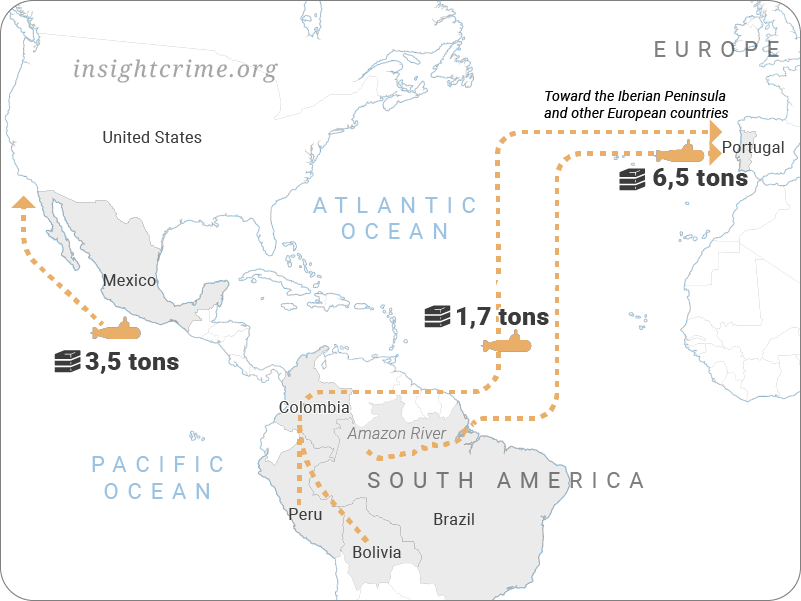
Amid improvements in port security and container scanning, traffickers appear to be switching the way they move drugs to Europe and even further afield, with growing discoveries of semi-submersible vessels, or narco-subs. The largest ever seizure from a sub was of 6.5 tons, found south of the Azores islands in April 2025 by the Portuguese navy. But the subs are not being used just for the European market. At least five narco subs were found around the Solomon Islands during 2025, showing not only the importance of the Oceania market but also that technological advances are allowing these vessels greater range.
3. Cocaine smuggling techniques are changing
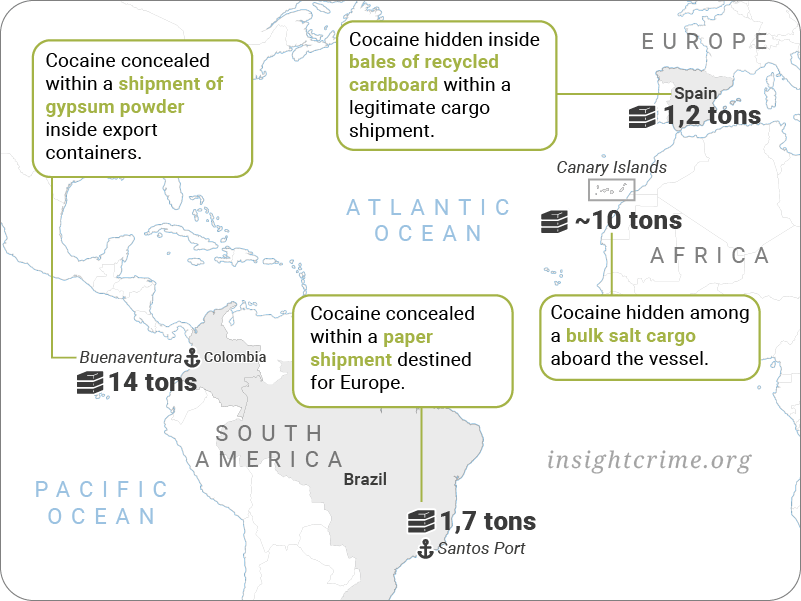
In efforts to trick the scanners looking for cocaine, traffickers are trying different ways to transform or disguise drugs. This might be mixing it with gypsum powder (sulfate mineral used in construction, agriculture, and industry), as in the case of 14 tons of cocaine found in the Colombian port of Buenaventura in November 2025.
4. Interdiction is happening closer to source
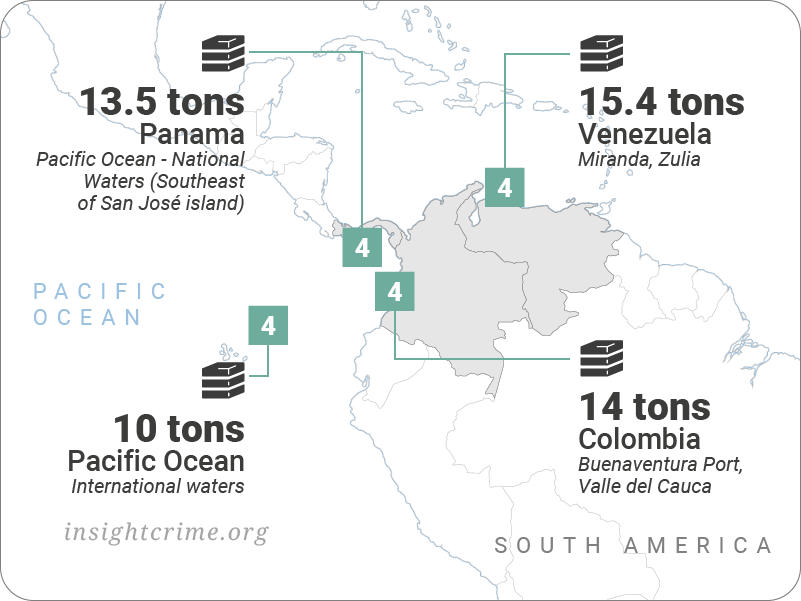
The biggest seizures tend to be close to the South American source countries, suggesting that the most successful interdiction occurs closer to home. As well as the 14 tons mentioned above, Panama seized 13.5 tons from a tugboat that had left Colombian waters.
5. Europe’s appetite for cocaine is growing

The market for cocaine in Europe is now the biggest in the world, and is still growing. While seizures in the United States grew, it was Europe that saw some of the greatest increases, with France registering a 49 percent rise, Belgium a 25 percent growth, and Portugal seeing record seizures. This reflects data from the European Union Drugs Agency showing a 22 percent increase in cocaine residue in wastewater tested across a selection of European cities. Complementary to this, we are seeing the growing involvement of European mafias in the cocaine business, not just to Europe but worldwide.
April 2026 | Source: Data compiled by InSight Crime based on official sources and local and international media
SEE ALSO: InSight Crime’s Cocaine Round-Up 2024
As we look to the future and start tracking the patterns for 2026, we expect to see more seizures appearing across Asia. A kilogram of cocaine there can be worth as much as $200,000 (average wholesale prices in the United States are around $20,000, while in Europe the average is around $30,000). We expect to see more use of semi-submersibles to all sorts of destinations, and likely some of them unmanned. Traffickers are using technology to build bigger vessels with longer range and are experimenting with subs that are remotely controlled.
Finally, we expect to see cocaine mixed with different chemicals or organic matter, or transformed into liquids or other compositions, to bypass growing scanner capacity at ports.
It remains to be seen if the continued missile strikes on go-fast boats by the United States have an impact on the way traffickers move cocaine. We are likely to see a move away from go-fast boats, which are easy to identify and track, towards fishing vessels and semi-submersibles. We do not expect to see any interruption or changes to drug production or to the flow of cocaine to destination markets.