


The Good Friday Agreement says the secretary of state must hold a border poll if it appears likely that a majority of people in Northern Ireland would vote for Irish unification – and the circumstances of when that could happen is the subject of constant debate in Northern Ireland and the Republic.
Earlier this week, Martin said there needed to be more clarity on when a border poll can be called, while Burnham ruled out calling a referendum, describing a poll as “off the table”.
Sinn Féin leader Mary Lou McDonald said she acknowledged Trumps comments on a united Ireland and said the onus is on the Taoiseach to begin planning.
Democratic Unionist Party (DUP) leader Gavin Robinson said Trump “knows better than most that elections matter”.
“Northern Ireland’s constitutional future will be decided by the people of Northern Ireland, not by commentary in London, Dublin or Washington,” he said.
Former DUP MP Ian Paisley and close friend of the Trump family said: “everyone is allowed a personal opinion even when it’s wrong”.
Welcoming his comments, the leader of the Social Democratic and Labour Party (SDLP) Claire Hanna said there was something “fairly extraordinary” about Trump standing in Dublin and talking openly about Irish unity.
“When even Donald Trump has clocked that Irish unity is no longer some distant or theoretical prospect, it tells you something about just how far this conversation has shifted.”
The Ulster Unionist Party (UUP) leader Jon Burrows said while America is an “important ally,” Northern Ireland’s future will be decided by its people”.
The Traditional Unionist Voice (TUV) leader Jim Allister said Trump “is not the first US President to meddle in the affairs which don’t concern him”.
Ireland’s Foreign Minister Helen McEntee said: “Something to this magnitude can only happen where there’s consent from the Irish people.
“It’s something that that we have to work on and we have to work towards.”
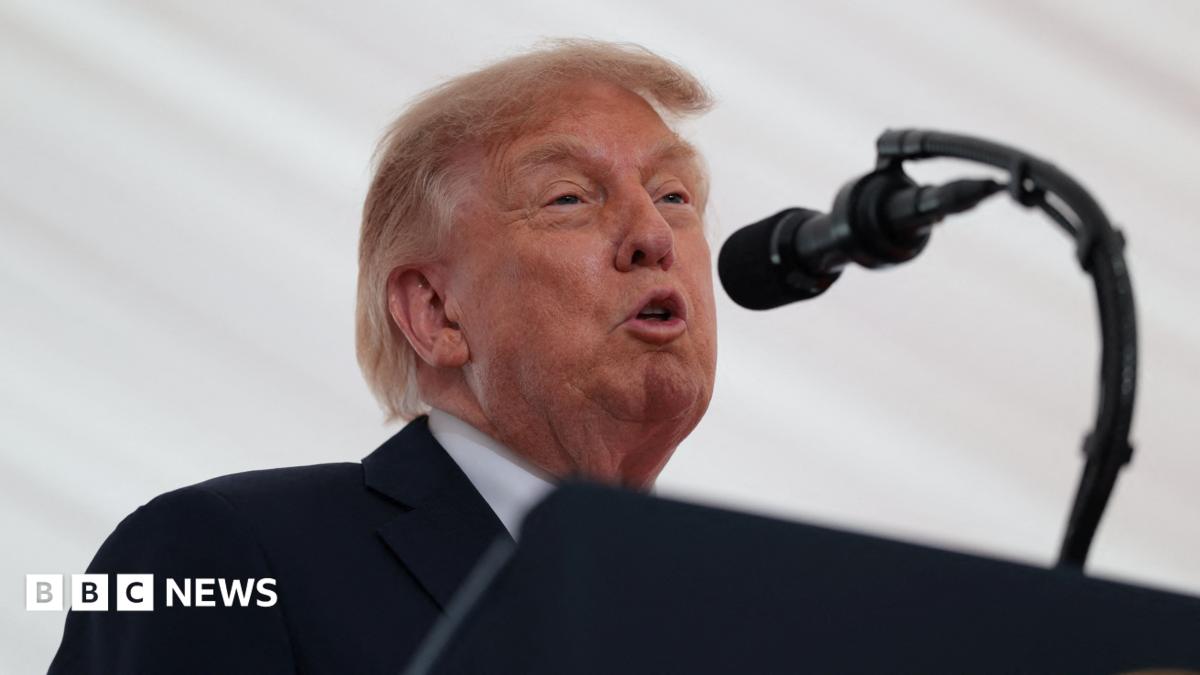
Later, while attending an event at the US Ambassador to Ireland’s residence, Trump said there is “no good answer” to a question about a united Ireland.
Recalling the moment, he said: “Oh that’s a nice question, I have a nice answer, I think, we’ll read about it tomorrow.”