


Alaska’s politics can be more than a little weird. Since the 2020 election, we’ve been saddled with ranked-choice voting (RCV), which is as knuckleheaded a way to run an election as I can think of. It’s confusing, it’s complicated, and worst of all, it eliminates partisan primaries. That’s not a good thing; each of the parties should be selecting their candidates. Republicans should choose who the Republican candidate will be, Democrats should choose who the Democratic candidate will be, and so on.
Advertisement
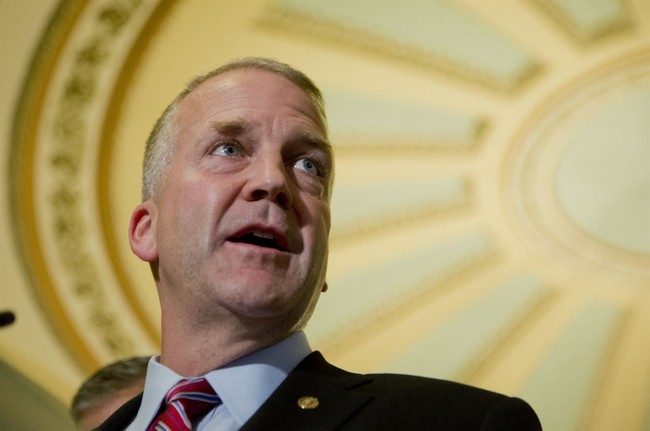
This year, Alaska’s Senator Dan Sullivan is up for re-election. Running against him on the Democratic side is former Representative Mary Peltola, who held Alaska’s at-large House seat until she was defenestrated by Republican Nick Begich III, who I will say I think is doing a bang-up job. Also on the ballot for the primary election is a guy from Petersburg, running as a Republican, named… Dan Sullivan.
Check out RedState’s previous coverage of this issue:
Read More: Alaska GOP Scores Win Against ‘Other Dan Sullivan’ Candidate
Democrats Keep Pushing to Restore Alaska’s ‘Other Dan Sullivan’ to the Ballot
RCV is making this a right old mess. All three of these people will be on the Alaska August 18th primary. The top four vote-getters in the primary, regardless of party, will advance to the general election, again under RCV. So, there may be two Republicans named Dan Sullivan on the ballot in November. How will this work? Like this:
Ranked Choice Voting allows voters to rank candidates on the ballot in order of preference: first, second, third, and fourth. If one candidate receives a majority (more than 50%) of the first-choice votes, they win! If not, the candidate with the fewest votes is eliminated and voters that ranked that candidate 1st have their vote counted for their next choice. This process continues until one candidate receives a majority of voters’ choices.
Advertisement
Yes, it’s confusing. Yes, it’s a dumb system. Another repeal measure is on the ballot for this year. Last time, the repeal failed by only a little over 700 votes, even though the repeal proponents were outspent ten to one, mostly by money from Outside. (Yes, when Alaskans use that word, it’s capitalized. Talk to an Alaskan about it, and when they say “Outside,” you can hear that capital “O” thudding into place.) That’s a discussion for another day; back to the two Dan Sullivans.
When the challenger, Dan Sullivan, filed to run, the Alaska Republican Party cried foul. The popular notion was that the challenger was a straw man, that the intent was to muddy the water, to give Mary Peltola an advantage. We can’t know that, but it doesn’t seem at all unlikely. But here’s where things took an odd turn: The Alaska Division of Elections ruled that the Petersburg Sullivan was a sham candidate and ordered his removal from the ballot. This decision was challenged, because of course it was. It went to the Alaska Supreme Court, which ruled in favor of the challenger; he stays on the ballot.
The ruling came hours after arguments Monday and just days after state court Judge Thomas Matthews found the Division of Elections had “abused its discretion” in booting the challenger Sullivan from the ballot. The state Supreme Court, in a brief ruling, affirmed Matthews’ decision but sent back to the division the issue of how the challenger should be listed on the ballot, “within the confines of existing Alaska ballot design law.”
Advertisement
So, the Division of Elections is now trying to figure out how to make it abundantly clear, on the ballot, which Dan Sullivan is which. And, if the challenger Dan Sullivan gets in that top four in the primary, Mary Peltola and whoever comes in fourth will face not one but two Dan Sullivans in the general election. Confusing? Yes. Stupid? Yes. Unnecessarily complicated and confusing? Yes. And, yes, it hands some advantage to Mary Peltola that she may not have otherwise gained, and we should bear in mind that she originally won her House seat – and in Alaska, the House of Representatives is, like the Senate, a statewide election, since we only have one – because she ran against a split Republican ticket, Nick Begich III and former Governor Sarah Palin. In 2024, with no Sarah Palin on the ticket, Republican Begich won handily. And, yes, it’s not at all unlikely that this is all deliberate.
Here’s where I take an unpopular stand, though: I think the Alaska Supreme Court is correct in its ruling. Here’s why, and I’m going to tell you.
Simply this: I don’t like the idea of the Division of Elections deciding if a candidate is sincere or not. The Petersburg Sullivan filed his candidacy according to the rules. Under the Alaska Constitution and the Constitution of the United States, he meets all the requirements. That is all that should matter. It’s not for the Division of Elections to rule on his sincerity. It’s not for the Division of Elections to rule on any candidate’s sincerity. Is he sincere? We don’t know. But now that he has filed and has met the requirements, he will be on the ballot.
Advertisement
The Division of Elections is now trying to figure out how to make it abundantly clear which Dan Sullivan is the incumbent and which is the challenger. As of this writing, it’s not clear how they are going to do that. Simply putting “Incumbent” on the ballot next to Senator Sullivan’s name may be seen as putting their thumb on the scale and will likely be challenged. I won’t guess how a challenge like that will work out.
So, what lessons should we take away from this mess? Well, RCV stinks on ice. We already knew that, and now we see another way it might be manipulated. With any luck, we’ll repeal it this fall, and Alaska Republicans will choose the Republican candidate, precluding another mess like this. But more than that, it’s not up to any state’s election authority to second-guess a candidate’s sincerity. That’s up to the voters. If a candidate follows the rules and takes all the legal steps to be on the ballot, that’s all that’s required.
How do we win this? How do we keep the incumbent Dan Sullivan in the Senate? That will all be up to turnout, and making sure that every Alaskan knows which Dan Sullivan is the sitting Senator. It won’t be easy. This has indeed muddied the waters. But that’s what we’ll have to do.
It’s about principles. Not principals.
Editor’s Note: The 2026 Midterms will determine the fate of President Trump’s America First agenda. Republicans must maintain control of both chambers of Congress.
Help RedState continue to report on the Democrats’ radicalism and inform voters as our nation faces a crossroads. Join RedState VIP and use promo code FIGHT to receive 60% off your membership.