


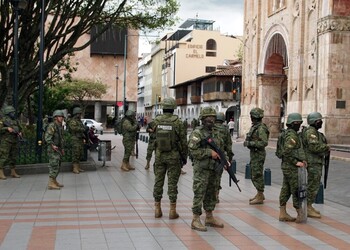
In response to a wave of violence in Ecuador, the government made an unprecedented decision last week and declared war on 22 criminal groups, which it has designated as terrorist organizations.
This decision by President Daniel Noboa intensifies the government’s militarized approach to the conflict — a strategy that has gained recently popularity among other Latin American countries after its apparent success in El Salvador.
SEE ALSO: Ecuador’s Explosive War on Gangs Lacks Exit Strategy
But the war in Ecuador will take place on two fronts. The first is between criminal groups battling for control of the criminal landscape. The second will pit the Ecuadorian government against these organizations.
On January 10, InSight Crime hosted an online conversation with Renato Rivera, coordinator of the Organized Crime Observatory of Ecuador, to discuss the recent events in Ecuador, and possibilities and pitfalls of the country’s mano dura (iron fist) approach to the fight against organized crime.
InSight Crime (IC): What is happening in Ecuador? It appears that militarization is pushing gang members to intensify violence against security forces and the civilian population.
Renato Rivera (RR): If we look not just at Ecuador, but Latin America, history has shown that militarization is a common response to security threats. Usually, when governments respond to organized crime with violence, it generates more violence.
But looking at whether this is the proper approach in the medium and long term, I would say no. First of all, organized crime has a transnational character that requires a different response, far beyond militarization. Governments should focus on fighting illicit economies, especially money laundering and drug trafficking. And the armed forces are not structured for that.
IC: Until now, the conflict had been between the gangs themselves. Are we now seeing a united front of the gangs against the government?
RR: Although it is too early to make that assertion, it appears that this is the case. Normally, in organized crime, there are two types of alliances. You have long-term alliances, which are strategic alliances with common objectives, and established traffic and routes, that benefit all participating organizations. Or you have tactical, short-term alliances for very specific objectives. I would say that the current coordination falls within the category of tactical alliances, with the common objective of demonstrating the power that these criminal organizations have, mainly to the government, but also to citizens.
IC: Cities like Loja, which are normally safe, this time have been affected by criminal groups. What do you think of that?
RR: There is a symbolic element to what organized crime is doing in Ecuador. In the last year, we have seen the Lobos increasing its power within Ecuador’s criminal ecosystem, concentrating a lot on the country’s Andean mountain region. That is where Loja is located, close to the border with Peru.
So, with this move, the Lobos are trying to send a message and demonstrate their power to the state, considering that in recent weeks the government has dealt significant blows to two of the strongest criminal organizations in the country: the Lobos and the Choneros.
Besides Loja, in cities with low crime rates like Riobamba or Ibarra, criminal groups have made announcements, like a recent statement from the Lobos on social media, saying that they were going to take actions in these cities.
IC: Noboa’s Communications Secretary, Roberto Izurieta, has interpreted the escapes of two important gang leaders, José Adolfo Macías Villamar, alias “Fito,” and Fabricio Colón Pico, alias “Capitán Pico,” as a sign that government policies are working well. He has stated that it shows that prisons are no longer refuges for gang leaders. What do you think of this analysis?
RR: This is the response I’d expect from a government representative. However, there is a second hypothesis gaining strength, and that is whether the escapes of Fito and Colón are in response to the government’s move to take control over the prisons. There is also a third — especially in the case of Fito — which proposes that the Choneros are losing power within the prisons and that their escape is an attempt at survival. The government has tried to regain control of the prisons in recent days, but it still does not control them absolutely, so the secretary’s argument does not seem to fully stand.
IC: What will be the outcome of Noboa’s declaration of a state of internal armed conflict?
RR: The decree has provoked much criticism. First of all, when a government justifies an internal armed conflict, it is important to look at the situation using the lens of international humanitarian law. There must be limitations on the methods and means of war used by government forces against their military objectives. This approach is key to protecting citizens who are not linked to organized crime and to prevent the appearance of “false positives” [civilians killed by armed forces and passed off as enemies], which happened in Colombia’s internal conflict. These are the greatest risks facing the Ecuadorian government, in addition to whether the armed forces are actually capable of urban combat and identifying the people behind these criminal organizations.
SEE ALSO: GameChangers 2023: Ecuador Loses Its Grip on Crime
Another question is whether all 22 of these organizations should be considered terrorist groups and whether they actually control territory. Because, in the last three years, seven organizations have generated the greatest territorial dispute and the greatest violence in the country. Of course, from this, we can make certain conclusions about territorial control, but we do not know if the others also have the same legitimacy and power within the Ecuadorian criminal context.
IC: Since we are talking about the repercussions at the human rights level, what do you think about the news that the president will pardon police and military personnel in the context of these operations?
RR: Although the police and the armed forces in Ecuador are very professional, no country has been exempt from the excessive use of force that often occurs in a situation like the one in Ecuador. Right now, I would not say that the police and armed forces are going to systematically abuse human rights, but the pardons will definitely attract a lot of attention. It is important to clarify that just because Ecuador has declared an internal conflict does not make it exempt from following the rules of international law. There are certain basic rules that institutions must comply with. The police and the military may be very well-trained, but that does not mean that these abuses do not take place, and it is essential that the judicial process is transparent.
IC: I would like to put another idea on the table, and that is, how do you deal with a 22-headed beast? I ask because in places like Colombia and Ecuador, these groups are not monolithic, they are all different.
RR: Right now, the government is just trying to contain the threat. But this is a short-term measure, and we have to think about what to do in the medium and long term. A justice system that depends heavily on in flagrante delicto [being caught in the act] in contexts of organized crime will not be very successful. It is more effective to create structured investigations that build on similar past investigations and impact financing.
One example is the need to strengthen policies against money laundering in Ecuador. The lack of prosecution of illicit economies is also a result of the fact that the justice system does not focus on confiscating assets that drive organized crime profits.
IC: After this declaration of war by the Ecuadorian government, everyone wants to know, what comes next?
RR: In the short term, it will be important to restore Ecuadorians’ sense of peace, as well as economic activity. Many Ecuadorians would say that this was like returning to the first weeks of the pandemic, where there was very little movement on the streets, which had a significant economic impact. So, we have to restore that trust, so that people can take to the streets again.
As much as possible, we must identify the people who are carrying out these acts of terrorism. And we must not forget that part of this problem comes from the use of firearms. Nine out of ten homicides currently committed in the country are caused by firearms. Arms trafficking and the availability of illegal weapons will not be completely eliminated. That is impossible to achieve. However, the availability of weapons on the market must be reduced.
*This interview has been edited for length and clarity.