


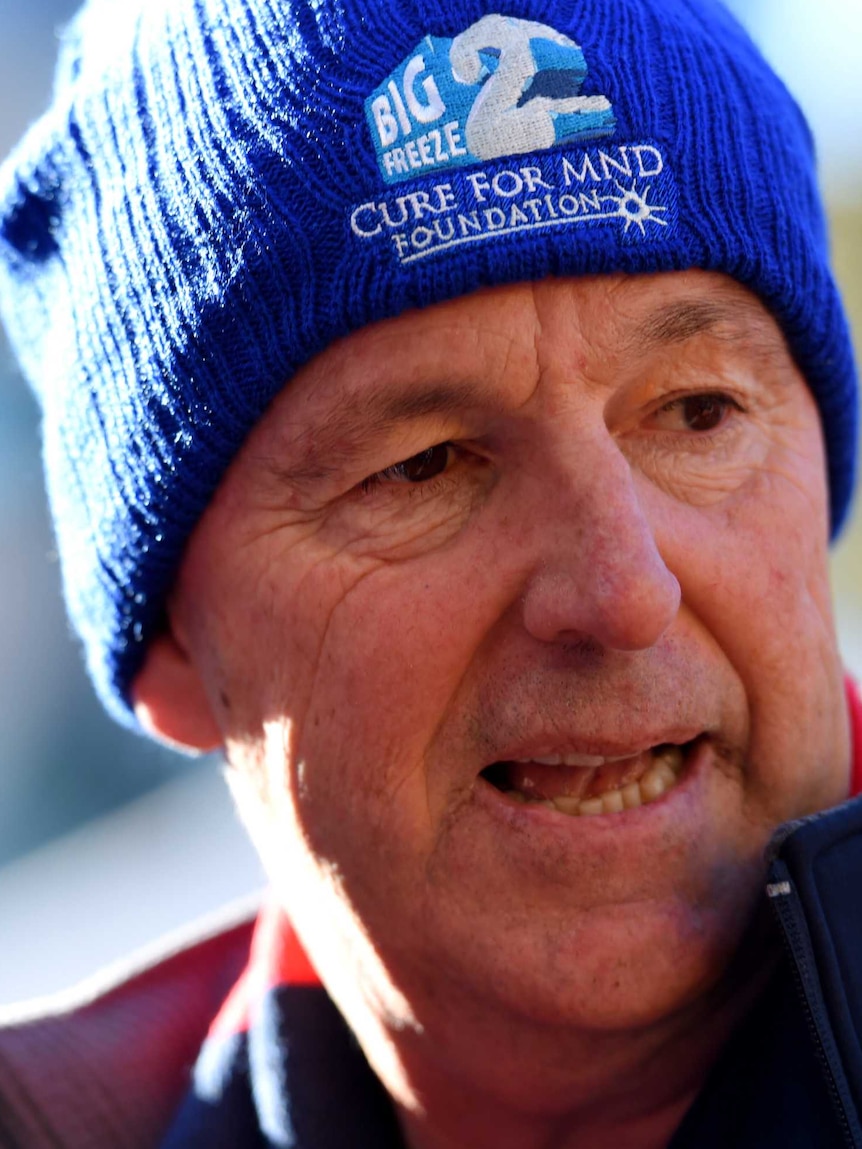
Former AFL footballer, Australian of the Year and motor neurone disease campaigner Neale Daniher has died at the age of 65.
His family confirmed his death today.
“We’re heartbroken to share that our much-loved husband, Dad and Poppy, Neale Daniher, passed away at home, surrounded by his family,” the family said in a statement.
“We will forever remember him for the lasting impact that he has made on us all. He has inspired, he has loved, he has lived, and it would only be fitting to finish with his words — Play On.”
Daniher played 82 games for Essendon over 11 years of an injury-plagued AFL/VFL career from 1979 to 1990.
He also coached Melbourne Football Club for more than 220 games from 1998 to 2007.
He was diagnosed with motor neurone disease (MND) in 2013 and dedicated his later years to raising awareness of the disease and fundraising for research.
Daniher was named Victorian of the Year in 2019 and Australian of the Year in 2025.
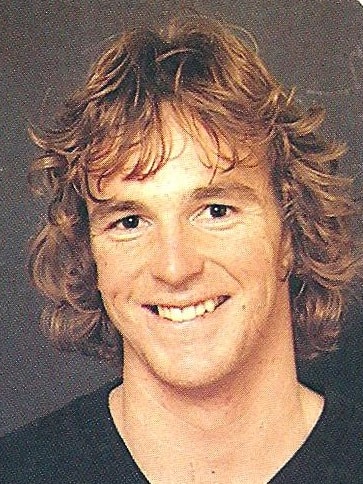
Neale Daniher during his Essendon years. (Supplied)
A family of footy players
Daniher was born in West Wyalong, in New South Wales, in 1961 and played Australian rules football, rugby union and rugby league as a schoolboy.
His older brother, Terry Daniher, one of four Daniher brothers who would play in the AFL or VFL, was already contracted to Essendon when Neale joined the club in 1979.
Daniher showed signs of being a star in the making, playing 23 games as a halfback flanker and kicking nine goals in his first season with the Bombers.
He was named the league’s Recruit of the Year and appeared destined for stardom in the game.
He was again a fixture in the side in the 1980 and 1981 seasons, earning a place in the New South Wales representative side and winning Essendon’s Best and Fairest in 1981.
A promising career cut short by injury
At the end of the 1981 season, Daniher suffered a knee injury he thought was minor until doctors revealed he had ruptured a cruciate ligament and would require a full knee reconstruction.
His selection as club captain ahead of the 1982 season was historic for two reasons: he was the youngest player ever picked in the role, and he would also become the only club captain never to lead his team onto the field.
Daniher’s knee injury turned out to be even worse than the club had feared, and he spent the next three years on the sidelines before making his comeback in 1985.
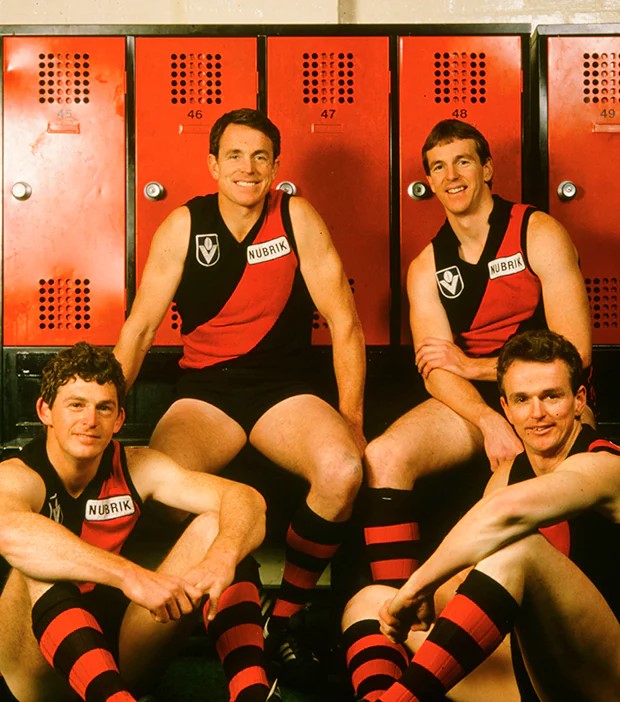
Neale Daniher and three of his brothers played at Essendon at the same time in the early 1980s. (Supplied)
However, just five games into the season, he seriously injured his knee again, requiring another reconstruction.
A second comeback in 1987 ended the same way, with Daniher going under the surgeon’s knife for a third time.
Daniher handled each injury setback in typical fashion, dealing with the disappointment quickly and quietly before applying himself to getting back on the field.
Speaking to the ABC’s Drew Morphett ahead of his comeback game in 1985, he said he would have given the game away if it were not for the support and encouragement of his brothers.
He played just a handful of games in the league’s top tier in his final season in 1990, but one of them happened to be in an Essendon side that included his three football-playing siblings.
He stopped short of saying the four had a telepathic connection on the field, but admitted they weren’t just regular teammates.
“You don’t tend to look out for each other, you just have a sense of where your brothers are,” he told Andrew Denton on the ABC’s Live and Sweaty program in 1991.
“I remember last year we played against St Kilda and I’d been struggling in the reserves and I got a game and they all looked after me pretty well that day.”
Daniher makes his mark as a coach
Daniher’s on-field career may have been curtailed by injury, but he showed he had plenty to offer on the sidelines, first as an assistant coach at Essendon and Fremantle, then as a senior coach at Melbourne.
In his third season as coach at the Demons, he steered the side to the AFL Grand Final against his old club Essendon, losing the decider by 60 points.
Daniher earned the nickname “The Reverend” during the 2004 season for his attempts to boost the club’s profile and membership by “preaching” to supporters to get behind the team.
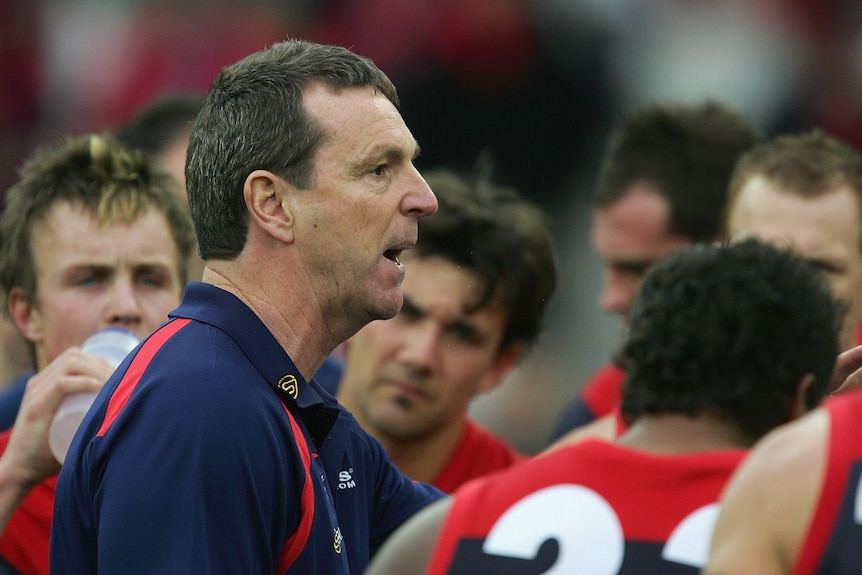
Neale Daniher addresses his players in 2006. (Getty: Sean Garnsworthy)
His spell as Demons coach ended in 2007 without an AFL premiership, but with the respect of football fans across the country.
He spent five years as general manager of football operations at West Coast before standing down for health reasons that were not publicly known at that time.
Battling ‘the beast’ after a shock diagnosis
In August 2014, Daniher revealed he had been diagnosed with MND, a disease he referred to as “the beast”.
“I call it the beast, mainly because I can personalise it. If I’m going to battle something, I like to give it a name,” He told ABC News Breakfast in 2015.
“It’s a beast of a disease because it’s got a 100 per cent strike rate. Once you’re diagnosed, you will die.“
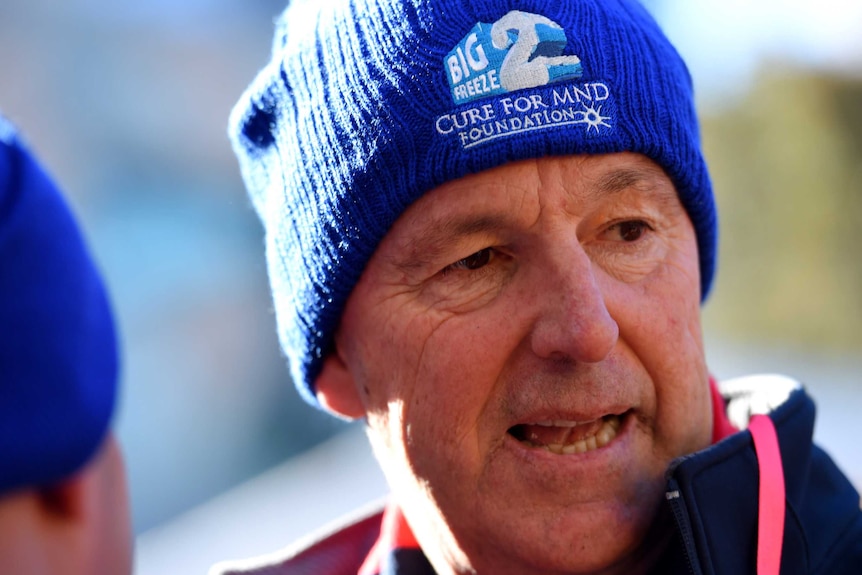
Daniher established the Big Freeze fundraising event for Motor Neurone Disease, which has run for a number of years. (AAP: Tracey Nearmy)
When he publicly revealed his diagnosis, Daniher said MND was a disease that was not very well known, but he made it his task to change that situation, founding the charity Fight MND, which raises money for research.
One of the charity’s signature events is the Big Freeze event, which sees celebrities sent hurtling down a slide into freezing water in the middle of the Victorian winter.
The 2024 event raised more than $20 million for MND research.
Daniher told the ABC in 2015 he was certain a cure for MND would be found.
“I always believe if there’s a will, there’s a way. We’re smart. Human beings have got an answer to this, but at the moment, it’s hidden away.”
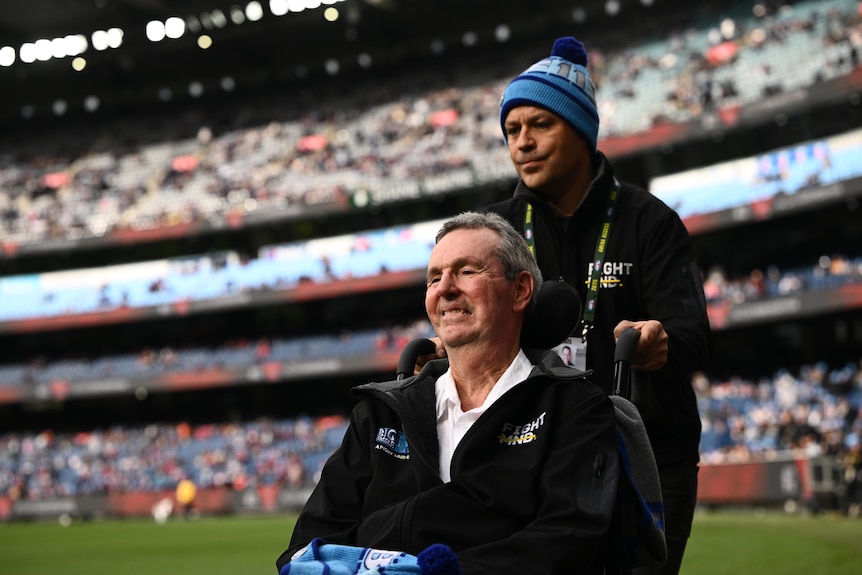
Neale Daniher during a Lap of Honour in 2025. (AAP: Joel Carrett)
Speaking at the launch of his autobiography, When All Is Said and Done, in 2019, Daniher said he wanted to leave his grandchildren with some words of wisdom in case he was not able to deliver them in person.
“Life’s not about finding yourself, it’s about creating yourself. I might not be around, but I’d like to leave a few signposts for them,” he said.
“I hope my kids understand that life doesn’t promise to be fair. It will be hard. It will be tough. You might have setbacks, but life is generally good if you understand it won’t be fair and if you know that, you can go about life looking for opportunities.
“Find opportunities when you suffer, and it gives you opportunities to grow towards the better side of your nature.”

Neale Daniher, wife Jan and Prime Minister Anthony Albanese during the 2025 Australian of the Year Awards. (AAP: Mick Tsikas)
By the time Daniher was named Australian of the Year in January 2025, he was unable to speak, so a prerecorded audio version of his remarks was played at the ceremony.
“I chose to fight because if I didn’t, how could I expect anyone else to? I chose to hope because I believe in the decency and generosity of Australians,” he said.
“I thought, if people truly understood the challenges we face, and joined the fight with me — and you have, oh, how you have.
“To everyone who has bought a beanie, donated a dollar, or spread the word — thank you. You are proof that when Australians unite, nothing is impossible.”
He is survived by his wife, Jan, and their four children and multiple grandchildren.
dan