


In the late 17th century, Caribbean pirates hunted galleons loaded with gold and silver bound for Europe. Today, things have changed — though not as much as it seems. Fast boats slip out at night, men climb aboard with machetes in hand, and terrified crews stay silent. The treasure chests are gone, replaced by fuel, engines, or food. But the underlying story remains the same: piracy flourishes amid economic crisis and the absence of the state along vast stretches of coastline.
During the first half of 2025, maritime piracy rose by more than 50% globally compared to the same period in 2024, according to the latest report from the International Maritime Bureau (IMB). This is the biggest surge recorded since 2020.
SEE ALSO: Guns in the Gulf: Mexico’s Navy Called to Protect Against Pirates
According to researcher Brandon Prins of the University of Tennessee–Knoxville, piracy in Latin America accounts for between 10% and 15% of incidents worldwide — far fewer than in regions such as West Africa or Southeast Asia. Still, the region has seen major spikes over the past decade.
Those increases, Prin said, coincide with moments of crisis, pointing to the Venezuelan economic crisis and Covid as examples when piracy spiked. “Economic conditions do drive people into crime on land, and they drive people into crime at sea,” he said.
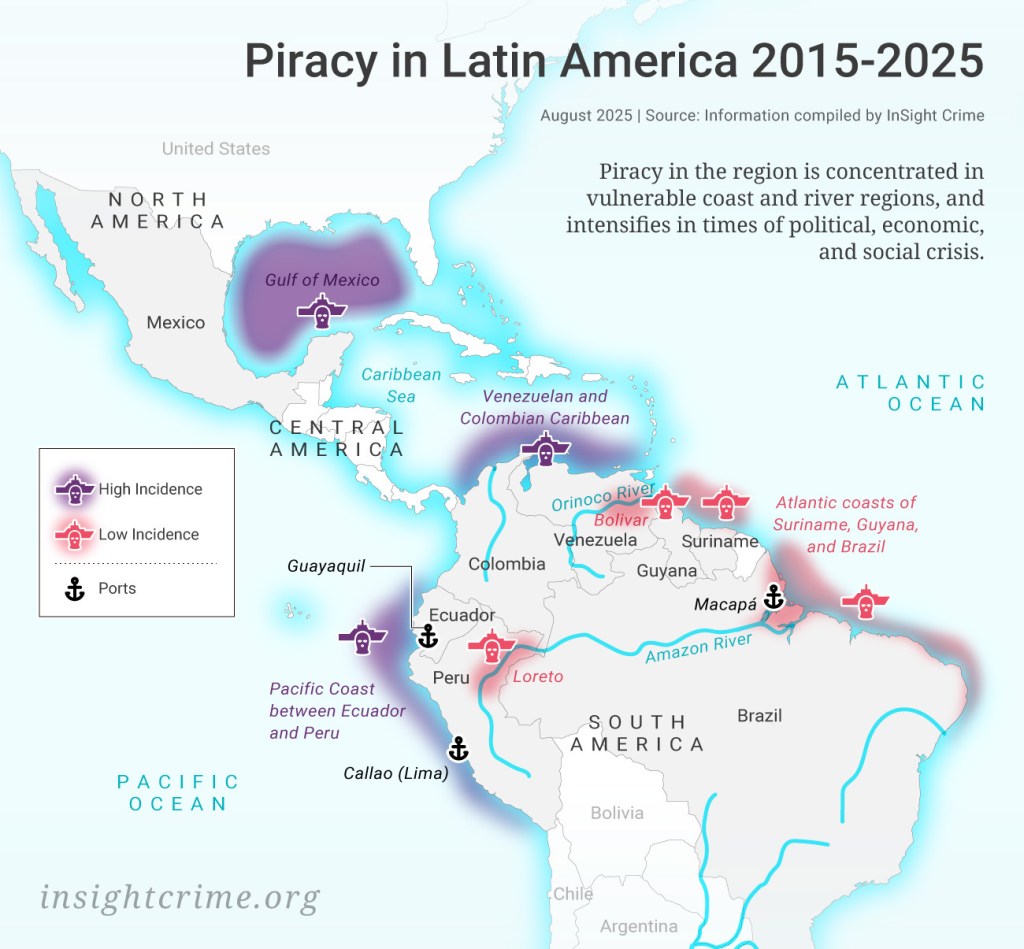
The attacks are concentrated in critical zones such as the Gulf of Mexico, the Venezuelan and Colombian Caribbean, and the Pacific coast between Ecuador and Peru. Isolated incidents have also been reported in Suriname, Guyana, Brazil, and in inland waterways like the Amazon and Orinoco rivers.
Still, this criminal dynamic is heavily underreported. Many victims never file complaints for fear that their work will be suspended during an investigation, that their insurance premiums will rise, or — in some cases — because they are themselves involved in illegal activity, from sailing off declared routes to transporting illicit or unregistered cargo.
There is also a technical detail: most attacks occur within territorial waters — the maritime area that extends 12 nautical miles from a country’s coastline and remains under its sovereignty. Authorities therefore classify them as “armed robbery” rather than piracy. “Armed robbery on ships and piracy really are the same activities,” Prins explained. “It just gets called armed robbery because it happens within 12 nautical miles.”
Cyrus Mody, director of Commercial Crime Services at the International Chamber of Commerce (ICC), agreed that the difference is merely a technicality. “If you tell a coastal state like Venezuela that you have piracy in your waters, they will turn around and say, ‘We don’t have any piracy’—and they are absolutely correct, because by definition, piracy happens outside territorial waters. But the incident is the same.”
Between the lack of complaints and the official classification, accurately measuring the scale of piracy in Latin America is nearly impossible.
Between Survival and Organized Crime
Piracy in Latin America is not dominated by large, organized fleets but by small, scattered groups. Most pirates are residents of marginalized coastal regions with little state presence and few economic opportunities who turn to the sea as a means of survival in times of crisis. Maritime knowledge is key — fishers or former sailors often fill their ranks.
Although most pirates operate independently, it has become increasingly common for some to claim allegiance to larger organizations. That was the case in July in the Gulf of Guayaquil, when a group of assailants identified themselves as members of the Ecuadorian gang the Lobos.
SEE ALSO: Ecuador’s Fishermen Face Death or Despair From Constant Pirate Attacks
In Colombia, the Gaitanist Self-Defense Forces of Colombia (Autodefensas Gaitanistas de Colombia – AGC) have carried out riverine attacks along the Magdalena River, boarding boats and collecting a “war tax” in exchange for letting them pass.
Elsewhere, the connection to organized crime is more indirect. In Mexico, for instance, pirates who attack oil platforms maintain ties to drug cartels; in Venezuela’s Caribbean waters, they are linked to land-based criminal gangs. Ports — like Callao, Macapá, and Guayaquil — have become sites where collaboration with local smuggling networks is most apparent.
Institutional corruption also plays a role. “Where corruption is higher in countries, there’s more piracy,” said Prins, adding, “There’s probably some collusion going on between local port officials or even law enforcement and pirate groups.”
Quick Strikes, Small Gains
Unlike in East Africa or Southeast Asia, piracy in Latin America relies on quick strikes launched from small boats that intercept vessels near the coast or even in port. Attackers usually carry machetes, knives, or sticks — and, to a lesser extent, firearms. Their violence is largely instrumental rather than lethal: they aim to intimidate crews into submission and avoid killings.
Targets also vary: oil tankers, cargo ships, and especially yachts and recreational vessels, which are more common in Latin America than elsewhere. In the Gulf of Mexico, even oil platforms have become regular targets. The loot, however, is usually modest — fuel, engines, provisions, or fish — setting it apart from other regions where kidnappings for ransom are common. In Latin America, success depends on speed.
From Illegal Fishing to Drug Trafficking: Criminal Crosscurrents at Sea
Direct links between piracy and other illicit economies are not always clear, but their territories overlap — drug trafficking, human smuggling, fuel theft, and illegal fishing often share the same routes.
In Mexico, the Sinaloa Cartel, the Jalisco Cartel New Generation (Cartel de Jalisco Nueva Generación – CJNG), and the Gulf Cartel have extended part of their operations to the sea. They extort fishing communities to gather information about routes and use those networks to move goods. The so-called “law of silence” rules the coastlines.
SEE ALSO: The Coast of Sucre – Venezuela’s Most Dangerous Place for Piracy
In Venezuela, a similar pattern has emerged on Lake Valencia, where pirates extort fishers, demanding a share of their daily earnings in exchange for “protection.”
The clearest connection is with illegal fishing: some fishers, driven to ruin by the collapse of their trade, turn to piracy; others already operating outside the law find that attacking boats is simply a more profitable way to survive.