On Friday afternoon, January 19, a man identified as 66-year old José Ángel Laguna González, was shot and killed outside of the Solo Ángeles CM motorcycle clubhouse located in the Independencia neighborhood in Tijuana. Tijuana has 86 homicides so far in January 2024.
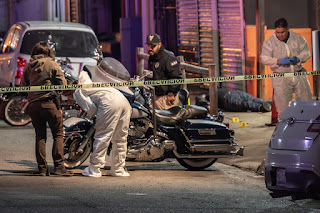 |
| Outside of the clubhouse at Allende and San Antonio de los Buenos streets, one person was killed. |
According to unofficial reports, a dark Audi pulled up to the clubhouse. The occupants inside fired, killing Jose “Chato” Angel Laguna González, who was a retired Captain of the Tijuana Fire Department. “Chato” died on the sidewalk outside of the clubhouse as the gunmen drove off.
The Solo Angeles CM issued a statement claiming that the man who lost his life was a member of the motorcycle club but that his death “had no relationship with the activity of the club, nor with the lifestyle of those who make it up.” They claim that Laguna González “was the victim of a random act of violence. We ask the authorities to follow up and promptly resolve the investigation in order to find the whereabouts of those responsible.”
According to the Solo Ángeles website, the first motorcycle club formed in Tijuana and possibly all of Mexico, was ‘Ángeles del Camino,’ which was founded in 1959…A few years later the Solo Ángeles motorcycle club was formed by Manuel ‘Meño’ Burgóin, who had been in the ranks of the Hells Angels [in the United States].
Regarding the birth of the name, from an interview with a member of the club, it was said that “Far from being ‘Hells Angels’ they are ‘Only Angels’.” Solo Ángeles Club de Motociclistas (Solo Angels MC) in the 1970s formalized the club and started wearing 3-piece rocker patches, or ‘colors’ identified with the outlaw motorcycle clubs established in the US and abroad. According to the site, around 200 members are based in Tijuana and San Diego.
“It’s a club that was founded, well, there’s a little controversy, in 1967,” said Larry Hughes, a Solo Angeles member who’s known as ‘Crazy Larry.’ “A Hells Angel wanted a club for the Mexicans, and he founded it down here … and it’s been here ever since.” ‘Crazy Larry’ said he joined the group in the 1970s, after partying with them in Mexico.
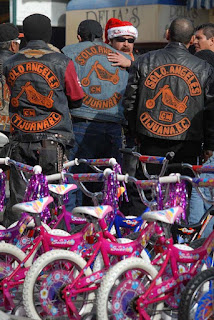 |
| The club has held charitable toy runs annually since the 1980s. |
The Solo Angeles has ties to the Hells Angels since the founding members were from the US-based club. Like the HA, they consider the Mongols, with many Hispanic and Chicano members rivals.
ATF Operation Black Biscuit
The world of Hells Angels and the Solo Angeles would collide again in the early 2000s as part of an infamous undercover ATF investigation targeting the Hells Angels in Arizona. Former ATF Agent Jay “Jaybird” Dobyns and an informant joined the Solo Angeles. Then they created a fake Nomads chapter to have credibility, to get close to and make deals with Hells Angels chapters outside of Phoenix, Arizona.
During “Operation Black Biscuit” ATF Agent Jay Dobyns told Hells Angels members they were looking into setting up a Solo Angeles chapter in Arizona, bringing along several other undercover agents who played the roles of fully patched members as well as prospects. They then prospected for the Hells Angels.
After an ATF staged killing of a “Mongol member in Mexico,” Dobyns alleges he was made a full-patch member of the Hells Angels; however, HA members in Arizona dispute this fact.
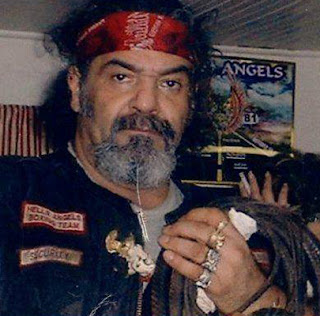 |
| “Chico” Mora |
The ATF believed that Robert “Chico” Mora, who was a founding member of the Hells Angels in Arizona, having patched over in 1996 from the Dirty Dozen MC, was “assembling a hit squad of old-school Hells Angels, former Dirty Dozen members, to take out the Solo Angeles.” HA members and associates in Arizona have denied this was the case.
At the time, Mora did not know the Solo Angeles were undercover ATF. He was just pissed that they were operating in his territory.
The supposed plot brought a premature end to Black Biscuit, which resulted in June 2003 raids on 30 people and resulted in indictments of Hells Angels chapter presidents, members, and associates on charges related to drug and gun dealing and racketeering.
Mora was indicted on a federal charge of possessing body armor with intent to sell, found guilty during a 2004 jury trial, and sentenced to 18 months in prison. A year later, the conviction was reversed on appeal. Dobyn’s home was later firebombed after the investigation soured, he blames the ATF for not properly protecting him and his family and following through on his undercover operation.