


“Morogris” and “redlogarythm” for Borderland Beat
 |
| Authorities captured the moment on video when Said “N” was taken into custody in Madrid, Spain. Based on the information presented below, it is likely the man’s full name is Said Rbib Erraouy or Erraoui. |
Spanish authorities have detained a Moroccan citizen who is believed to be the “European representative” for Los Zetas.
This individual was known to “distribute” drugs to “trusted individuals” across Spain and Europe, with a specific focus on the Netherlands, where the port of Rotterdam serves as a major entry point for drugs into Europe.
Despite having his residence in Madrid, the detainee led a nomadic lifestyle, frequently moving around, which posed challenges for the investigation teams.
During the operation, a total of five individuals were apprehended, and significant seizures were made, including 400 kilograms of cocaine, 220,000 euros in cash, two vehicles, 10 telephones, and several documents of interest, as stated by the police.
Spanish sources only referred to the detainee by his first name “Saíd” and omitted his last name. It is unclear if this Saíd is the same as Said Rbib Erraouy (alias “El Hermano” or “El Sami”), a confirmed Zetas representative who worked under the former European leader of Los Zetas, Juan Manuel Muñoz Luévano (alias “Mono Muñoz”).
The Spanish authorities also announced the successful dismantling of the largest cocaine processing laboratory in Europe, located in Pontevedra, Galicia. This operation involved an alliance between a Mexican cartel and a Colombian organized crime organization.
In regard to the operation to dismantle the Zetas group in Europe, the National Police highlighted that it was a joint effort, involving collaboration between the Colombian National Police and the United States Homeland Security Investigations (HSI).
While there have been other instances of international cooperation in this field, there is no mention of the involvement of a Mexican agency or authority in this investigation.
High-Ranking Colombian Counterpart
Among the five detainees is a reputed Colombian drug trafficker, known as El Repetido (The Repeated One), who happens to be a twin brother. The Spanish police describe him as “well-known in the world of drug trafficking.”
Colombian court records consulted by Borderland Beat show that El Repetido’s real name may be Edwing or Edwin Mauricio Gómez Luna, who also goes by the alias El Mello Pobre.
His brother Huber Anibal Gomez Luna also goes by the alias El Repetido and as El Mello Rico. Investigators say they have been involved in drug trafficking since 1994 and that they were once based in Santa Marta, Colombia.
Collectively, the two brothers were known in the Colombian underworld as Los Mellizos (The Twin Brothers) or as Los Mellos. An investigative report from the Colombian Prosecutor’s Office revealed that Los Mellos were in control of the cocaine shipping routes to Central America, and even extended its reach to the coasts of Mexico and Europe.
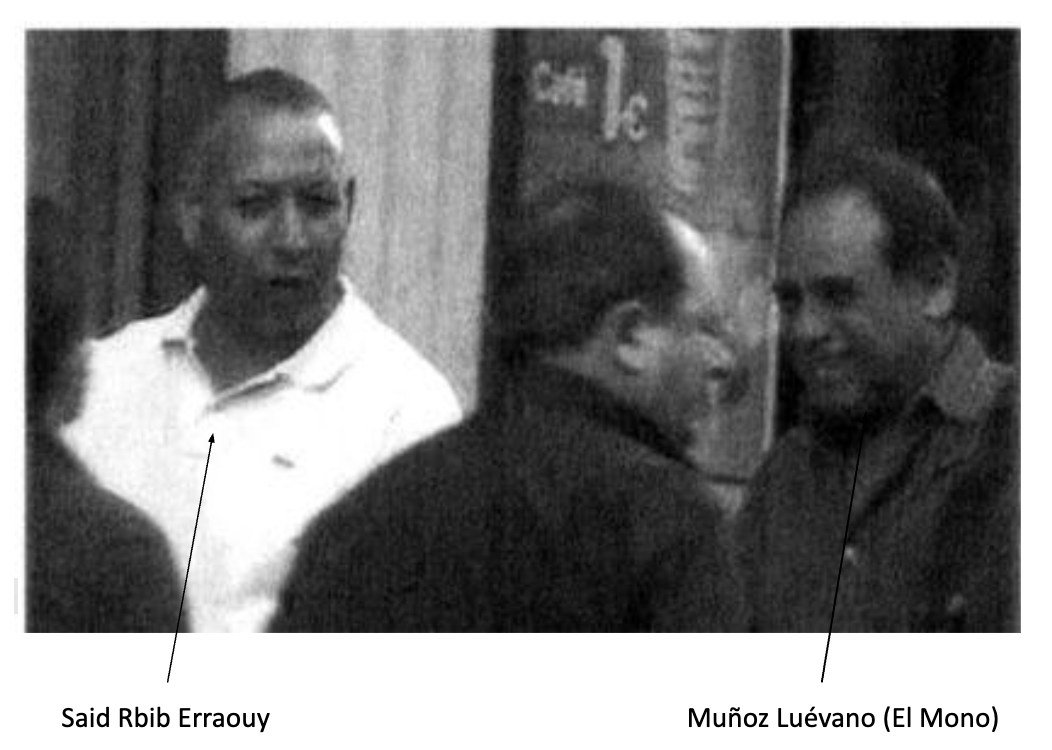 |
| Picture take by Spanish authorities where Said Rbib Erraouy and Muñoz Luévano (El Mono) are seen together in Spain |
Background: Los Zetas in Europe
The history of Los Zetas’ operations in Spain dates back to the early 2010s when a cell led by Juan Manuel Muñoz Luevano, also known as “Mono Muñoz,” was detected in the country. This faction of the Mexican group operated from within the State of Coahuila.
Based in Madrid, Spain, El Mono’s cell was involved in smuggling multi-ton loads of cocaine into the Iberian Peninsula. Although the exact details of how and where the drugs were introduced remain undisclosed, it is known that a highly successful smuggling operation took place between 2012 and 2013.
During this period, El Mono managed to sell at least 2,100 kilos of cocaine, generating a revenue of 63 million euros. The profits were later repatriated to Mexico through money laundering techniques, including the purchase of European luxury goods that were resold in Mexico to recover the cash.
In 2016, El Mono was arrested, and a year later a significant blow was dealt to El Mono’s network when eight accomplices, including his wife, were captured in a second operation in March 2017.
El Mono Muñoz had an intricate network of businesses in Coahuila, including casinos and a local chain of gas stations, through which he laundered his illicit profits. He also had ties with former Coahuila Governor Humberto Moreira, who was detained in Spain a few months before El Mono’s downfall.
Both El Mono and Humberto Moreira were arrested by the Spanish National Police and handed over to the Audiencia Nacional, a Madrid-based tribunal responsible for high-level organized crime investigations. The investigation linked both individuals to the National Prosecutor Office Against Corruption and Organized Crime.
El Mono was later extradited to the US, where he pleaded guilty and became a protected witness, and was released from US prison in 2019. On the other hand, Spanish authorities released Humberto Moreira, and he negotiated with US authorities, including the FBI to cooperate in El Mono’s capture.
While Mexican organized crime’s presence in the Spanish underworld is not as significant as other organizations, such as Colombians or Moroccans, the Spanish National Police, and Civil Guard occasionally carry out operations against specific Mexican groups. These operations are often planned through international cooperation instruments facilitated by American counterparts and Europol’s intelligence units.
A notable operation occurred in June 2022 when the National Police dismantled a family clan based in central Spain, Madrid, and Guadalajara, which had ties to members of the Sinaloa Cartel. The Spain-based clan was involved in cannabis cultivation and local commercialization, as well as cocaine trafficking. They had established a sophisticated financial structure using corporate entities in Portugal, Spain, Switzerland, and Colombia for money laundering purposes.
The cultural ties and favorable financial and real estate legislation in Spain have attracted many Mexican former statesmen and businessmen to conduct their operations there.
Notably, former President Carlos Salinas de Gortari (1988–1994) recently obtained Spanish citizenship due to his Sephardic ancestry. Former presidents Felipe Calderón (2006–2012) and Enrique Peña Nieto (2012–2018) also reside or have resided in Spain.
Sources on background: Borderland Beat archives