


Arms trafficking presents complex challenges to authorities around Latin America and the Caribbean, but a recent report found combating these issues need not require long periods of time nor many resources.
The report, authored by the Organization of American States (OAS), a regional organization designed to foster cooperation between nations, used qualitative methods to pinpoint the highest priority challenges facing authorities in the Americas when dealing with illicit arms flows.
Part of a wider initiative by the OAS called the “Hemispheric Study on Illicit Trafficking of Firearms and Ammunition,” the study was undertaken in response to the major threat that illicit arms continue to pose to the region. Violence between criminal groups in Latin America and the Caribbean is fueled by these arms, which often originate in the United States, leading to soaring murder rates. Caribbean and Mexican officials have repeatedly urged US officials to do more to combat the problem.
SEE ALSO: 4 Takeaways From CARICOM Firearms Report
The study entailed polling and interviewing over 20 arms trafficking experts, mostly from the Americas. The experts — the majority of whom had over 10 years of experience working in the field — were asked to identify what they view as the biggest obstacles to effectively preventing illegal arms flows.
It then compiled these responses into 39 concrete, “high priority” challenges. These included, for example, “insufficient or inadequate data and information exchange between different state agencies” and “inadequate process for authorizing private security companies that use firearms.”
Many of the challenges mentioned by experts matched InSight Crime’s recent coverage of arms trafficking. In Ecuador, inconsistencies in the collection of data between different government agencies have inhibited accurate information on the extent of the illegal arms problem. Meanwhile, in countries like Honduras and Colombia, the legitimacy provided by private security companies facilitate criminal groups’ access to arms.
“The growth of private security companies in the region is concerning because the reality is that no state truly has the capacity to monitor those firearms,” Cecilia Farfán-Méndez, head of the North American Observatory at the Global Initiative Against Transnational Organized Crime and one of the co-authors of the report, told InSight Crime.
SEE ALSO: How Ecuador’s Criminals Are Taking Advantage of Private Security Firms
While nations around the region have struggled to combat the illicit arms issue, the findings of the OAS study are “positive” for nations in the Americas, the authors claim. That is because the solutions to many of the challenges presented by the experts require “low resource investment” and are “capable of being implemented in the short to medium term,” the study concluded.
“We are showing here that … not everything related to firearms trafficking requires this massive investment,” Farfán-Méndez said.
To support this finding, the authors arranged the 13 highest priority challenges identified by experts into a matrix. On one axis, they organized challenges based on the resource investment required to address them. On the other, the authors outlined whether they believed solutions could be achieved in the short, medium, or long term.
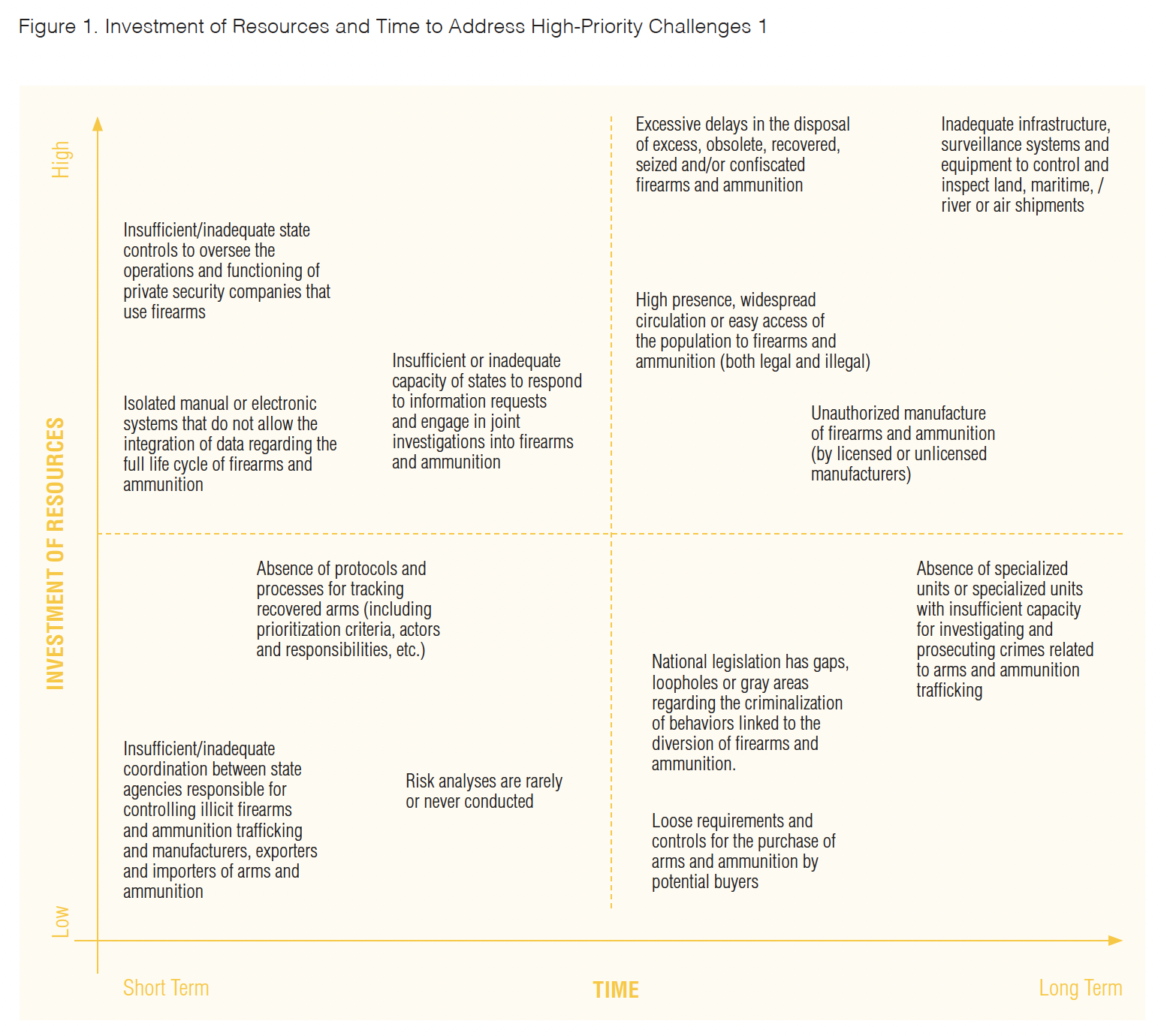
Short-term, low resource challenges included the lack of coordination between different branches of government and closing loopholes in firearms legislation. Other challenges, however, require more time and resources to combat, such as the lack of physical infrastructure at ports and land borders and the unauthorized manufacture of arms and ammunition.
The report stops short of digging into the roots of these challenges and what’s preventing their implementation. This, according to Farfán-Méndez, requires more research going forward.
“The next step is about understanding why these challenges — for instance, insufficient coordination — exist in the first place,” she told InSight Crime.
Featured image: Handguns seized en route to the Caribbean are displayed in Miami following a 2022 US law enforcement operation. Source: Giorgio Viera / Getty Images