


“We were like expectant mothers and fathers,” he quipped, explaining how his team was kept on tenterhooks with concerns over the pup’s health.
The tourist attraction’s chairman, Paulo Pong Kin-yee, said the breeding of the pup marked a milestone in the park’s conservation and education efforts.
“This accomplishment serves as a powerful example of our focus on conservation and education, inspiring us all to protect and understand our precious marine ecosystem,” he said.
Hong Kong’s Ocean Park posts HK$118.5 million surplus after years of deficits
Hong Kong’s Ocean Park posts HK$118.5 million surplus after years of deficits
The park’s rays belong to the Rhinoptera javanica species, which is listed as “endangered” on the International Union for Conservation of Nature (IUCN) Red List, a database which tracks the risk of extinction of different animals, fungi and plants.
In the wild, the fish – named for the distinctive feature on its head, with two dents resembling a cow’s nostrils – is typically found in Indo-Pacific waters, stretching from Southeast Asia to as far as Japan and Oman.
But their numbers have been decimated by climate change and commercial fishing – whether caught directly or swept up as by-catch along with other sea creatures.
Globally, the Javanese cownose ray population has plunged between 50 and 79 per cent over the last 44 years, according to IUCN estimates.

The birth of April was not the first time the park had adopted the technique. Lee said the park’s first dolphin conceived via artificial reproduction was born nearly 20 years ago.
But the team was motivated to attempt it with cownose rays after observing how natural conception could be difficult for the creatures, compounded by their slow maturation and breeding cycles.
Although cownose rays can live for 15 to 25 years, they only reach sexual maturity at the six- to eight-year mark, and females typically only gestate one pup at a time.
“In our own facility, we have some experience that sometimes they are born dead, and the successful numbers that are born are not too high,” Lee said. “So by using AR [artificial reproduction] techniques, we can help them along.”
Will efforts to help Hong Kong’s two giant pandas breed bear fruit?
Will efforts to help Hong Kong’s two giant pandas breed bear fruit?
The project began in late 2021, when the team selected three female rays for the process.
The artificial insemination procedure itself took place in February 2022, when the team collected semen from two adult male rays. They diluted it with a special solution and chilled the mixture at 4 degrees Celsius before inseminating the female rays.
To help the rays stay calm when undergoing multiple ultrasound scans, the team decided to train the creatures to accept the check-ups voluntarily, a process which “truly exemplifies the strong bond between the animals and our animal care team,” said Dr Paolo Martelli, the park’s director of veterinary services.
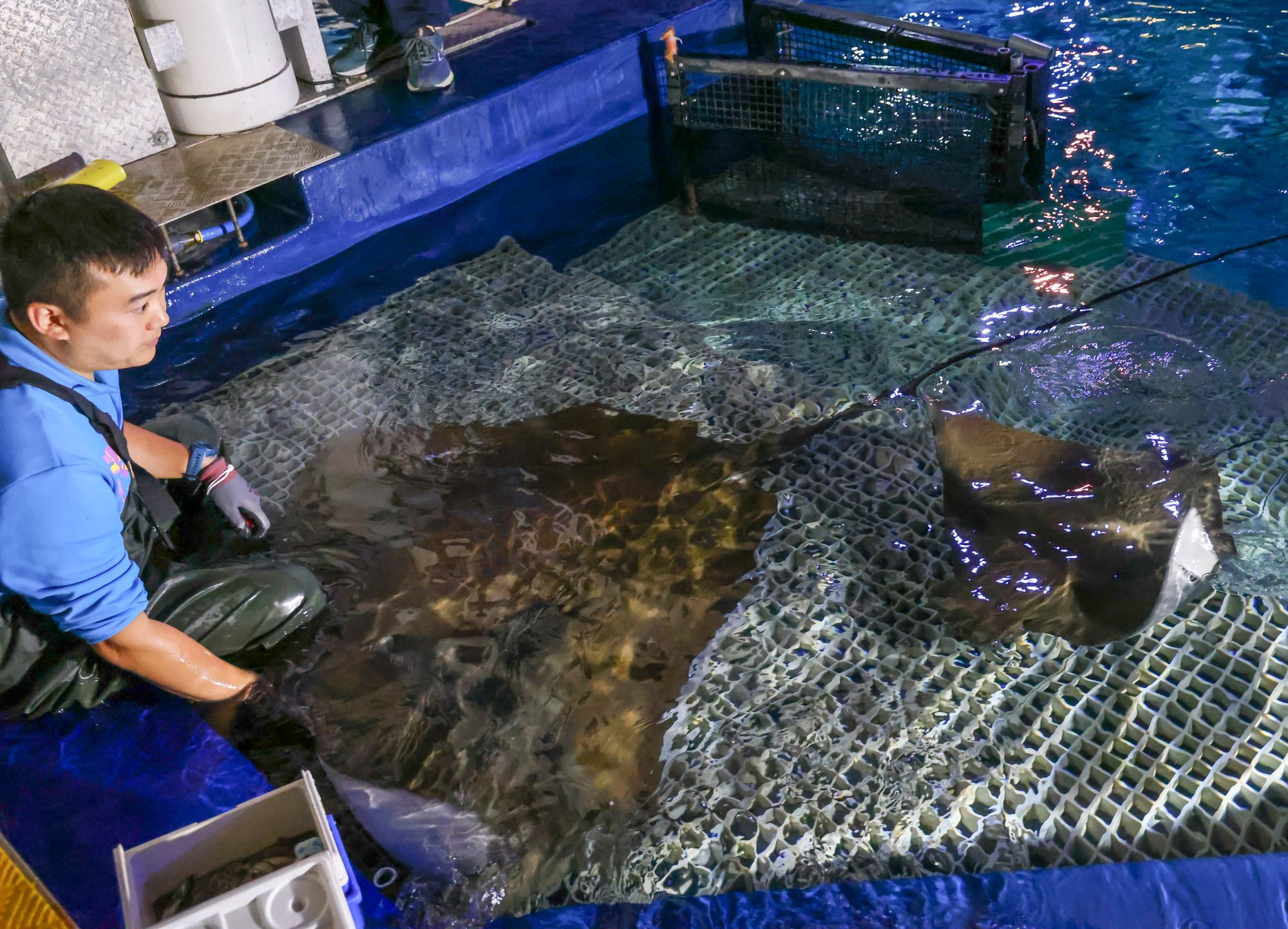
Lee, the senior vet, said that when he first joined the park 15 years ago, staff had to chase after the rays with nets, which exhausted everyone – rays included – and increased the risk of distorting the creatures’ blood test results due to stress.
He said the team hoped the knowledge and skills they acquired would help with future conservation efforts for endangered animals, especially sharks and rays, by providing more opportunities for breeding and increasing the gene pool for creatures in captivity.
For now, visitors to Ocean Park can see April swimming in the shark and ray pool with a male ray named Ma On. But visitors might find it tricky to tell the two apart, said Lell Luk, an assistant curator in the animal department.
“Ma On is male and April is female, so for the staff we can recognise them, but it might be harder for guests,” he said.
The birth is another boon for the tourist attraction, which recorded a HK$118.5 million (US$15.2 million) surplus for the financial year ending June 30 from a HK$1.82 billion deficit a year ago, reflecting its post-pandemic recovery.