


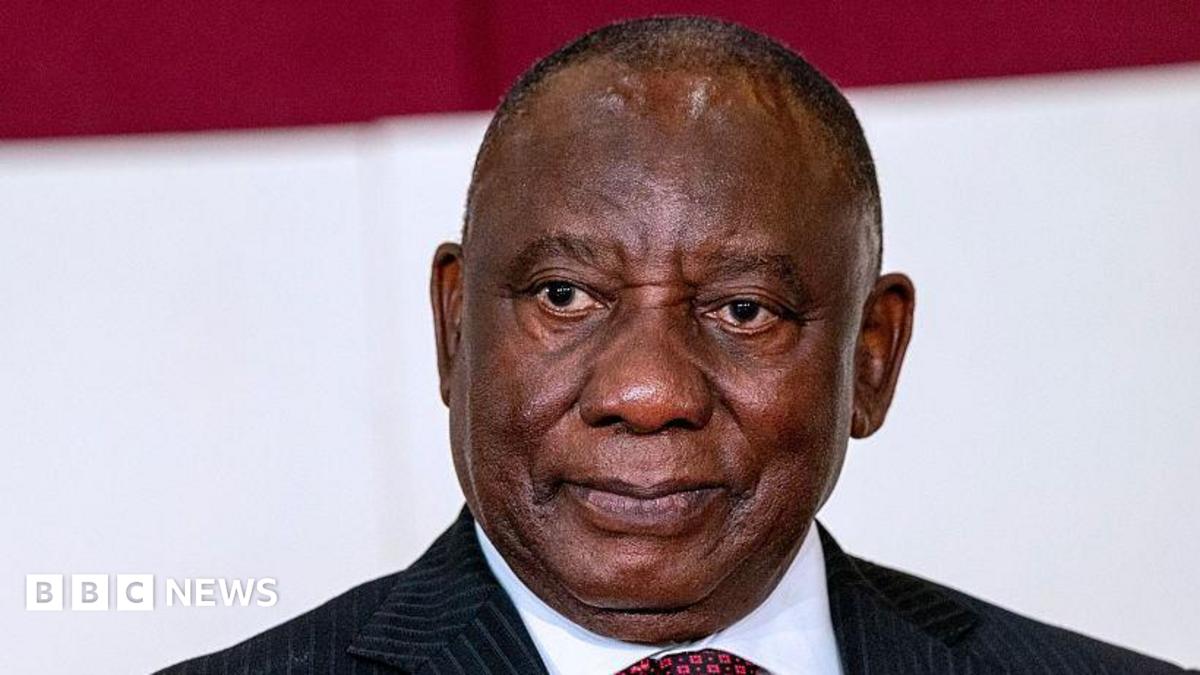
On Friday, Western Cape high court judge Andre le Grange halted the parliamentary committee from proceeding with its hearings “pending the determination by this court of the applicant’s review” – a reference to Ramaphosa’s case against the panel.
The ruling effectively buys more time for Ramaphosa – time in which the president hopes he will be able to clear his name.
In court his legal team had argued that not halting the impeachment committee’s work until his other case was ruled on could cause him irreparable reputational harm.
Three judges heard the matter: two ruled in his favour. The majority judgement means that until his other case is heard and finalised the impeachment proceedings cannot continue.
This whole saga goes back to 2020 when a robbery that took place at the president’s private farm in Phala Phala, in Limpopo province.
Thieves broke in and stole money – at least $580,000 (£430,000) in US dollar bills – that had been stuffed into a sofa.
Details of the theft only came out two years later when the country’s former spy chief, Arthur Fraser, highlighted the theft in an explosive dossier that he sent to the police.
Fraser, a close ally of Ramaphosa’s predecessor Jacob Zuma, accused the head of state of hiding the theft from the police and tax authorities.
As the stolen cash was in foreign currency, it meant that exchange control laws could also have been contravened.
Ramaphosa said the cash came from the sale of buffaloes.
The president released a statement shortly after Friday’s ruling saying he noted and “respects” the court’s decision.
There has been a range of reactions to the ruling.
The Democratic Alliance, the second biggest party in the governing coalition, said the ruling was not unexpected but it did not “stop the committee from continuing with preparatory [work]”.
The opposition party led by Zuma, uMkhonto weSizwe (MK), accused the president of using the courts to stop a process that was trying to uncover what happened at his private farm.
While the ANC welcomed the ruling and urged other parties to “refrain from politically motivated distortions” as the legal process unfolded.
Additional reporting by Pumza Fihlani in Johannesburg