




It was supposed to be the payoff for a decade-long land-rights struggle for the Garífuna, the Afro-Indigenous people who live on Honduras’ Caribbean coast.
On the morning of October 14, 2024, government officials and members of the security forces arrived in Punta Piedra, a community in the municipality of Iriona in the department of Colón. They were there to measure, plot by plot, land that had been occupied by terceros, or third parties, the name the Garífuna use to refer to the outsiders that have been invading their territory for more than thirty years. It was the first step to enforcing a 2015 ruling by the Inter-American Court of Human Rights (IACtHR) that had censured the Honduran state for failing to demarcate and title Garífuna land and called on it to remove the terceros.
SEE ALSO: The Moskitia: The Honduran Jungle Drowning in Cocaine
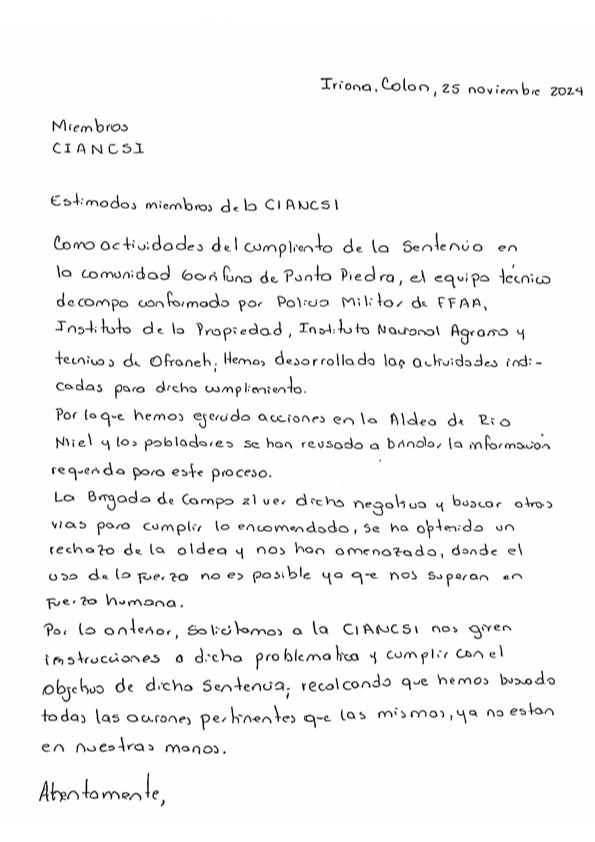
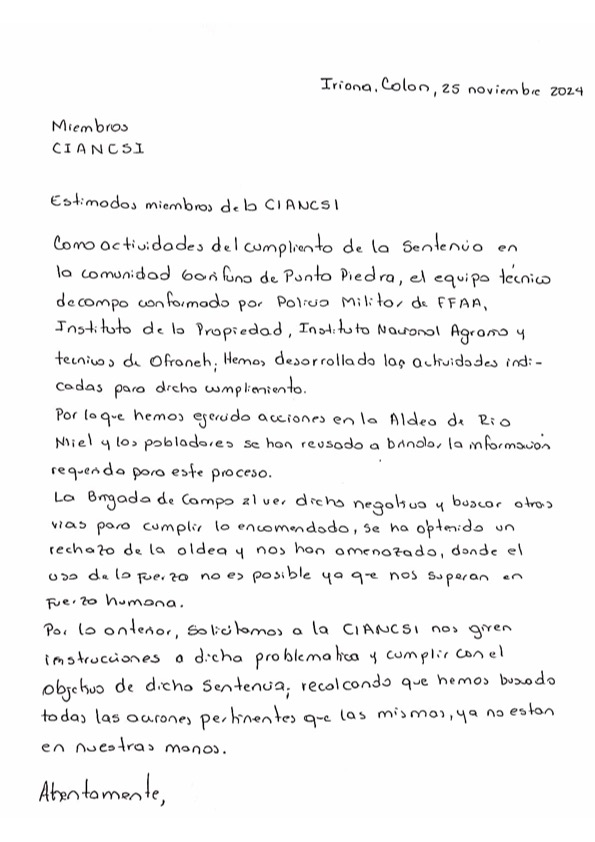
But behind the land invasions are powerful interests, and they soon made their presence felt. Twenty days after arriving, the government officials drew up a handwritten report stating that they were going to abandon the mission because they had received threats in the village of Río Miel.
“We have been threatened, and the use of force is not possible, since they outnumber us,” reads the document, signed by 11 military police officers and government officials.
The threats came from the drug traffickers who have turned Punta Piedra and other parts of Iriona into cocaine corridors, according to Rony Castillo, one of the leaders of the Garífuna association, the Honduran Black Fraternal Organization (Organización Fraternal Negra Hondureña – OFRANEH).
“These are established drug traffickers,” Rony said. “The state itself has publicly identified them as wanted for extradition.”
Two years on, the overlapping presence of drug trafficking and powerful economic interests remains one of the main obstacles to implementing the IACtHR rulings in Punta Piedra and three other Garífuna communities. The state, meanwhile, has shifted from failing to protect the Garífuna’s land rights to accusing their leaders of organized crime.
The Garífuna have a unique cultural history. The first community was established on the Honduran island of Roatán in 1797. They soon spread along Central America’s Caribbean coast, using and caring for their lands under their own rules of collective ownership for generations, despite a lack of recognition from the state.
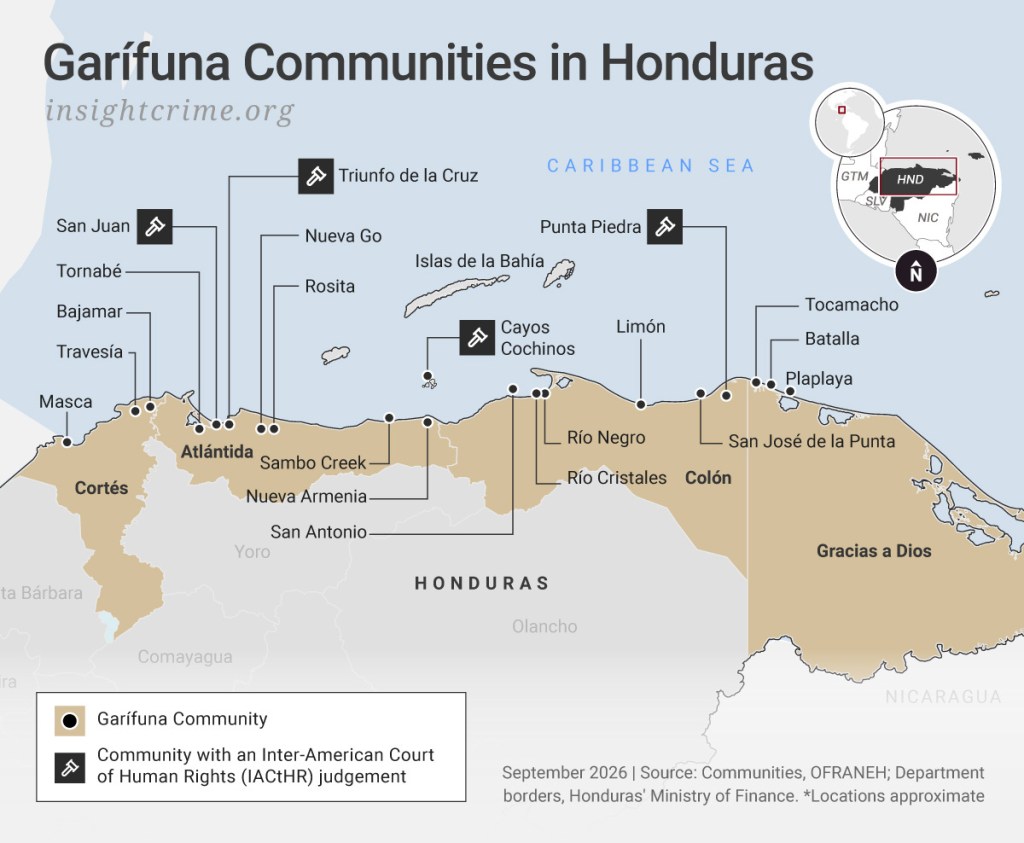
It was not until 1993 that the Honduran state granted the Garífuna of Punta Piedra a communal title covering just over 800 hectares. But it never effectively resolved any competing claims to the land nor cleared the territory of terceros.
Tensions between the terceros and the Garífuna deepened after the state granted the community a second title in 1999. The ruling expanded Punta Piedra’s territory to just over 2,300 hectares, but more than 600 of them overlapped with lands claimed by a village of settlers, Río Miel. This sparked conflict between the Garífuna and the terceros, and leaders denouncing the invasions faced harassment, threats, and even death.
While many of the terceros were landless migrants from elsewhere in Honduras, the Garifuna’s efforts to claim their lands also brought them into conflict with much more powerful and sinister forces.
In the 1990s, drug traffickers seeking out new cocaine corridors along Honduras’ northern coast began to arrive in the region. And the department of Colón had become a superhighway for drugs.
The region connects key cocaine arrival points on the Caribbean coast, such as the jungles of the Moskitia, with the center of the country and routes that continue north through Guatemala. Colón was also the main stronghold of the Cachiros, one of Honduras’ most important drug transport groups since the turn of the century.
“Our ancestors said: ‘Here there is sea, there is river, there is lagoon, and that is what we need to live,’” said Miriam Miranda, coordinator of the OFRANEH. “But they never imagined, 200 years ago and more, what living in those places would mean for their descendants.”
In recent years, the region has also become a coca-growing enclave and cocaine production center. Over the past decade, the municipalities of Iriona and Limón have topped the list of places in Honduras where security forces destroyed the most coca crops and drug laboratories. In 2025, authorities eradicated just over 208,000 coca plants, most of them in Colón, according to Attorney General’s Office data.
SEE ALSO: Honduras Sees Record Number of Municipalities Growing Coca
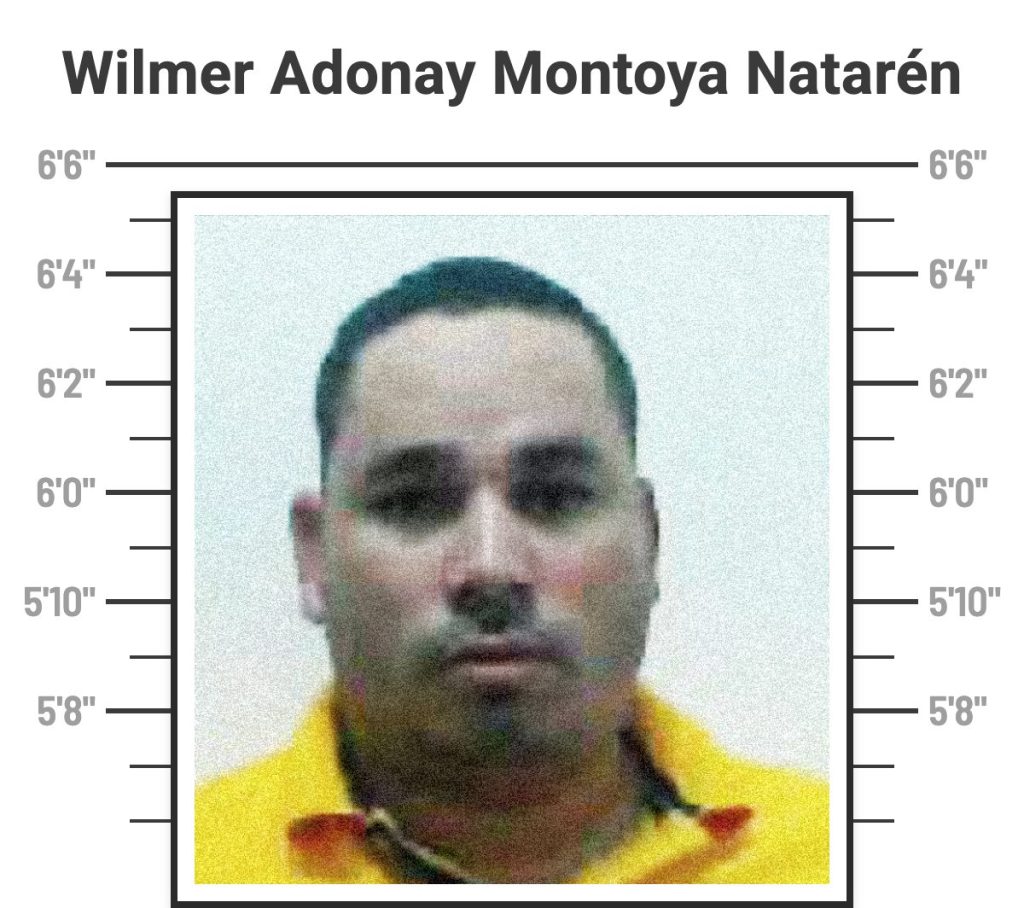
Behind much of this business today, according to prosecutors, are powerful drug trafficking networks, the Montes Bobadilla clan and its partners, the Montoya Natarén brothers.
In August 2025, the Attorney General’s Office raided properties in Iriona and Limón linked to the Montes Bobadilla clan and to brothers Milton Raúl, Elmer Omar, and Wilmer Adonay Montoya Natarén. According to prosecutors, the network moves cocaine from Colombia to the United States and controls coca crops in Colón. Prosecutors allege the clan also acquired African palm plantations and cattle without being able to justify where the money came from.
Honduran authorities have listed all three brothers as wanted for extradition to the United States on drug trafficking charges. But that has not stopped them from moving around Punta Piedra, two local residents told InSight Crime.
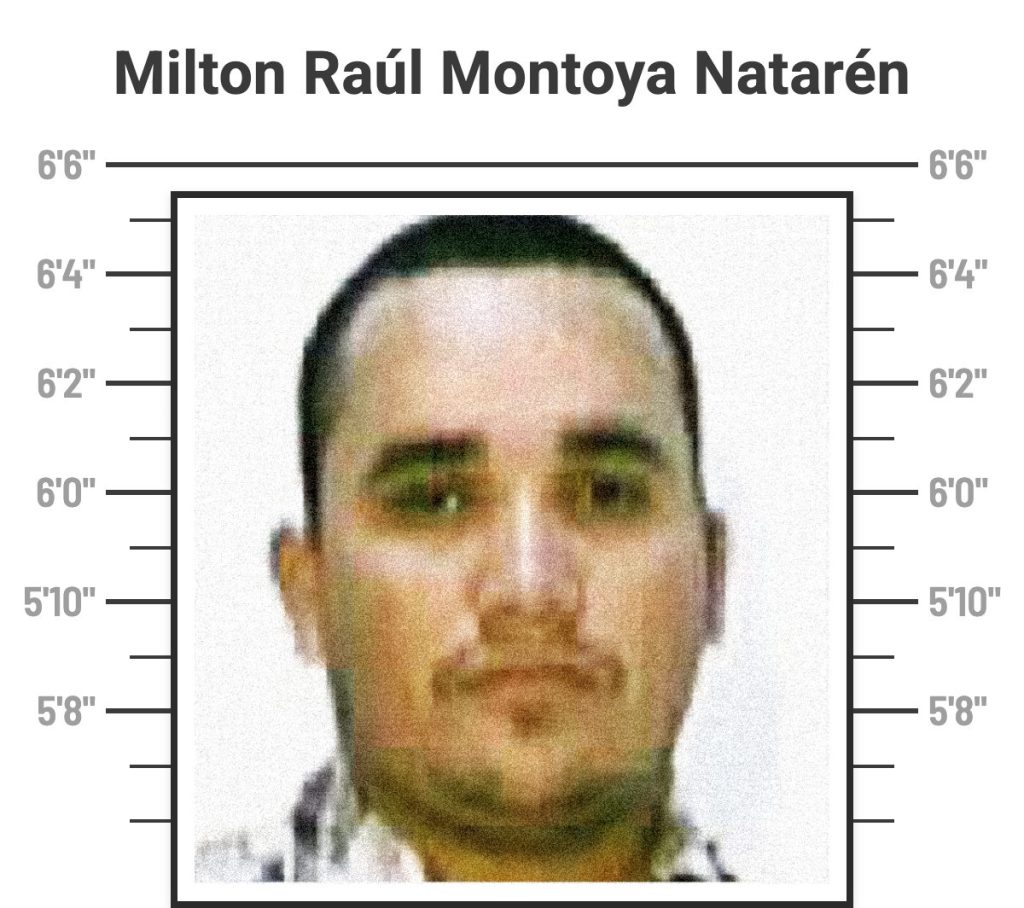
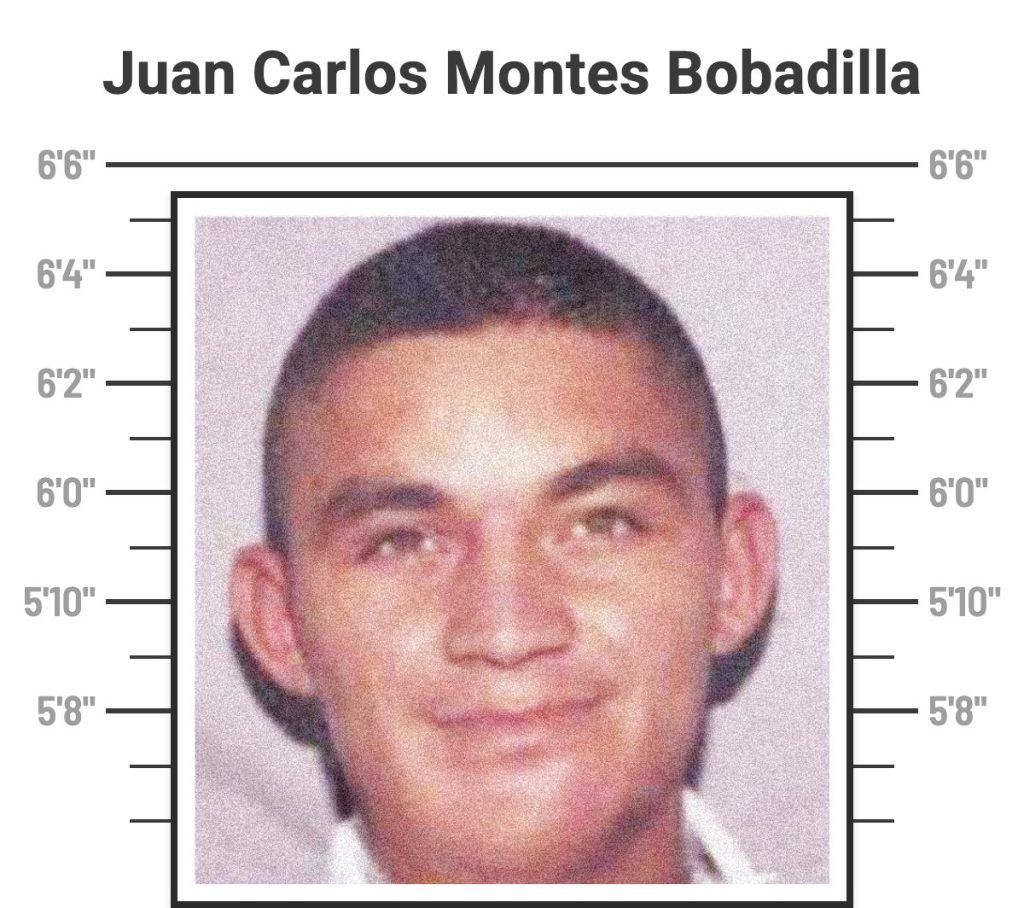
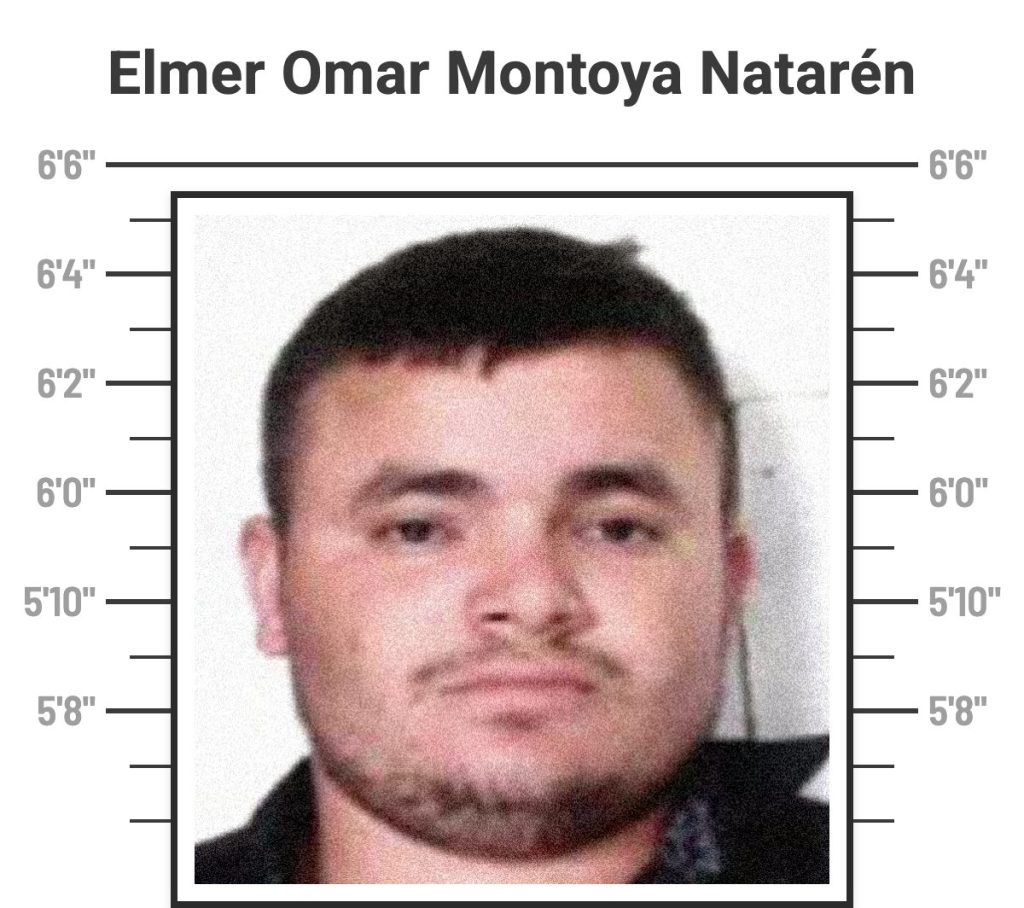
It is easy to tell when one of the brothers, Milton, is in the area, according to one community member who spoke with InSight Crime on condition of anonymity for fear of being identified.
“First, the police set up a checkpoint. Then a man arrives on a motorcycle, like a flag going up,” he said. “Then Montoya’s car goes by, followed by another with his bodyguards, and at the end, more motorcycles.”
At night, the traffickers’ control over the area is even more evident, the residents added. Checkpoints staffed by men without uniforms appear on the area’s only road, and residents don’t leave their homes after 9 p.m.
After witnessing such criminal governance in action, it came as little surprise to many in the community when the government commission sent to help them secure their lands turned and fled in 2024.
“That’s how far it has gone: Organized crime has more control and more power than the state itself. And the state uses that as an excuse not to comply with the ruling,” OFRANEH lawyer Caleb Navarro told InSight Crime.
On the Wrong Side of the Law
In addition to Punta Piedra, three other Garífuna communities—Triunfo de la Cruz, San Juan and Cayos Cochinos—have won rulings from the IACtHR. While drug trafficking is not such an obvious presence in the other Garífuna communities, leaders say they have also faced threats from shadowy forces allied with the big business interests staking a claim to their lands. And, in a bitter irony, leaders of these neighboring communities have found themselves accused of organized crime.
On June 26, the Honduran Congress passed the 2026 Agroindustrial Law to boost business in the agriculture, energy, livestock, and tourism industries. The law declares that the state has “an immediate obligation” to protect areas outlined for these industries by using “preventive evictions.”
The day after the law passed, the National Police issued a circular ordering evictions to be carried out. Days later, La Prensa reported that at least 1,000 eviction orders were ready to be executed nationwide. Despite the IACtHR ruling, the Garifuna of San Juan were among the targets.
Early in the morning on July 6, police arrived in full force to remove the Garífuna from San Juan. There were hundreds of officers, said Garífuna representative Deinor Osmany Mejía Arzu, who filmed the encounter. His video shows police with riot shields, guns, and batons facing off with community members asking for calm and pointing out that there are women and children present.
The scene turned violent, with police hitting protesters and setting off tear gas, Deinor said. He and four companions were arrested and charged with “aggravated usurpation,” or illegal squatting.
“It’s not about who has rights, it’s about who has money,” Deinor said. “This evil law is to legitimize the displacement of people and delegitimize their struggle.”
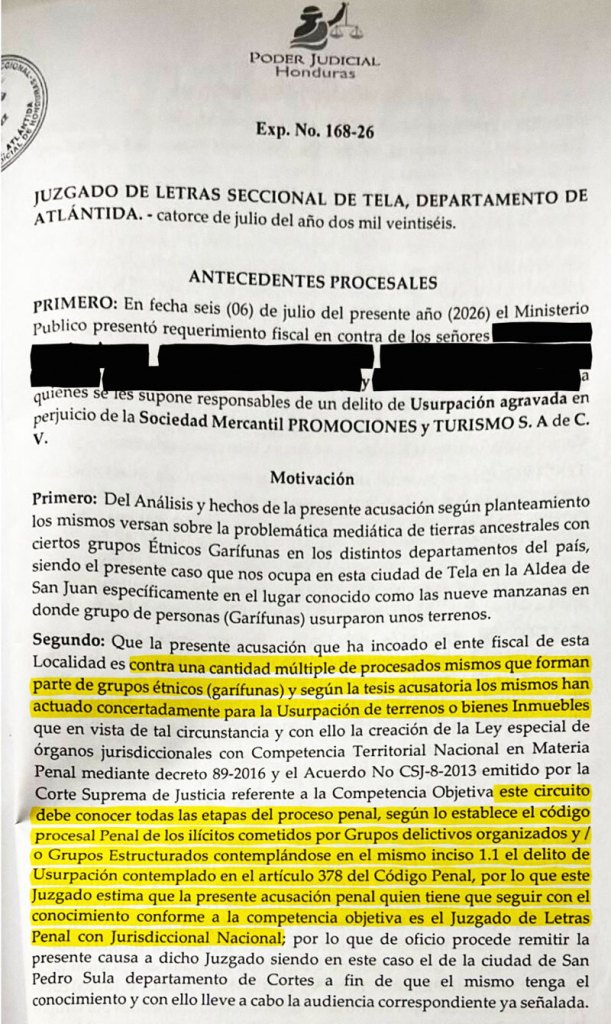
Deinor and his associates found themselves not only accused of squatting their own lands, but of running an organized crime network. The local judge, citing Honduras’ penal code, which considers three or more people coming together to commit a crime to be an organized crime group, referred the case to the specialized national criminal court.
In response, on August 10, Garífuna communities and the OFRANEH set up a protest camp in Tegucigalpa. Called “Viva Berta” in honor of the murdered environmental leader Berta Cáceres, the camp houses hundreds of Garífuna and their allies in a sprawling neighborhood of tents nestled in the curve of a highway off-ramp in front of the Honduran Supreme Court.
InSight Crime visited the encampment as part of an international delegation organized by OFRANEH and its partner organization, the Mesoamerican Initiative of Women Human Rights Defenders (IM-Defensoras). During the visit, representatives of the delegation met with three Supreme Court justices, who promised to present the delegation’s demands to the president of the court. InSight Crime also attempted to contact the Public Prosecutor’s Office but had not received a response by the time of publication.
The specialized organized crime court sent Mejía Arzu’s case back to the local court a few days later, but the Garífuna have remained in the camp, demanding that the government dismiss the case against the five Garífuna arrested in San Juan, and finally comply with the IACtHR’s rulings, even if it means wresting territorial control back from criminal interests.
“We have a long legacy of resistance, and that gives us the strength to keep going,” said Miriam. “The state has a debt to settle with the Garifuna people.”
Cover image: The entrance to the Garífuna’s “Viva Berta” encampment in Tegucigalpa, Honduras. Credit. Liza Schmidt