


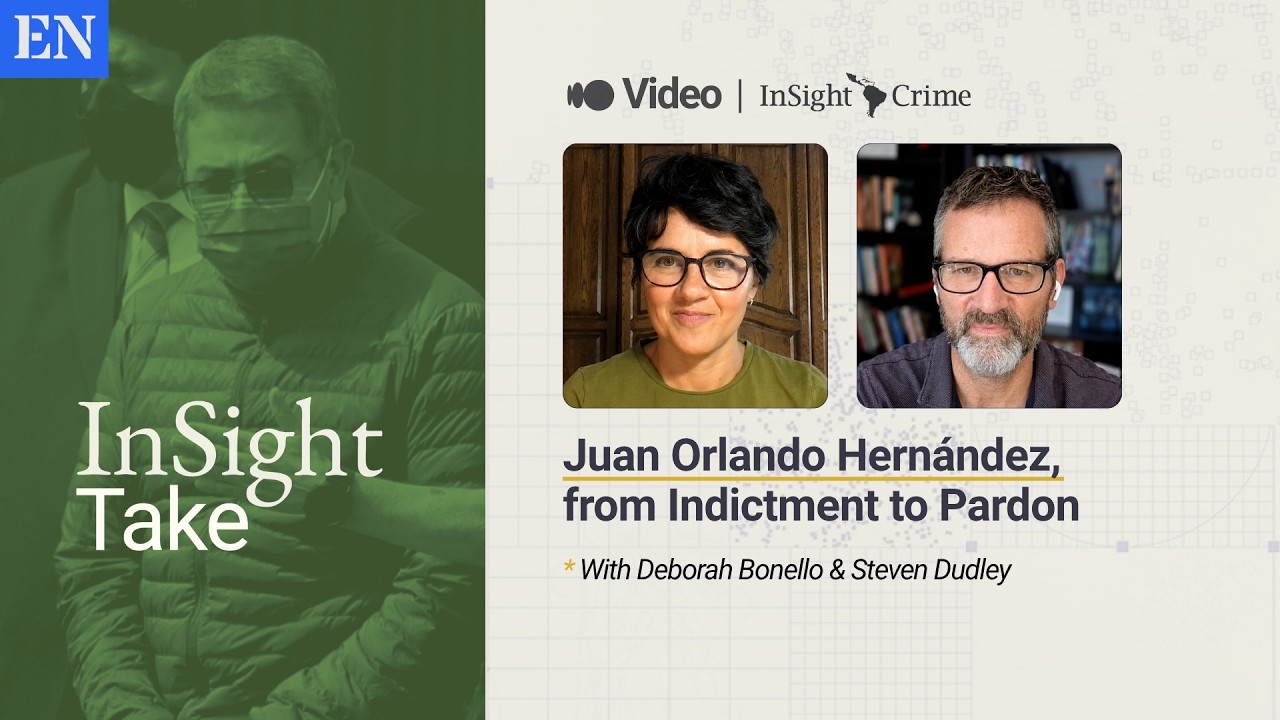
From the halls of presidential power to a 45-year prison sentence for drug trafficking, and then an astonishing return to freedom: This week, we take a look at the remarkable story of the former president of Honduras, Juan Orlando Hernández (JOH).
Once championed as an ally of Washington in the fight against drugs, JOH was extradited shortly after finishing his term in early 2022 and convicted on drug trafficking and weapons offenses in New York in March 2024. Prosecutors argued JOH used the entire state apparatus—including the military, police, and courts—to protect drug interests. His conviction was celebrated by scores of Hondurans tired of impunity, but his sudden and controversial pardon by President Donald Trump at the end of 2025 flipped the script.
On July 26, JOH returned to Honduras after the country’s Supreme Court suspended an arrest warrant against him for corruption charges. There are now concerns that the country’s weak justice system and the return of JOH’s party to power will see the former president acquitted.
InSight Crime’s Managing Editor Deborah Bonello speaks to Co-director Steven Dudley about JOH’s twisting tale, from indictment to pardon.
Transcript
Deborah Bonello: [00:00:00] Juan Orlando Hernandez was once Washington’s man in Honduras. When he was president, he spoke the language of security and migration cooperation, police reform, gangs, drugs—all the key words that prick up ears in the White House. And then, a US jury found that, behind that image, he allegedly had helped turn Honduras into one of the most important cocaine trafficking corridors in the hemisphere. And allegations turned into a conviction, and in March 2024, he was sentenced to 45 years in prison. And then, another extraordinary twist: President Donald Trump releases him and pardons him at the end of last year, just in time for Christmas.
SEE ALSO: The Drug Case Against the Former Honduras President Trump Pardoned
Deborah Bonello: [00:00:52] This is the InSight Take. I’m Deborah Bonello, managing editor of InSight Crime.org, and I’m joined today by our co-director, Steven Dudley. Steve, you and I have covered narcopolitics across Latin America for years, and even by those standards, this is a pretty wild story.
Steven Dudley: [00:01:11] Wild indeed. You know, I think part of the reason it feels so crazy is that this guy wasn’t a marginal figure—he wasn’t just a mayor of a rinky-dink town; he was the president of a country, the president of Honduras! And more than that, he built his entire career around being this top security ally for the United States. He could control the gangs; he could control drug trafficking. And he worked hand-in-glove with the United States for years. All of this under the guise that he was making Honduras more stable. But what the case showed, anyway, was that he wasn’t doing that. He was using those same institutions in favor of many drug trafficking interests.
Deborah Bonello: [00:02:14] Yeah, it’s not just a story about a corrupt president. I mean, it’s very hard to be a corrupt president in a straight system and vice versa. Right? It’s about how the entire system—the political parties, the arms of the state, the police, the military, the courts—all of these parts of the government were involved. It wasn’t just him taking a bribe, you know? I remember when I was at the border of Honduras with Guatemala, where the Valle Cartel was once based—or is still based, let’s be honest, just the younger generations. I was told by people there who I spoke to that the police were paid for and equipped by the Valle Cartel, not by the government—the working vehicles they had, the gas they had was paid for by the Cartel. And villagers said that Joaquín “El Chapo” Guzmán—who is now, of course, doing life in the States—during his time on the lam, was a pretty good friend of the Cartel. The Valles were transporters for the cocaine that Guzmán’s Sinaloa Cartel moved. And he was something of a regular figure there with the villagers, would pop up in local religious festivals and what have you. And reportedly El Chapo sat at a table with Juan Orlando Hernández’s brother Tony, alongside the Valle Cartel in a meeting that brought money from the Valles and El Chapo into Juan Orlando’s eventual bid for the presidency, which he won.
Steven Dudley: [00:03:57] Yeah. I mean, and if we take a step back, this was a time period in which Honduras had transformed itself into this crucial land bridge, even more so than it had been in the 1980s, during which it was a very important land bridge, and there were very important figures that were working closely with Colombian groups. Well, by the early 2000s and then the 2010s, we’re talking about this being one of the main land bridges through which cocaine is passing. But the geography of this does not explain everything. You know, in order for this to happen, you have to have police that look the other way; you have to have access to ports and roads and airstrips. And you need politicians at the highest levels and ministers. And the drug traffickers had both. I mean, if we just take what the prosecutors argued inside the New York courtroom, it was in essence that Juan Orlando Hernández provided the entire architecture of these protection mechanisms. I mean, he had everything at his disposal in order to, as they termed it, you know, jam the cocaine—and I quote here—”right up the noses of the gringos.” You know, this was stuff that was coming out of this New York courtroom: that this president of a country was jamming cocaine up the gringos’ noses. So this is really something to have it go from this kind of accusation—and for it to be proven in court, or at least adjudicated the way it was adjudicated in court, where this guy lands in the United States prison—and then completely flipped to now, “Oh, well, now we can let him go” is just a crazy, crazy situation.
Deborah Bonello: [00:06:18] It is crazy. And you know, we reported extensively on Honduras and JOH, as he’s known at home, before his pardon. I think we have his entire criminal history on the site in various work that we’ve done and the elites that were around him. He came out of Gracias Lempira, of course, in western Honduras and becomes a congressman, I think in the late 1990s, and then eventually becomes the president of Congress, which makes him, you know, one of the most powerful figures in the National Party. So by the time he wins the presidency in 2013, allegedly with $1 million in help from Chapo Guzmán, he’s already created this sort of narcopolitical ecosystem. And then he starts backing for the return of extradition between Honduras and the United States. Which is just a crazy kind of parallel strategy of his to take whilst he’s sort of aiding and abetting the cartels. He’s telling the Americans, yes, you can take our biggest and baddest drug traffickers—traffickers he was also allegedly protecting at the time and helping at the time. So he was walking, if we are to believe, you know, he was walking a very dangerous tightrope back then.
Steven Dudley: [00:07:43] I mean, yeah, tightrope is one way of putting it. I mean, the other thing to think about is that, he was allegedly also receiving monetary contributions from these drug trafficking figures, and from the court documents, we can see that allegedly this was in return for his support to not be extradited. And what does he do? He starts to extradite them. So, there’s a little bit of a contradiction there, and certainly that played into some of his defense, like, “Hey, I wasn’t protecting these guys. I was, and my government was, going after these guys.” And this time period in which all of this is happening is a time period in which the drug trafficking organizations in Honduras are being dismantled. Some of these guys, it should be said, were not being extradited; they were handing themselves in. They were seeking to basically use the United States’ system to lower their sentences by cooperating, by, in some cases, tape recording or maybe even video recording, some of the interactions they had with other drug traffickers, with politicians—with prominent politicians and prominent members of cabinets. So those sorts of things. But you know, the case, if it shows us anything, and again, sort of taking a step back, it shows us how the Hernández’s rise to political power was fueled by a lot of this money, and that this money was going through these campaigns. So it’s like one and the same sort of system. Right. And at least according to US witnesses in these US cases, that was what—or at least a good portion of what—propelled him to power. So, there’s just so many kinds of contradictions built into this case.
Deborah Bonello: [00:10:10] Right. And you see how his former investors, if you can look at them that way, you know, these prominent traffickers from the Cachiros and the Valles who then ended up behind bars and who, frankly, were some of the main contributors to the case against him. We have seen that in the case of JOH, we saw that with El Chapo as well, and Genaro García Luna in Mexico, that we are being asked to take the words of convicted drug traffickers to then bring down these high-ranking officials. So there’s no doubt that there would have been some hard feelings there, I think, in terms of, you know, you pay $1 million for protection and you end up in prison. It’s kind of not what you’re paying for. So you can see how it does add complexity to the case and complexity to a lot of the testimony around it. And then of course, there’s Tony Hernández, JOH’s brother, who was convicted before JOH and sentenced, I believe, to life in prison. He has not been pardoned but sort of formed the bridge between his brother’s political world and the trafficking world. He brokered a lot of the meetings between the traffickers that took place. He was a former legislator and then appears to have been kind of a broker who connected the Valles with JOH. So yeah, he was pretty central too, and he’s still sitting in a jail cell.
Steven Dudley: [00:11:38] Yeah, I mean, Tony’s case was the case that bubbled up first. We did a lot of reporting on it at the time, and we were the first to break the story that he was a “person of interest” at the time, this term they use in the Justice Department to talk very vaguely about people who are connected to these drug trafficking interests. And absolutely! I mean, Tony was central. And the testimony around him was extraordinary because it was much more personal. His involvement was much more intimate. He was in vehicles. He was in these meetings. He was actively communicating with people. He was putting his stamp on cocaine loads. This was a much more intimate portrait of a drug trafficking operation and his direct involvement in it than the Juan Orlando case was. The Juan Orlando case was built much more around testimonies, and in some instances, some documentary evidence, but mostly testimonies that he was involved. So this is a different level of involvement. And he was that bridge. He was the bridge between the political world, in particular his brother, and the drug trafficking world.
Steven Dudley: [00:13:27] You know, there are elements of this that are, I would say, less established than others—certainly the Chapo Guzmán part of this is something that’s hard to substantiate. We’ve done a lot of work on this over the years as well, as you know, Deb, and I can tell you from having done three different stories on presidents receiving money from drug traffickers, you are totally reliant on these testimonies because there’s no paper trail—these are stacks of cash passed in suitcases, so this isn’t something that’s easy to establish. But the larger point is really more important, which is that these Honduran traffickers, they needed the Mexican cartels, and they’re part of a sort of larger chain of distribution. And that the Mexican cartels, they need these corridors, right? They need these trampolines, these spaces through which they can move their drugs. And it’s really—the people who can most make these corridors work, they’re the Honduran politicians.
SEE ALSO: Special Series: The Rise and Fall of Honduras Ex-President Juan Orlando Hernández
Deborah Bonello: [00:14:57] Yeah. And I’ve often wondered, Steve, I know we report about corruption so much and about the kind of intersection between the state and drug trafficking. And I often wonder whether people like JOH go into it with that intention, whether they know that entering Latin American politics at most levels requires some kind of relationship with the mafia, with these criminal networks. It is hard to be a straight peg in a crooked shaft—we know that. What’s your view of that? I think there’s this idea that they’re, you know, bad people and on the take, and I’ve always felt like it’s got to be much more nuanced than that.
Steven Dudley: [00:15:44] I think so. I think there are definitely some who may go into it for the wrong reasons, but I think a lot of them go into it for the right reasons, and then they are either either corrupted or they are constantly justifying what they’re doing by saying that this is for the greater good. I think it’s important to remember that Juan Orlando, even while he was doing this, was part of a historic effort to purge the police of its rot. And part of the rot was very connected to drug trafficking, but it was also connected to other activities, including literally murdering people. So there’s something to be said for some work that was being done—that was being done, by the way, in conjunction with a very prominent international NGO at the time. And working hand-in-glove with them, not just on that, but also other issues to do with health and education and other things like that. So, I think that there is a world in which someone could be connected or be working with drug trafficking interests or facilitating some drug trafficking interests while also maintaining their hold on power and thinking, “Well, I’m working for the greater good, and if I were not doing this, were it not for my relationship with some of these drug traffickers—who, by the way, are really forming part of these elite classes—and if I were not connected to them, if I were not taking their money or not getting their support, then I wouldn’t be in power and I wouldn’t be able to do these good things.” So I think that there is an element of this that is about what you mentioned, that there are people who—that there’s a lot of nuance here. This isn’t necessarily black and white.
Deborah Bonello: [00:17:50] Yeah. And that doing a deal with the devil is sort of part of public office in some ways. I don’t know. But whatever were the drivers behind it, Washington did embrace him, and they bought it. They invested in it. They really kind of made him their man, and he was making all the right noises, you know? He cooperated on migration, on drug interdiction, and lots of other bigger issues that weren’t directly related to Honduras, which does raise a pretty awkward question for his relationship with Washington, right? It was weeks after he left office that the charges emerged, right? So that case had been built, had been being built over a series of years, as it usually does take to construct cases like that. So parts of the administration clearly knew or were aware of his nefarious relationships and dealings. Were other parts of Washington not? Did parts of Washington make a willful decision to just look away? What’s your view on how people sort of metabolize JOH and his reputation, whilst he was working hand in hand with them?
Steven Dudley: [00:19:13] Well, I think we have to start with the fact that the US government is not a monolith. And so there may have been parts of the US government that knew more than other parts and that were more troubled by it than others were. I think the US, or members of the US government, also go through some of the same things that I was talking about as related to Juan Orlando Hernández, which is that, for the greater good, we are going to continue to work with this person. Maybe the alternative is worse. There’s certainly that possibility. Having spoken to us a couple of the former ambassadors, I can say that it wasn’t an open-and-shut question necessarily, even though it was a long investigation. And I can say also, having followed the case very closely, that it didn’t parallel his brother Tony’s case. As I was mentioning earlier, it wasn’t an intimate portrait of a drug trafficker, as Tony’s case was, where he was literally in these vehicles, in these meetings, putting his stamp on these cocaine loads, in these telephone calls and communications, you know? That was the picture of Tony.
[00:20:42] The picture of Juan Orlando was, from his perch, he was supporting these drug trafficking interests. And his counter to that—which may have played or not, we don’t know the back and forth that existed about his pardon—was that, “How can you say that when I was arresting these guys, or at least putting them in a position where they felt like they had to hand themselves over, and/or extraditing these guys, and I implemented extradition when it hadn’t been used in Honduras for a century?” So this is, it’s an argument that you have to take seriously, and obviously somebody in Washington took it seriously. I think the other thing that played to his favor was that he obviously ingratiated himself, or at least his circles had ingratiated themselves in the Trump circles, and that, we know, is certainly a factor, or has been a factor, in many a pardon. So listen, everybody is going through their own justification processes when they’re making these arrangements, and there are no perfect partners. And I think when you when you start with that as your baseline, then there are a lot of relationships that are going to look dodgy after the fact. But you may just be justifying them in the moment.
Deborah Bonello: [00:22:17] Right. And I mean, there’s no denying that all of this has been super high drama. I remember seeing JOH in handcuffs, I think it was during Covid, he was wearing a face mask and being led out and put on a plane. Of course, we had heard a lot of allegations against him and his brother in the build-up to the end of his administration, but I’m not sure I ever really, truly thought that that would happen. And clearly, you know, people in Washington bought it or didn’t buy it until they didn’t. And he left office, and he ceased to be quite as useful to them. And I think at the time, it sort of seemed like accountability. And in a country like Honduras, which is rife with criminal impunity, it was and has been one of the most violent countries in the region—a little less so now if we’re to believe the government’s stats. But it does feel like, you know, two years later, and then Trump’s pardon, it feels like accountability is also political.
Steven Dudley: [00:23:29] I mean, absolutely. I think, just going back to the conviction, I think the conviction really did matter. It mattered in the sense that, all the way to the highest levels of politics, you could be held accountable. I mean, the message that that sort of thing sends is tremendous, or can be tremendous. And then to have it completely reversed and now him being back on the stage, or at least partially, is something that is—that has to be—incredibly disheartening. That this could completely flip on its head is just sending what many would say in Honduras, I’m sure, is the exact wrong message, right? That, get into politics, get to the highest levels, ingratiate yourselves with the right people, and you can get away with virtually anything.
Deborah Bonello: [00:24:39] Right. And if you’re the wrong trafficker, you’re getting, you know, bombed in speedboats or arrested whilst you’re still in government, like we saw in Venezuela at the beginning of the year. Like, the mind really does boggle about what happens behind closed doors and, you know, in conversations between heads of state and between people in power on a geopolitical level that gets some people off and other people killed.
Steven Dudley: [00:25:09] Right. Exactly. So now, we’re not talking about justice, we’re talking about politics. That if this person is your person, what they used to say, you know, “The guy’s a son of a bitch, but he’s our son of a bitch,” right? That was the old mantra way back when there were dictators. Well, now we’re not talking about dictators, now we’re talking about drug trafficking presidents. And if you’re the Venezuelan drug trafficking president, you’ve been on the wrong side of the political aisle, well, then you’re in jail. And if you’re the Honduran president and you’ve been convicted of drug trafficking crimes, well, now you’re free to go. And that is, in terms of the message you’re sending for anti-corruption efforts, for rule of law, that is just a really difficult pill to swallow.
SEE ALSO: Special Series: Maduro’s Arrest and Its Criminal Aftermath in Venezuela
Deborah Bonello: [00:26:09] Right. And if we can turn to Honduras momentarily, you know, since before JOH’s pardon, but after his conviction, we released a story about this narco video that connected very prominent politicians connected directly to the current president and convicted traffickers, and it caused a political crisis, I would say, in Honduras: There was a break in the schedule programing on TV where President Castro defended her administration live to the Honduran people. Do you think anything’s better in Honduras, which is kind of the stage on which all of this has played out?
Steven Dudley: [00:26:57] I don’t. I think that the notion that we are and that they are investing in institutions that are going to mete out this accountability has been abandoned. So I think that is really the essence of the larger story, is that these institutions and the institutions that are set up and established to go after these people at the highest levels don’t have the power to do it. They haven’t been equipped with the types of tools that they need, or if they have been, then they’re undercut by the politics. And that is very frustrating given that, you know, we’ve been watching this for 15 years play out and, and while you want to believe that there’s a certain arc towards justice, what we’re seeing is something very different.
Deborah Bonello: [00:28:11] Right? I mean, the rise and fall of JOH is definitely an extraordinary arc, though, I have to say. And the pardon did change the ending and kind of became a cautionary tale about narcopolitics, but I’m not sure whether the tale is just, you know, don’t get caught. I mean, I don’t think anyone was expecting a pardon at the end of that. But once again, Honduras is kind of left to pick up the pieces. Steve, I think we could talk about this endlessly, but we should probably leave it there. Thank you for joining me.
Steven Dudley: [00:28:46] Thanks, Deb.
Deborah Bonello: [00:28:48] You’ve just watched The InSight Take, our weekly video analysis on the biggest crime stories in Latin America. You can find it on our website, in the multimedia section, or on YouTube and Spotify. And if there’s a story or subject that you want us to pick apart, then email me, please, at dbonello@insightcrime.org.
Deborah Bonello: [00:29:07] And also, please, this week, don’t miss the second season of Insight Crime’s Podcast, the first episode of which is out this week. You can watch or listen to it on YouTube or your preferred platform, and hear tales collected by us that go beyond the kingpins and into the very lives of those forced to live with the consequences of their actions and organizations. We hope you enjoy it. And of course, we’ll be back with another InSight Take next week. Bye for now.