


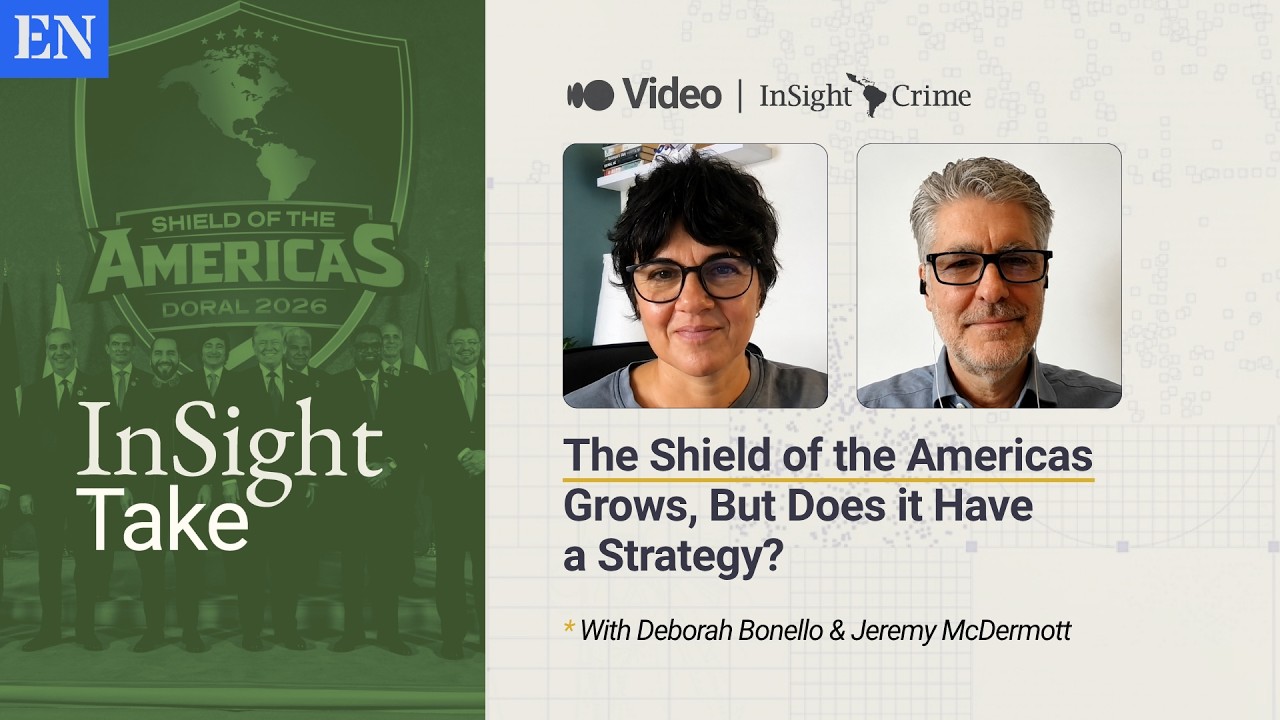
Colombia just became the 19th member of the Americas Counter Cartel Coalition—better known as Shield of the Americas—days after Defense Secretary Pete Hegseth flew to Panama to declare its new motto: “We do bad things to bad people.”
On this week’s InSight Take, Managing Editor Deborah Bonello and Co-director Jeremy McDermott unpack what this fast-growing coalition actually commits its members to, five months after its founding and still without an approved operational plan. With lethal strikes on Caribbean and Pacific boats having killed over 200 people—and no evidence the US drug flow has slowed—they ask whether Shield of the Americas can actually disrupt organized crime.
Transcript
Deborah: [00:00:00] Colombia just became the 19th member of the Americas Counter Cartel Coalition, better known by its public-facing name, Shield of the Americas. We saw Defense Secretary Pete Hegseth fly to Panama to make the announcement personally, and he told assembled ministers and chiefs of defense from across the hemisphere that the coalition’s new motto is “We do bad things to bad people.” He also used the platform to push member states to abandon the International Criminal Court.
Deborah: [00:00:31] So five months after Donald Trump signed the founding proclamation at his Doral resort in March, the coalition has grown from 17 countries to 19 and absorbed a new hardline Colombian government and sits along a parallel campaign, of course, of lethal strikes on boats in the Caribbean and Pacific that has killed over 200 people. We have no evidence that this campaign has interrupted the flow of drugs to the United States. Indeed, the wholesale price of cocaine in the US seems to be at an all-time low. But there have been some shifts in the modus operandi of drug smuggling.
Deborah: [00:01:08] I’m Deborah Bonello, managing editor of InSight Crime, and this week I’m joined by our co-director, Jeremy McDermott, to try to untangle what this coalition actually is, what it commits its members to. And perhaps the biggest question is what it’s actually capable of achieving. Jerry, thanks for joining me.
Jeremy: [00:01:27] Good to be here. Good to talk about something which is essentially going to shape security policy for the next couple of years in the region. Deb.
What is the Shield of the Americas?
Deborah: [00:01:36] I think you’re right. And I think the best place to start, because I think there could be some confusion with our viewers who hear “Shield of the Americas” and “A3C” and aren’t sure if those two things are the same thing or two different initiatives. What can you tell us about that?
Jeremy: [00:01:56] They are the same thing. Two different names for it. The formal name, the Americas Counter Cartel Coalition, came a wee bit later on. The initial use was of the “Shield of the Americas” branding that came out of that founding summit you mentioned in Florida in March, and the two names now seem to be interchangeable.
Jeremy: [00:02:22] Perhaps what’s interesting to focus on is not necessarily the name but how it came about. Before the announcement at the Doral summit, we had Hegseth, we had Stephen Miller, and the Southcom commander, General Francis Donovan, meeting with regional defense ministers in Miami and laying out some sort of groundwork. On March 7, President Trump signed the proclamation in which the Secretary of War established the Americas Counter Cartel Coalition as a military alliance that the White House says is built around a policy to use lethal force against cartel and narco-terrorist networks. That’s the founding document. And it’s worth saying, Deb, that since President Trump took office the second time, he’s put a list of criminal groups on the terrorist list. And, you know, I suspect this isn’t a coincidence. I suspect this is to enable the US to target these different criminal syndicates with less legal risk around it. So now we’ve got 19 countries signed up, with Colombia just literally signing up with the election of President Abelardo de la Espriella, who’s just taken office a bit earlier this month.
Colombia Joins the Shield of the Americas
Deborah: [00:04:00] Yeah. And Colombia joining does feel like something of a big deal because we were seeing a world where Colombia wasn’t at the table, Mexico wasn’t at the table, Brazil wasn’t at the table. So I guess this feels like kind of a positive thing for the coalition, because obviously the former president, Gustavo Petro, himself a former guerrilla, I believe, was not included in the founding meeting. What do you make of Colombia saddling up?
Jeremy: [00:04:28] Well, as you said, Colombia was deliberately left out initially because relations between President Petro and President Trump were very bad. And indeed, the US put Petro onto its OFAC list of people who are liable to sanctions for involvement in transnational organized crime. So that was not an ideal relationship. So for the first five months of this coalition’s existence, the most important cocaine-producing and drug-trafficking nation in the hemisphere wasn’t part of a regional anti-narcotics and crime alliance. So now that de la Espriella has signed up, it does change the dynamics in the sense that we now have perhaps the most important nation, alongside Mexico and Brazil that you’ve mentioned, at least one of them is now part of this alliance. And it means that the ability of this coalition to actually have some effect has increased significantly. Perhaps what’s worth focusing on—and maybe we can pick this up in a bit, Deb—is that this coalition wasn’t founded principally with criminal dynamics in mind.
SEE ALSO: Colombia Criminal Profile
Deborah: [00:05:57] Yeah. I mean, and let’s get into the mechanics because I think what the coalition is is actually quite hard to pin down. So what does membership actually oblige a country to do?
What is Required of A3C Member States?
Jeremy: [00:06:10] That’s an excellent question, and there doesn’t seem to be a clear answer. It seems to be a gathering of like-minded politicians. And this is where we’re waiting in a sense for the rubber to hit the road, in terms of operational scope, defined strategy, and therefore the aims of this coalition. Specific aims in terms of the new sheriff in town, which is how Hegseth and the US are now describing themselves. When I look at the signatories, they are, without exception, nations that are aligned politically with Washington. So there’s a lot of political rhetoric around this. There is, up until now, very little action. And there’s still not any definition of what all these different nations are going to do apart from work together and what the specific targets are, except drug trafficking and narco-terrorism.
Deborah: [00:07:46] Right. And so five months in, the coalition still doesn’t really have a formally approved plan. Meanwhile, we’re seeing the missile strikes in the Caribbean, which have been going on for the best part of a year now. I believe they started in early September, and increasing talk from the Trump administration in terms of taking that campaign to land. We’ve seen those conversations taking place over the last week. How can it not have an approved plan by now? I mean, is that unusual?
SEE ALSO: Special Series on the US Missile Strikes
Jeremy: [00:08:23] Yes, Deb, I think that’s a good word. Let’s look at other US initiatives. Let’s look at Plan Colombia, you know, perhaps the most ambitious US strategy against drug trafficking, which went into effect in the year 2000 in Colombia and had enormous impact. Then, you know well, the initiatives in Mexico and Central America that were very well-thought-out strategies that involved a wide portfolio of tools, not just the military. And they weren’t signed and announced until actually a strategy was in place and often had a document or manifesto attached to them. We haven’t seen this with the Shield of the Americas. So, you know, you and I are going to be largely restricted to a bit of speculation on this front. So let’s, let’s do some speculation.
Deborah: [00:09:30] Well, a little. And what Mérida had, and I’m sure the Colombia agreements too, amongst other things, were some very distinct human rights sort of safety catches in terms of, you know, the way that organized crime and drug trafficking was being attacked. And that brings me to the whole International Criminal Court element of this, which is, again, as much political as it is strategic because Hegseth did layer in that to membership. That he wanted to increase pressure on those companies to essentially abandon the ICC.
SEE ALSO: GameChangers 2025| How the Trump Administration Reset the Fight Against Organized Crime
Jeremy: [00:10:10] Yeah. This has got lots of moving parts, so let’s try and unpack some of it. This is obviously more about Washington’s agenda than tackling criminal threats in the region. And yet, as you correctly say, it’s packaged together as part of this Shield of the Americas, and allies are being encouraged to speak out against the ICC, and this is not to do with Latin America. It’s not even to do with the boat strikes, although that is the ostensible reason that the ICC may come for the different members. This is linked to Gaza and Afghanistan and various other things in the Middle East and other parts of the world. So Washington is trying to bundle quite a sensitive geopolitical issue into this alliance. And if it becomes an actual condition of being a member of this, then that changes the dynamic for the signatories, because it forces them essentially to take a position against international law as we know it. And many of these nations are, of course, already signed up to the ICC. So it’s a huge diplomatic issue. And what are they going to get in return for this?
Jeremy: [00:11:41] Now, at InSight Crime, we are not interested in politics except insofar as they affect policy and strategy against what we study, which is transnational organized crime. The issue of respect for human rights, which used to lie at the heart of US strategy and US aid, has now, of course, slipped very far down the list of priorities and perhaps even disappeared from view. It seems now when I bring this up, not for some liberal perspective, but because our research tells us that governments and security forces need to win over local communities if they’re going to have any chance of really tackling organized crime at its root, because where organized crime works in tandem with the civilian population, it becomes extraordinarily difficult to tackle on any level. And killing people without trial or killing people who you don’t even know who they are, in the case of the go-fast boats, suspending civil liberties, not following international law and due process. These all challenge the legitimacy of the rule of law and therefore state authority and over time, can undermine public support. And so, I worry about, and I’ll return to this, I suspect, in our conversations, short-term tactical gain or victory compared to long-term strategic legitimacy and success. And I feel that you’re going to sacrifice a lot by adopting just this side, the tactical side, in the long-term overarching chances of success.
What is the True Potential of Shield of the Americas?
Deborah: [00:13:34] Yeah. And as you said earlier, it’s hard to speculate on what the coalition is going to achieve given that we don’t really know what it’s setting itself up for exactly yet. But does it have the potential? You know, it’s not new to have regional states agreeing to collaborate with the US. We have seen this on and off for the last 50 years, perhaps not at such a sweeping regional level as we’re seeing now. But, you know, calling on what we already know about other anti-transnational organized crime efforts in the region. What does this new push have the potential to deliver?
SEE ALSO: GameChangers 2025 | US Reignites the War on Drugs and Weakens It for 2026
Jeremy: [00:14:19] I really think we need to be careful that I don’t think this is anything new. I think the rhetoric is new. But the United States has spent the last how many decades persuading, cajoling, and occasionally bullying nations in the region to cooperate with the US and, in many cases, each other in the fight against transnational organized crime. So, you know, this has been the centerpiece of US diplomacy and effort in our region. So let’s not paint this as something “wow” and something completely unprecedented. And we are absolutely in favor of regional cooperation to tackle transnational organized crime. It’s the only way to deal with transnational organized crime. So the idea that these nations pool intelligence, better coordinate training, and cooperate on stemming illegal financial flows, work together in denying safe havens to transnational organized crime networks that don’t recognize borders and move wherever the resistance is lowest. If the Shield of America actually does this and does this better in a well-thought-out and integrated way, then I think this is a good thing. I think it could lead to some real results. So let’s not see this as something completely new. The exclusively military rhetoric and perhaps the submersion of human rights as an element of US strategy and leadership. That’s the really new stuff.
Deborah: [00:16:13] Yeah, I agree there is some repackaging going on here to present this as something of a new idea. And like we say, it’s, it’s far from it. I suppose what’s different to the Mérida Initiative we saw in Mexico, for example, is that this is purely military. And in part that’s to do with the dismantling of USAID and basically the sort of softening of soft power in a sense, which has all but disappeared really from the US’s approach to organized crime here, but have we seen a purely military approach achieve success in the fight against drug trafficking and transnational organized crime?
Jeremy: [00:16:55] I’m going to go back again to tactical success and strategic. But listen, security force pressure is a really important element to any counternarcotics and anti-crime strategy. But in isolation, it’s not been proven to work in the long term. Let’s look at what has worked—what we’ve got concrete examples of.
SEE ALSO: Peace Never Had a Chance: Colombia’s ELN in Venezuela
Jeremy: [00:17:20] Colombia is probably the most concrete example. And when I arrived in the country in 1997, Deb, you know, there was a real threat of Colombia becoming a narco state. The Marxist guerrillas were camped outside and even within the three biggest cities, Bogotá, Medellín, and Cali. The Colombian state could not pretend to claim that it was governing more than half of the national territory. But then US aid in the form of Plan Colombia really was crucial in leading to a weakening of the illegal actors and the demobilization of two of the most powerful drug trafficking organizations, I would say in the world, certainly in the region, which were the United Self-Defense Forces of Colombia, a right-wing paramilitary organization, the AUC. It demobilized more than 30,000 people in this process. And then, the infamous FARC, or Revolutionary Armed Forces of Colombia, a Marxist rebel group: they demobilized 13,000.
Jeremy: [00:18:33] Now, I think it’s hard to understate the importance of these two demobilizations in terms of transnational organized crime, in terms of drug trafficking, and in terms of Colombia’s national security and indeed the security of regions, because many of these groups had a presence outside of the country. But this was not achieved purely through military operations. That was certainly an important part of the equation. But economic and social investment, long-drawn-out negotiations, and political concessions were what carried this over the line. And USAID, which you mentioned, played a significant role in this process. And it was one of the more powerful pieces in the US toolbox to fight transnational organized crime. It’s gone. And the Shield of America seems to be suggesting that it can get things done through purely military tactics and strategy, and history in the region suggests that this is a flawed analysis.
SEE ALSO: Ecuador Criminal Profile
Deborah: [00:19:44] Okay, so let’s take the example of President Daniel Noboa in Ecuador as someone that has embraced both the political and security messaging from President Trump and is a very close ally to Washington. And he has employed a very militarized approach himself, placing gangs on his own terrorism lists and using economic tariffs against other nations. And now there are joint operations with the US on Ecuadorian soil. You know, we’re now two years into this. And what would you say, as an experienced observer of drug wars, have been the results of this approach in Ecuador so far?
Can Military Responses Alone Defeat Organized Crime?
Jeremy: [00:20:28] Yeah. President Noboa’s been the most enthusiastic and earliest recruit to President Trump’s rhetoric and tactics. And you mentioned one of the first things he did upon taking office was to declare the country’s gangs terrorist organizations and to declare an internal armed conflict, which allowed him to deploy the military to take the lead on national security, domestic security issues. And there have been some successes in killing and capturing, you know, the leaders of these groups.
Jeremy: [00:21:02] We know that the so-called kingpin strategy, which is, you know, taking out the leadership, has had mixed results. And in many cases, it’s actually led to more violence and more crime, not less. Yes, there are joint operations with the US forces. There’s intelligence sharing. There’s coordinated maritime operations. Yet so far, our fieldwork in Ecuador over the last two to three years hasn’t found any evidence of a significant reduction in the flow of cocaine through the country. The criminal groups have adapted to security force operations. They’ve become more clandestine, more sophisticated. And one thing that is beyond any doubt is that the level of homicides has reached record levels under President Noboa, and Ecuador’s moved from being one of the safer countries in the region just seven years ago to one of the most dangerous today. Homicide rates have jumped from just over seven per 100,000 in 2020 to 50 per 100,000 last year. So the country hasn’t become safer by unleashing the military. And in fact, it’s become really exponentially more dangerous to live in.
SEE ALSO: Durán: A Window into Ecuador’s Organized Crime Explosion
Deborah: [00:22:30] Okay. So with that in mind, as we look forward to the potential of this new coalition and its impact, its capacity to really impact transnational organized crime and drug trafficking. Is there a version of this that produces measurable results in that—without an architecture that mostly produces a rising body count—and has potential perhaps to produce more diplomatic wins than anything else? How do you see it?
Jeremy: [00:23:08] Let’s be glass half full about this. And let’s look at the more positive potential. I think there is a chance of short-term impact depending on where the resources are directed and whether or not they’re deployed in a systematic and constant manner over a longer period of time. What we’ve seen with the targeting of the go-fast boats, Deb, is it has changed modus operandi. Surprise, surprise, drug traffickers don’t want to use go-fasts as much. So, you know, it has had an effect on routes and on the vehicles or vessels that move drugs. What are going to be the results of this being taken on land and being adopted by all the nations that have signed up to Shield of the Americas, assuming that their constitutions allow them to deploy with the US, which I think people haven’t really been talking about. It’s not like the president can just turn around and go, “Sure, American troops just come in and fill your boots. No. The Constitution in many countries prevents foreign nations and foreign troops operating on their soil without the approval of Congress, and perhaps even Constitutional Courts. So let’s not get lost in the weeds. We’re a glass half full. So if this is applied in a strategic and constant way, it may well change criminal dynamics.
The Adaptability of Organized Crime
Jeremy: [00:24:50] One thing we’ve learned, Deb, in all of these years of looking at transnational organized crime is that it’s the most agile business in the world. It quickly adjusts to changing conditions. And if it has any infrastructure or leadership that is vulnerable to military strikes or operations, then it’s going to move to lower the risk by becoming more clandestine, hiding among the civil population, or maybe going like in the case of Mexico and the Jalisco cartel, which armed up its cartel, issued body armor, armored vehicles, point fives, and in certain, you know, scenarios took on the security forces head-on. So if we’re talking about, again, military action in isolation, there may be some tactical victories. It may force change to criminal dynamics.
SEE ALSO: Mexico Criminal Profile
Jeremy: [00:25:50] But this isn’t really going to have any long-term effect unless the planners are thinking about what to do next. Knowing that organized crime is going to adapt, they need to be playing 3D chess, and they need to be thinking, you know, how are they going to react? And we’re going to anticipate this by doing X and Y. The problem is the military toolbox is very limited. And if they hide in the civilian population, if they don’t present any targets for the military, then the military becomes a blunt and maybe even counterproductive tool in this fight, and we’ll see organized crime deepen its ties with local communities, broaden forms of criminal governance, and it may be that this particular cure worsens the disease rather than moves the dial in a long-term and strategic way to help Latin America contain and hopefully begin to dismantle transnational organized crime and drug trafficking.
Deborah: [00:27:07] Yeah. I mean, this feels like a good place to leave it. We could talk about this forever. We didn’t either sort of go into the issue of how criminal organizations are embracing cybercrime. They’re embracing crypto and so much…
Jeremy: [00:27:24] Drone warfare.
Deborah: [00:27:26] Yeah. So much technical innovation is happening within those criminal organizations, which governments are already behind on. So I think the devil really is going to be in the detail of the strategy of how they’re going to move forward in the coming months and years as to whether it’s going to produce any evidence that it’s working. And, of course, we’ll be watching pretty closely for that strategic document, or that strategic clarity, if it comes right. Jerry.
Jeremy: [00:27:57] Oh, yeah, we will pick it apart, assuming there is something to pick apart.
Deborah: [00:28:03] Well, thanks very much for joining me. And to you watching the Insight Take. Thanks for tuning in to our weekly video chat analysis on what are the biggest crime stories in Latin America. You can find it on our website, in the multimedia section, as well as on YouTube and Spotify. If there’s a story or subject you’d like us to take apart, please do reach out to me at flagship@InSight Crime.org and we’ll be back with another Insight Take next week. Bye for now.