


“Socalj” for Borderland Beat
For a detailed history of the crimes and corruption that Genaro Garcia-Luna stands accused of, follow this series by Borderland Beat founder “Buggs” on the former Secretary of Public Security for Mexico.
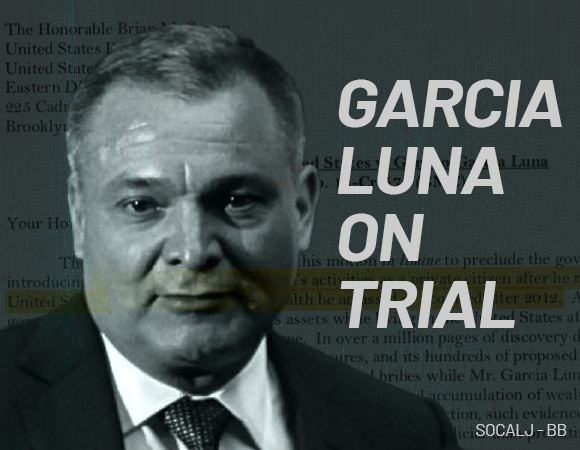 |
| Over 3 years after his arrest in Dallas, Texas; the trial of Garcia-Luna officially started. |
This article will outline the recent developments leading up to the trial that began this week with jury selection. As more information, details, and witness identities become available throughout his trial, Borderland Beat will look to not only report on but analyze these facts within the context of the past and current drug war in Mexico.
 |
Charges Against Luna
Led by Breon Peace, a team of five prosecutors from the Department of Justice intends to prove, before Judge Brian Cogan, that the Sinaloa Cartel corrupted García Luna and bribed him and others with millions of dollars in cash in order to reach the highest levels of power within the Mexican governments of Vicente Fox and Felipe Calderón. García Luna was the top security officer in Mexico between 2006 and 2012, during the government of President Felipe Calderón, and had previously directed the extinct Federal Investigation Agency between 2001 and 2005, in charge of fighting corruption and organized crime.
Cocaine Importation, Distribution & Conspiracy
Making False Statements

Prosecution & Defense Motions
 |
| Additional documents were provided this month in an effort to show that the conspiracy he is accused of resulted in criminal acts in the US stemming from the drug trafficking he allowed to take place. |
The documents were confiscated on September 13, 2008, others on March 18, 2007, January 28, 2003, August 16, 2002, May 24, 2002, and February 2012; these were during the presidencies of Fox and Calderón. The other five pages with classified or protected information include translated letters and documents, birth certificates, information on immigration issues, pages that intentionally do not describe their content, and others.
 |
| Luna with then-US Secretary of State Hillary Clinton in 2009 during her visit to Mexico. She wrote a letter in support of Luna during his US Visa application in 2013. |
 |
| The DOJ filed a motion to preclude the defense from offering into evidence any photographs of Luna meeting with US officials. |
According to the file shared by the journalist Keegan Hamilton through his Twitter account, in an interview after his arrest, the defendant lied about and even denied having met with a group linked to drug trafficking.
 |
| Luna’s defense looks to limit any mention of his wealth during the trial. |
The most recent motion filed by the defense seeks to limit any mention of his wealth from the trial. Stating that his millions have come from private companies. “The government cannot establish a connection between the alleged bribes when he was a government official in Mexico before 2012 and exposing the accumulation of wealth or luxuries after 2012 when he was part of a private business,” wrote César de Castro. “When Calderón’s presidency ended, García Luna retired as a government official and moved to Miami, Florida, where together with partners he established a business that offered security advice to foreign companies and governments,” lawyer De Castro clarifies.
The defense also notified the judge that the Mexican government accuses Luna of stealing over $250 million from that country. This was supported by García Luna’s lawyers in the investigation that the Financial Intelligence Unit of the Ministry of Finance and Public Credit (SHCP) of Mexico opened against him in 2019.
But, according to the indictment, on two occasions, the cartel personally delivered bribe payments to Garcia Luna in briefcases containing between $3 and $5 million. Based on financial records, by the time Garcia Luna relocated to the United States in 2012, he had amassed a personal fortune of millions of dollars.
 |
| The defense countered the prosecution’s motion to preclude evidence of meeting and working with US officials and law enforcement, stating that many of the potential witnesses were arrested and extradited to the US during Luna’s tenure. |
Potential Witnesses
Following a request by the defense, and approval by Judge Cogan, the Department of Justice has promised to inform García Luna’s defense of witnesses it plans to bring no less than 3 days prior. This, however, mostly applies to specialists, law enforcement, and other witnesses including officials from all levels of government, federal agents, forensics, and specialists in finance, biometrics, and cyber communications.
Potential Witnesses

A former prosecutor of Nayarit, Edgar Veytia, could also testify; Colombian kingpins, such as Juan Carlos Ramírez Abadía, “Chupeta,” and the wife of Joaquín “El Chapo” Guzmán, Emma Coronel Aispuro, who is soon to be released could even be called as a witness. We do not officially know the list of bombshell witnesses yet, most notably “La Barbie” who recently, as discovered by Borderland Beat, is no longer listed in BOP prison custody.
The DOJ does not have to disclose the names of these witnesses to the defense team until 24 hours prior to their testimony so that the defense can adequately prepare.
 |
Jury Selection Process Begins
While the trial of Luna began on Monday, January 9, 2023; the first week will consist of jury selection. The pool of 400 potential jurors in New York City will be questioned and the defense and prosecution will dismiss or select jurors reaching a total of 60 by January 17. From there, the final 12, plus alternates will be selected before the core of the trial begins. It is not known currently if the jury will be sequestered due to the nature of the offenses and the attention it is sure to get. And with accusations of Luna threatening potential witnesses while behind bars; the concerns for safety could extend to the jurors.
If found guilty by the jury, García Luna could be sentenced to life imprisonment as the maximum punishment or a minimum of 20 years in prison. Should he decide to forego the trial and change his plea to guilty, it is likely that sentence could be around 7-10 years in federal prison. Currently, Luna is being held at MDC Brooklyn, a common holding facility for federal prisoners on trial including mobsters, and terrorists.
Sources Proceso, Proceso, Proceso, Procesco, Proceso, Keegan Hamilton, Borderland Beat, El Pais, DOJ, DOJ, Mexico News Daily, DOJ