


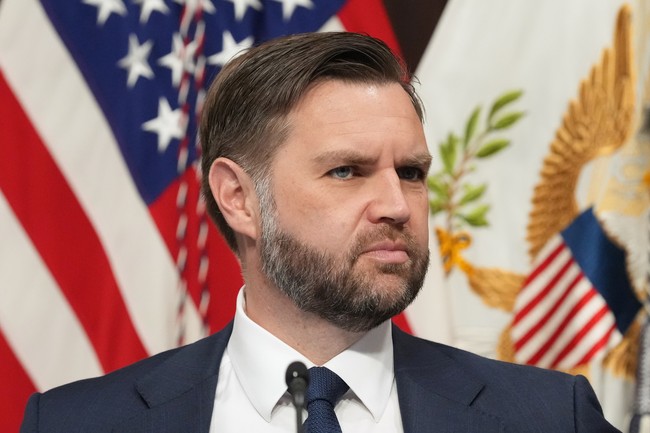
On Thursday, Vice President JD Vance took to the podium at the White House press briefing, something he hasn’t often done; but the vice president had some specifics to lay down for the assembled media on Iran and the new Iran deal’s effect on energy prices, and lay them down he did.
Advertisement
First, on the opening of the Strait of Hormuz and the effect on gasoline prices:
.@VP: “Last night, 12.5M barrels of oil went through the Strait of Hormuz. That is a high since the beginning of the conflict. Oil prices are down nearly at their level from the pre-war [level]. Gas prices dropped below $4/gallon today for the first time since the conflict, and… pic.twitter.com/3TRvwCBVRM
— Rapid Response 47 (@RapidResponse47) June 18, 2026
The vice president said:
First of all, I think the president’s peace plan in Iran is already bearing real fruits for the American people. Last night, 12.5 million barrels of oil went through the Straits of Hormuz. That is a high since the beginning of the conflict. Oil prices are down, nearly at their level from the pre-war conflict (sic), gas prices dropped below $4 a gallon today, for the first time since the conflict. And, importantly, they’re going to keep falling further, given how low oil prices are.
On the military side, the Iranians, for the second night in a row, did not shoot at any ships in the Strait of Hormuz; so far, they are honoring their end of the commitment. And on the blockade, CENTCOM has allowed north of a dozen ships to go through our naval blockade, and so we’re honoring our end of the early part of the agreement. On the military side, there are a couple of things that are still true and will be true whether the Iranians comply with the rest of the deal or not. Number one, their nuclear program has been completely destroyed. Their capacity for enrichment, the facilities at which they were using (sic) to develop enrichment, to develop potential nuclear weapons, those facilities are still destroyed. Their conventional military is still destroyed. Their capacity to threaten their neighbors is still largely gone. And now, we see if they are willing to comply with the next step of the president’s peace plan.
Advertisement
As of this writing, US oil futures are at 74.17, down from a mid-April high of 116; UK (Brent) oil futures are at 77.78, down from a mid-April high of 110. Also as of this writing, nationwide average gasoline prices have dropped below $4/gallon. That could be better, but at least it’s moving in the right direction.
Read More: The Proposed US-Iran Framework Warrants a Closer Look
First Look: White House Reveals Key Terms of Trump’s Iran Framework
The vice president also had some comments on Iran’s trustworthiness.
.@VP: “I’ve seen skeptics of the deal, people say, ‘the Iranians will never change their behavior!’ Well, maybe that’s true, and if so, they don’t get ANY of the benefits of the bargain—but isn’t it worth trying? Isn’t it worth seeing whether this incredibly weakened position… pic.twitter.com/A0D6TenzxU
— Rapid Response 47 (@RapidResponse47) June 18, 2026
In this segment, the vice president said:
You know, I’ve seen skeptics of the deal, people say the Iranians will never change their behavior. Well, maybe that’s true, and if so, they don’t get any of the benefits of the bargain. But isn’t it worth trying? Isn’t it worth seeing if this incredibly weakened position that the President of the United States has put the Iranians under, whether that motivates them to change their behavior? Not just vis-à-vis the West, but vis-à-vis the Middle East. Now, one of the interesting things about this is, you know, the technical details of this; we can of course get into. There are going to be any number of opinions about negotiation, about where it’s ultimately going to go, but I tend to think you should trust the people who know the Iranians the best, and who have the most to lose.
What are the Gulf Arab states saying about this deal? What are they saying about this deal compared to the JCPOA in 2015? This is the Obama nuclear deal. Well, back then, they hated that deal. They felt like it empowered the Iranians to be bad actors across the region, and of course, that’s exactly what happened. They were right about that. What are they saying about the president’s peace deal? They’re saying this is an amazingly transformative thing for the region, because either way, we and the broader region will win. Iran is weakened, their nuclear program destroyed, their economy in desperate straits, and if they change their behavior, big things are going to happen for Iran and for the world. If they don’t, no skin off our backs; either way, we win, and that’s the way the president has set up this deal and its negotiation.
Advertisement
The deal appears to turn on that presumption of trust – or, in the case of Iran, that they can’t be trusted. If they renege on any of their obligations, there will be consequences. If they don’t – they could be selling oil on the open market, and coining money. That would be good for the Iranian people, but we should bear in mind that, since 1979, Iran’s leadership hasn’t been overly concerned with what’s good for the Iranian people.
With a dash of luck, that might change now. It’s still not completely clear who’s really in charge in Iran right now, but surely there are a few people in that country’s civil government who have some idea of the opportunity that has been placed before them. Over the next few weeks, months at the most, we’ll see how that develops.
Editor’s Note: For decades, former presidents have been all talk and no action. Now, Donald Trump is eliminating the threat from Iran once and for all.
Help us report the truth about the Trump administration’s decisive actions to keep Americans safe and bring peace to the world. Join RedState VIP and use promo code FIGHT to get 60% off your VIP membership.