


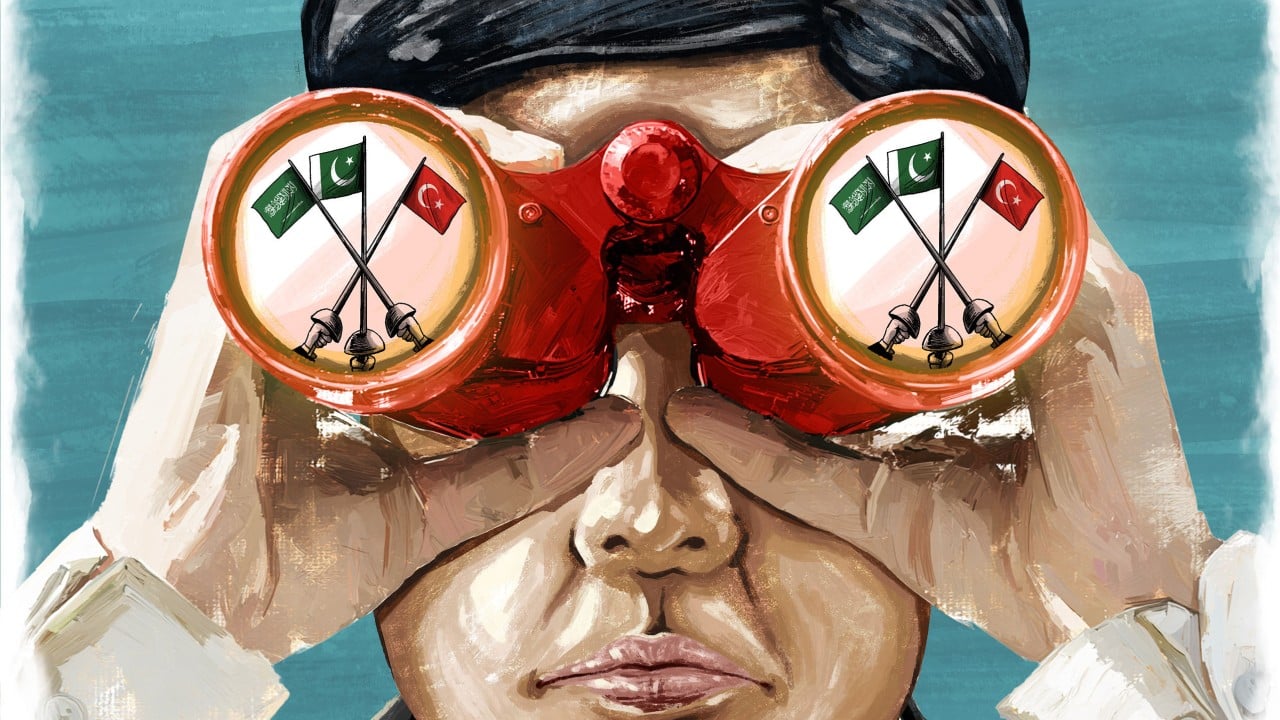
When Saudi Crown Prince Mohammed bin Salman, Turkish President Recep Tayyip Erdogan, and Pakistani Prime Minister Shehbaz Sharif signed the Mecca defence agreement, they executed a structural overhaul of the Middle East’s security architecture.
The pact codifies a defence commitment, where an armed attack on one is treated as an assault on all. Building upon September’s Saudi-Pakistan defence agreement, this tripartite arrangement bridges the financial capital of the Gulf, the industrial-military muscle of a Nato member and the operational capacity of a South Asian nuclear-armed state.
For Ankara, it is the ultimate vehicle to project power across the Islamic world under its “Asia Anew Initiative”, expanding its defence export footprint, anchored by Bayraktar drones and fifth-generation Kaan fighter jets. For Islamabad, it secures Gulf financial lifelines and energy supplies, while elevating its military elite to indispensable regional power brokers.
Ideologically and geopolitically, the Mecca pact represents a pragmatic realignment towards regional self-reliance. While some observers label it an “Islamic Nato”, the comparison is functionally flawed.
Unlike the transatlantic security alliance, which relies on a rigid, institutionalised command structure, integrated command hubs and shared doctrine under American hegemony, the Mecca pact is seen to be operating as a flexible, transactional strategic coalition. It lacks a permanent bureaucratic headquarters, relying instead on state-to-state defence integration, intelligence sharing and defence-industrial co-development.