


“Char” for Borderland Beat
This article was translated and reposted from RIODOCE
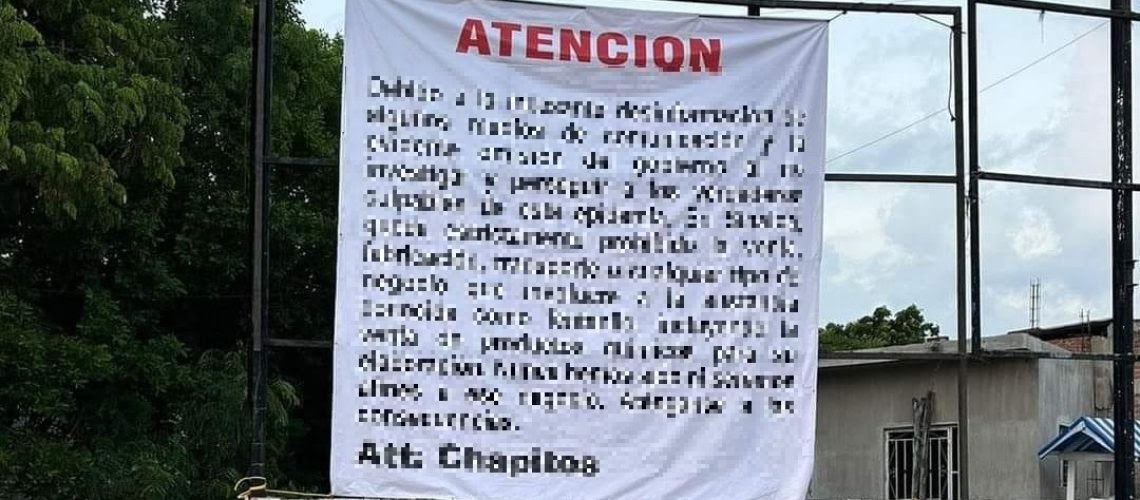
In Sinaloa it is strictly forbidden to do business with fentanyl.
They were everywhere. In Culiacán, El Rosario, Angostura, Guamúchil… Later it was learned that they were also in Sonoyta and Caborca, in the state of Sonora.
The message was from Los Chapitos, or so it is presumed. As if they were the government, they decreed categorically: “In Sinaloa it is strictly forbidden to sell, manufacture, transport or any type of business involving the substance known as fentanyl… Be aware of the consequences.”
Days later, senior security officials from Mexico and the United States would meet to discuss a bilateral strategy to stop the production and trafficking of Fentanyl, as well as an alternative plan to regulate the migration crisis; the Mexican delegation would insist on a measure to end the trafficking of weapons coming into Mexico.
“We must join efforts to implement joint actions to combat synthetic drug trafficking, but at the same time urge the U.S. government to prevent weapons from continuing to arrive in Mexico, and arming criminal groups,” said Alicia Bárcena Ibarra, head of the Mexican Ministry of Foreign Affairs (SRE).
The security meeting, held in one of the halls of the National Palace, came amid an unprecedented campaign initiated by the sons of imprisoned drug trafficker Joaquín Guzmán Loera, who months ago banned the production and trafficking of fentanyl in Sinaloa. And just last Tuesday, the ban migrated to the Altar area of Sonora, where several narcomantas warned other drug traffickers not to produce the drug, or else they would “face the consequences”.
The meeting, however, titled “High Level Security Dialogue,” did not mention the narcomantas or the actions taken by Los Chapitos, but focused on how fentanyl continues to be a problem for the United States, despite the seizures that have been made in Sinaloa, and the arrest earlier this year of Ovidio Guzman Lopez, who the DEA considered the mastermind for the manufacture and trafficking of fentanyl.
It was precisely Antony Blinken, U.S. Secretary of State who, contradicting public statements made by President Andrés Manuel López Obrador and ratified by the Secretary of Public Security Rosa Ícela Rodríguez Velázquez during the meeting, mentioned that the fentanyl that is sent to the United States and that is killing hundreds of thousands of users of this drug is indeed produced in Mexico.
“There must be some kind of fentanyl arriving in Mexico and, yes, it does indeed go to the United States, but I insist that Mexico does not produce fentanyl, I want to say it very clearly,” said Rodríguez Velázquez in response to expressions of displeasure from U.S. officials.
That statement was refuted by Todd Robinson, head of the State Department’s Bureau of International Narcotics and Law Enforcement, who said earlier that fentanyl is indeed being manufactured in Mexico, although he acknowledged that the precursor chemicals used to make it do come from China.
Personal Brand
Beyond the contradictions of whether or not fentanyl is produced in Mexico, Mexican authorities have seized impressive quantities of this drug and methamphetamines, although it is clear that both governments have focused exclusively on Sinaloa, where it seems all resources have been allocated and all operations have been applied to dismantle laboratories, as shown in a table from the Ministry of Defense, where the difference can be seen.
According to a chart from military authorities to which Ríodoce had access, 89 percent of the laboratories that have been secured during López Obrador’s administration have occurred in Sinaloa, while in a distant second place is the state of Durango with 4 percent, and Michoacán and Jalisco with 3 and 2 percent respectively.
Sources close to criminal groups in other states, to whom this weekly had access, revealed that they are happy that this is the case, because, although they are also producing fentanyl in their territories, it is better for the operations to remain in Sinaloa.
“Fentanyl is produced here, but we don’t want the ground to heat up like in Sinaloa,” said a cook, who spoke on the condition that his name and the group he works for would not be revealed, and only limited himself to saying that he was between the borders of Michoacan and Jalisco.
Just last Friday, elements of the Mexican Navy located and destroyed six clandestine laboratories where synthetic drugs were produced in the municipalities of Cosalá and San Ignacio, in Sinaloa. The Semar report does not specify whether fentanyl was being produced in those places.
“The government is pretty tough,” commented a young cook, contacted for this report.
For Merrick Garland, that personal brand will continue indefinitely, because after thanking the Mexican government for the extradition of Ovidio Guzmán, he said he hopes he is not the only son of Guzmán Loera they have in their possession.
“He certainly won’t be the last,” Garland said during the meeting.
Also present at the meeting were Alejandro Mayorkas, U.S. Secretary of Homeland Security, Rafael Ojeda, Secretary of the Navy, and Luis Cresencio Sandoval, head of Sedena.
Article published on October 08, 2023 in the 1080th edition of the weekly Ríodoce.