


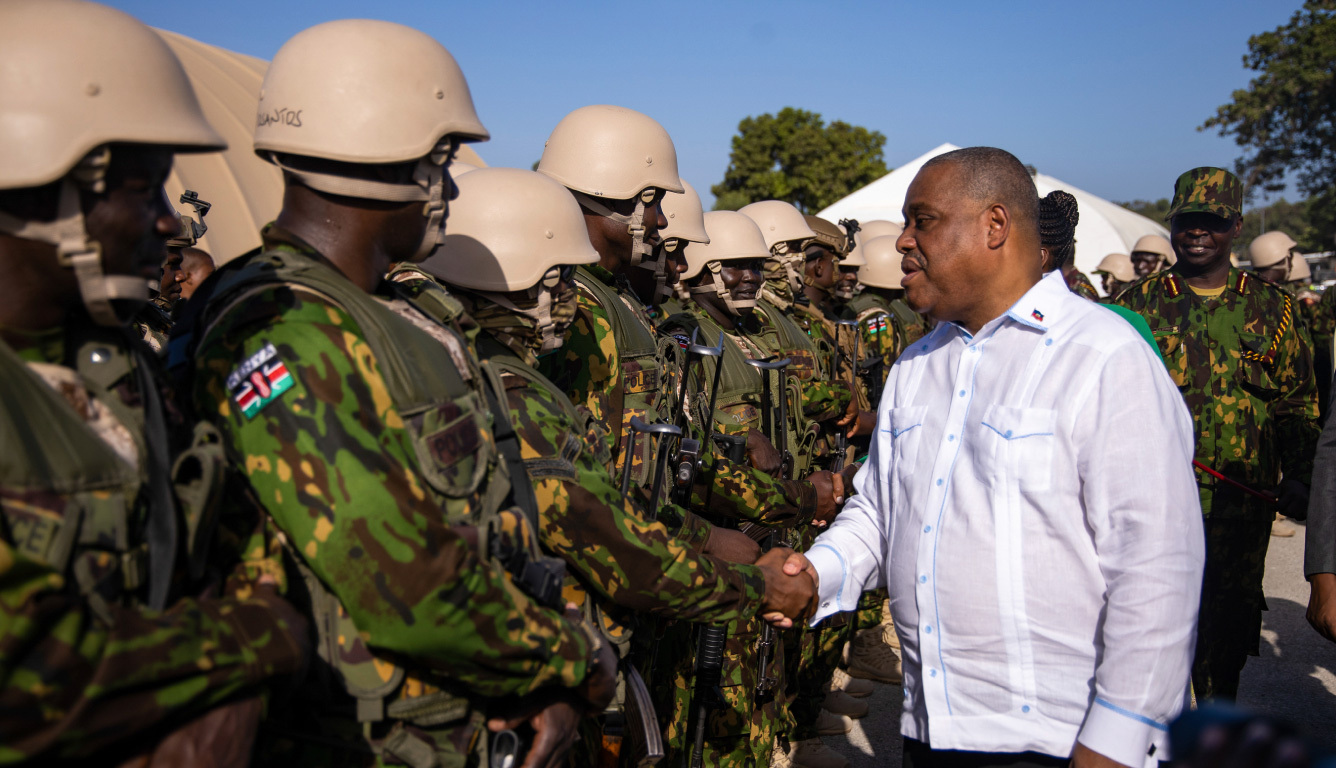
As hundreds of Kenyan police officers work to support Haiti’s embattled police force, concerns about their ability to thwart the country’s powerful street gangs are growing.
The second contingent of 200 Kenyan police officers arrived in Haiti on July 16, joining 200 of their compatriots who landed on June 25. The Kenyans are part of a United Nations-backed Multinational Security Support (MSS) mission, which aims to reclaim the country from gangs that, according to the United Nations, control up to 80% of the capital city, Port-au-Prince.
Following the arrival of the second contingent, an emboldened, newly-appointed Haitian Prime Minister Garry Conille called on the gangs to surrender their weapons and “recognize the authority of the state.” He also announced that 14 areas currently under gang control will be placed under a state of emergency, allowing the government to establish a curfew and prohibit anyone from driving through these areas.
The MSS, approved by the UN Security Council in October 2023, will provide operational support to the Haitian National Police (Police Nationale d’Haïti – PNH), including “planning and conduct of joint security support operations,” according to the resolution.
However, Haitian authorities will have the final word on where the Kenyan officers will be deployed, what their mission will be, and to what extent they can engage with suspected gang members, Carlos Hercule, Haiti’s Minister of Justice and Public Security, said in an interview with Haitian media outlet AyiboPost.
The MSS arrives at a crucial time. The total number of people who have been forced to flee their homes increased 60% between March and June, surpassing 578,000, roughly 5% of the country’s population, according to the UN.
“The entire social fabric of families is unraveling as family members become separated, jobs are lost, schools are closed, and health services collapse,” said Abdoulaye Sawadogo, head of the UN’s Office for the Coordination of Humanitarian Affairs (OCHA) in Haiti.
A Lack of Clarity on Kenyan Operations
Since their arrival, MSS Mission Commander Godfrey Otunge says the MSS has been involved in two significant battles against gangs.
On July 7, the MSS helped recapture the country’s largest public hospital, commonly known as the General Hospital, according to a press release published on the MSS’s official X account.
And, in an interview with Kenyan newspaper, Nation Africa, on July 19, Otunge claimed that Kenyan and Haitian officers recaptured the Autorité Portuaire Nationale port after a brief firefight with gangs in the area.
However, questions have since emerged about the hospital operation’s significance and the Kenyan officers’ role.
“[Hospital] personnel abandoned the building because of the surrounding insecurity, and from time to time, gang members would go there and use it as a base, but they never established a [permanent] presence there,” said Widlore Mérancourt, editor-in-chief of AyiboPost. “I don’t know if you can call it recapture because the General Hospital was never ‘officially’ captured.”
SEE ALSO: Prime Minister’s Resignation Tips Haiti Into Uncharted Territory
To further complicate matters, multiple PNH officers who participated in the hospital operation reported no Kenyan officers were present at the scene or involved, according to an AyiboPost investigation. (In the same investigation, a Kenyan source within the MSS disputed that account.)
What’s more, Haitian authorities have not confirmed the port’s recapture, and social media users have claimed that Otunge’s claims regarding the port are false.
“We have seen a couple of patrols with the PNH, but nothing concrete in terms of going inside the spaces controlled by the gangs and dislodging them,” Mérancourt told InSight Crime.
Since 2023, surveys have suggested that Haitians’ support for intervention is relatively high. Upon the Kenyan officer’s arrival, residents interviewed by local media outlets expressed relief and optimism about the force, even given the country’s history of disastrous foreign interventions. And the MSS, which will eventually include 2,500 security personnel from several other countries, is far from full operational capacity.
Prime Minister Conille has repeatedly called for “cooperation between the population and the police” in the fight against gangs, but public opinion may be wavering.
“We are seeing a turn in people’s opinions of the force,” said Mérancourt. “When they first arrived, people were in a ‘wait and see’ mode. But increasingly, I’m reading comments [on social media] like, ‘They are not doing anything,’ ‘This is a huge waste of money and resources,’ and people are beginning to ask questions about what this mission will do to change the insecurity problem.”
Gang Response
As patience wears thin, violence in Haiti continues.
On July 21, hundreds of members of the 400 Mawozo gang attacked security forces in the community of Croix-des-Bouquets, killing at least four civilians and injuring several more.
On June 30, at least 20 residents of Gressier, an area south of Port-au-Prince, were killed by members of the Viv Ansanm coalition. The coalition, which is led by gang leader Jimmy Chérizier, alias “Barbecue,” also attacked and seized the municipal police station for the second time in less than three months.
Violence also continues in other regions. On July 19, six people were kidnapped by gang members in Pilate, a commune in the Nord department in northern Haiti. Earlier in July, four people were killed and 11 injured when armed gangs attempted to take over a police station in the town of Moro in the Artibonite department.
Gang leaders could use this violence to gain leverage with the government, according to Mérancourt. Some leaders, such as Barbecue, have called for negotiations between the gangs and the new prime minister, seeking to avoid prosecution and possibly maintain some level of power in exchange for laying down their weapons.
Meanwhile, other gang leaders appear to be preparing for a confrontation with the Kenyan officers. Johnson André, alias “Izo,” the leader of the powerful 5 Segonn gang (Five Seconds gang in English), who frequently posts rap music videos, released a video earlier this year promising to kill Kenyan officers, if the force attacks the group.
The 5 Segonn gang has also begun constructing a wharf in Village de Dieu, an area they appear to control in Port-au-Prince. The dock would give the group a far stronger maritime capacity, allowing it to move members, weapons, and drugs more easily and surreptitiously, according to an AyiboPost investigation.
Furthermore, gangs are calling on civilians who have been displaced to return to their homes in gang-controlled neighborhoods, allegedly so they can use them as human shields, Mérancourt told InSight Crime. This would complicate security operations against the gangs.
Featured image: Haitian Prime Minister Garry Conille shakes hands with newly arrived Kenyan police officers in Port-au-Prince, Haiti. Source: AP