


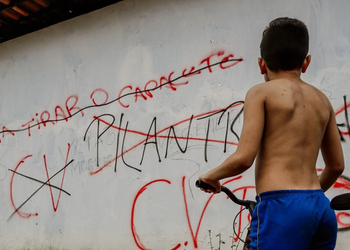
Local and national criminal networks battling over drug routes and markets have turned Brazil’s northeastern state of Ceará into one of the country’s main epicenters of violence.
Ceará had the third-highest homicide rate in Brazil last year, after registering three straight years of rising murders, according to data released in July from the Brazilian Forum of Public Security (Fórum Brasileiro de Segurança Pública – FBSP). Three of the state’s municipalities were among the ten most violent in the country, among them Maranguape, which was the most violent in Brazil with a homicide rate of 79.9 per 100,000 people.
As much as 90% of all the state’s homicides may be due to gang conflicts, according to Ceará’s state governor.
“Our perception based on all the evidence is that organized crime plays a very significant role in this lethality,” Roberto Sá, Ceará’s secretary for public security and social defense, told InSight Crime.
SEE ALSO: Deadly Gestures: Brazilian Gangs Crack Down on Hand Signs
This fighting is disproportionately affecting young people. While Ceará’s state-wide homicide rate in 2024 was around 35 per 100,000 people, it was 73 per 100,000 for those under the age of 29. The number of people aged under 18 who were killed in Ceará increased 18% from 2023 to 2024, according to data from the state’s Secretariat of Public Security and Social Defense.
Key Trafficking Territory
Much of the violence in Ceará can be traced to competition over local criminal economies and international drug trafficking routes.
Ceará is located along historic cocaine trafficking routes that start in Colombia and traverse the Amazon to Brazil’s Atlantic coast. It also offers dispatch infrastructure through the state’s busy shipping ports, which include the Pecém Complex, which is run by the Ceará government in partnership with the Netherlands’ Rotterdam Port, and is one of the main entry points for cocaine heading to Europe.
There is evidence that trafficking through these ports is on the rise. In just two port seizures in 2025, customs seized over half a ton of cocaine, more than they seized in all of 2024 combined.
The local cocaine market is also lucrative. Ceará’s state capital, Fortaleza, is the fourth-largest city in Brazil and has higher per capita cocaine use than larger cities like Brasilia and São Paulo, according to waste water analysis.
A Fragmented Criminal Landscape
The fight to control these illegal economies has resulted in an increasingly fragmented criminal landscape characterized by shifting alliances and splinter groups. This chaos and instability has further fuelled the conflicts racking the state.
The first major criminal organization to make inroads in Ceará was likely the Red Command (Comando Vermelho – CV), who followed their typical modus operandi of first establishing themselves in the state’s overcrowded and violent prisons. In the early 2000s, the CV built up its presence across Brazil’s northeast while forging alliances with other trafficking networks like the Family of the North (Família do Norte – FDN).
SEE ALSO: Top-Down Peace, Bottom-Up War: The Collapse of Brazil’s Gang Alliance
However, local rivals also began to emerge. The most prominent of these groups was the Guardians of the State (Guardões de Estado – GDE), which became notable for the young age of its members. The gang later gained control of the municipalities surrounding Fortaleza, such as Caucaia and Maranguape, according to an academic evaluation of the state’s criminal groups. When the GDE struck an alliance with the CV’s main rivals, the First Capital Command (Primeiro Comando da Capital – PCC), a new criminal conflict erupted.
As the violence spiraled out of control, a faction of the CV in Ceará split from the group in 2020 to form a new gang called Prison Masses (Massa Carcerária). The gang’s original goal of staying out of the criminal wars led to them also being known as the All Neutral (Tudo Neutro). However, the Prison Masses did not stay on the sidelines for long, and as the gang landscape fractured, more violence followed.
“When [groups fracture], there is a very high peak in deadly violence,” Sá told InSight Crime. “People who worked together suddenly became enemies.”
Filling in State Gaps
Despite its high levels of development and high-quality education system, Ceará has not been able to avoid youth recruitment by gangs aiming to increase their membership.
Compared to much of Brazil, Ceará’s education system scores highly in both attendance and academic markers such as literacy levels. However, the youth left behind still form a significant recruiting pool for gangs. This inequality is reflected in violence statistics: of the 3,272 victims killed in the state during 2024, only around 15% had finished high school, according to data from Ceará’s Secretariat of Public Security and Social Defense.
Furthermore, improved education opportunities do not always translate into better job prospects. Currently, nearly 50% of the state’s workforce is employed in the informal sector, according to data from the Brazilian Institute of Geography and Statistics (Instituto Brasileiro de Geografia e Estatística – IBGE). The earnings on offer rarely compete with the instant profits offered by organized crime.
“The appeal of crime is very immediate. Profits often exceed a minimum wage and the earnings of the adolescent’s parents. Schools are unable to compete,” Ricardo Moura, member of the Violence Studies Laboratory at Ceará’s Federal University (Laboratório de Estudos da Violência da Universidade Federal do Ceará – LEV-UFC), told InSight Crime.
In addition to the promise of quick economic gains, organized crime is also appealing to teenagers as a way of gaining status in marginalized neighborhoods.
“Joining a gang involves various symbolic elements for these vulnerable young people, who are suddenly faced with the opportunity to gain social recognition,” Artur Pires, also from LEV-UFC, told InSight Crime.
Feature image: Child looks at wall in Ceará with graffiti from criminal organizations marking their territory. Credit: O Povo