


[embedded content]
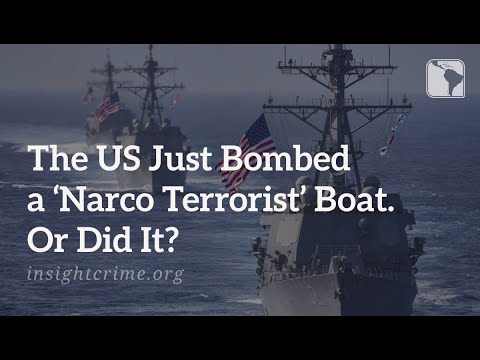
A US military airstrike in the southern Caribbean’s international waters, which the Trump administration claims killed 11 members of the Tren de Aragua “narco-terrorist organization,” is a concerning, deadly escalation in the current “war on drugs.”
We debunk the myths that Tren de Aragua is either a terrorist group or involved in the international drug business, and question whether these extrajudicial killings could set a dangerous precedent in a region currently rife with drug-related violence.
Transcript
Deborah: [00:00:03] You’re watching Insight Crime, my name is Deborah Bonello. I’m the Managing Editor, and I’m speaking to one of Insight Crime’s co-directors, Steve Dudley. Steve, we saw a US airstrike yesterday in international waters in the southern Caribbean, claiming to take out 11 members of the Tren de Aragua “narco-terrorist organization.”
Now, first of all, this seems to be not unprecedented, but extremely rare in anti-narcotics ops — we’re essentially talking about extrajudicial killings against what even Southcom admits was a suspected drug trafficking vessel. What’s your take on this?
Steven: [00:00:40] Yeah, I think that what we are in is a new world in the sense that that their decision to go after what is allegedly a drug trafficking vessel without any clear notion of where this vessel was headed, what was on the vessel, and who was on the vessel is new territory for the United States. That’s not to say that this may not have happened in other instances, and indeed, we know that it has happened in other instances. And in those instances we have seen huge repercussions. I’m thinking back to a time in Honduras when some DEA agents were connected to an assault — also on a moving boat, this time in a river, on a coastal province — and there were huge repercussions, all kinds of investigations and other things connected to that.
In this case, we don’t expect any of that. What’s more, this is a situation in which they are claiming that a criminal group, in this case the Tren de Aragua, is trafficking drugs on an international level. We’ve been following this group since it started — so over 10 years. And this is not an international drug trafficking organization. It has never been an international drug trafficking organization. So, to sit there and claim that this particular criminal organization was moving drugs in what is notably a sophisticated manner across international waters headed towards the United States is bordering on the absurd.
Deborah: [00:02:27] And do you think this kind of operation is going to impact the international drug trafficking business in Latin America in any way?
Steven: [00:02:36] The idea that you can take the military, any military, and go after these criminal organizations is also really — let’s just leave the word absurd out of it — but it is a very difficult prospect. And it’s difficult because these organizations are not top-down superstructures. They’re not vertically integrated. They are very dispersed, loose networks. And in the case of the Tren de Agua, in addition to not being an international drug trafficking organization, it’s also much more of a brand than it is a consolidated criminal organization. It has a number of different cells that are operational in different countries, including very, very small presence of very small footprint in the United States. But none of it is run from a single operational headquarters with clear command and control.
Deborah: [00:03:47] Yeah. I mean, I think the impact I can see in this region is the Trump administration kind of giving a green light to other nations in Latin America, right? The US has always kind of set the tone for the drug war, as we’ve seen them working with Colombia and Mexico for decades in the region. And we’re also seeing countries like Ecuador and the Dominican Republic following the US example of designating organizations as terrorist organizations — I think today the Dominican Republic got on board to designate the Cartel of the Suns, another Venezuelan criminal group, as terrorists. So could we start to see the likes of Ecuador and Mexico and Colombia starting to carry out airstrikes on trafficking networks, now that they’re seeing that the US thinks that that’s okay?
Steven: [00:04:39] Look, the idea of designating groups as narco-terrorists is not new. It goes back to the 1980s, to be fair to the Trump administration. And that was a period in which the United States was looking for a way to go after insurgencies, specifically the insurgencies like the FARC and ELN in Colombia. So that’s not new. But the word terrorism, as you’re noting, is doing a ton of work in this particular instance and gives all kinds of top cover, not just for the United States, but for any other country that wants to start to target anyone and designate them as terrorists without much preamble or, seemingly, evidence. So yes, again, this is a license of sorts. It’s a green light of sorts that that is definitely going to be watched by other governments. And so we’re going to see how this plays out, but, but definitely, as you note this could open the door for a lot of other operations around the regions by other governments.
Deborah: [00:05:57] This is definitely an evolving situation, and for those watching, if you want the background and history of anti-narcotics ops in the region, then you’ve come to the right place, and you can find all of that on insightcrime.org’s archive. Thanks for watching everyone.