


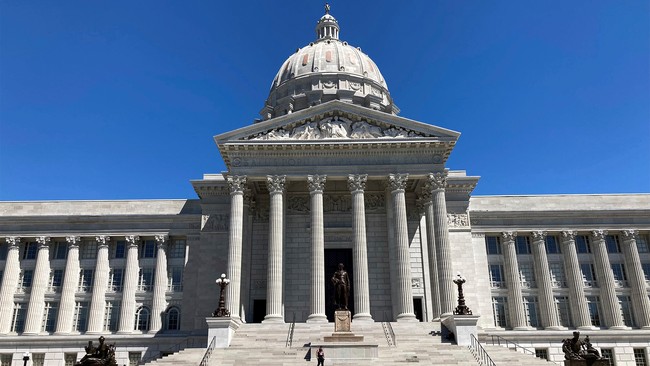
We’ve got some big news out of the Show-Me State on Tuesday with Missouri’s Supreme Court ruling in not one, but two redistricting-related cases — in both instances issuing a decision that effectively locks in place the 7R-1D map (pursuant to HB 1, passed by the state legislature in September 2025) for the 2026 midterm elections, constituting a pickup of one seat for Republicans.
Advertisement
The Missouri Supreme Court rules the new 7R-1D map doesn’t violate the state constitution and will be in place for the 2026 midterms. pic.twitter.com/2NZFLP4PLk
— Politics & Poll Tracker 📡 (@PollTracker2024) May 12, 2026
The court heard oral argument in both cases on Tuesday morning and issued unanimous decisions in both cases on Tuesday afternoon, making it clear that courts are not political map-drawing commissions — and that referendum activists don’t get to suspend laws merely by dropping boxes of signatures at the secretary of state’s office.
Here’s what was decided today:
First, in the consolidated cases of Healey v. Missouri and Wise v. Missouri, the challengers sought to have the 2025 map declared unconstitutional on the basis that it violated the compactness requirement of Article III, Section 45 of the state’s constitution. Specifically, they contended that the new configuration of the state’s 4th, 5th, and 6th Districts (in and around the Kansas City area) violates the requirement.
Old map for comparison: https://t.co/M6xgfaftyR pic.twitter.com/NFIWZljjCP
— Susie Moore ⚾️🌻🐶 (@SmoosieQ) May 12, 2026
But as the court notes in its decision:
The map “is assumed to be constitutional and will not be held unconstitutional unless the plaintiff proves that it clearly and undoubtedly contravenes the constitution.”
Advertisement
And as the court further explains:
Courts are tasked with deciding only the legality, not the prudence, of a congressional district map. No matter how unpopular or celebrated a congressional map may be, the judiciary’s duty is limited to determining only whether the drawn districts are “contiguous territory as compact and as nearly equal in population as may be.” Mo. Const.art. III, sec. 45.
Second, in the case styled Maggard v. Missouri, the challengers contended that their filing of a referendum petition (regarding the state’s congressional map) in December of 2025 automatically suspended HB 1, even though the signature verification process is not complete. In holding otherwise, the court rightly notes why tying the suspension to the mere filing of the petition versus the completed verification process won’t fly:
Under Appellants’ argument, the suspension is automatic, regardless of whether the boxes contained petitions consisting only of invalid signatures, signatures of unregistered voters, or even blank pieces of paper. Appellants’ argument would permit legislation truly agreed to and finally passed by a majority of Missouri citizens’ elected representatives to be automatically suspended based on nothing more than the delivery of boxes purporting to contain signed referendum petitions complying with article III, section 52(a).
Advertisement
Now, here’s the kicker on this second case: The deadline for signature verification is August 4, 2026 — which also happens to be the date of Missouri’s primary. In theory, if the referendum petition is ultimately certified sufficient, the suspension would “relate back” to Dec. 9, 2025 (before HB 1 took effect). But the court (wisely, in my view) sidesteps that issue for now.
What’s clear is that the mere filing of the referendum petition did not suspend HB 1 from taking effect, and the 2026 midterms will be governed by the 2025 map. From a practical standpoint, that means that Democrat Rep. Emanuel Cleaver, who is 81 and has represented Missouri’s 5th Congressional District since 2005, will likely be looking at retirement come January.
Editor’s Note: This article was updated post-publication for clarity.
Editor’s Note: The 2026 Midterms will determine the fate of President Trump’s America First agenda. Republicans must maintain control of both chambers of Congress.
Help RedState continue to report on the Democrats’ radicalism and inform voters as our nation faces a crossroads. Join RedState VIP and use promo code FIGHT to receive 60% off your membership.