


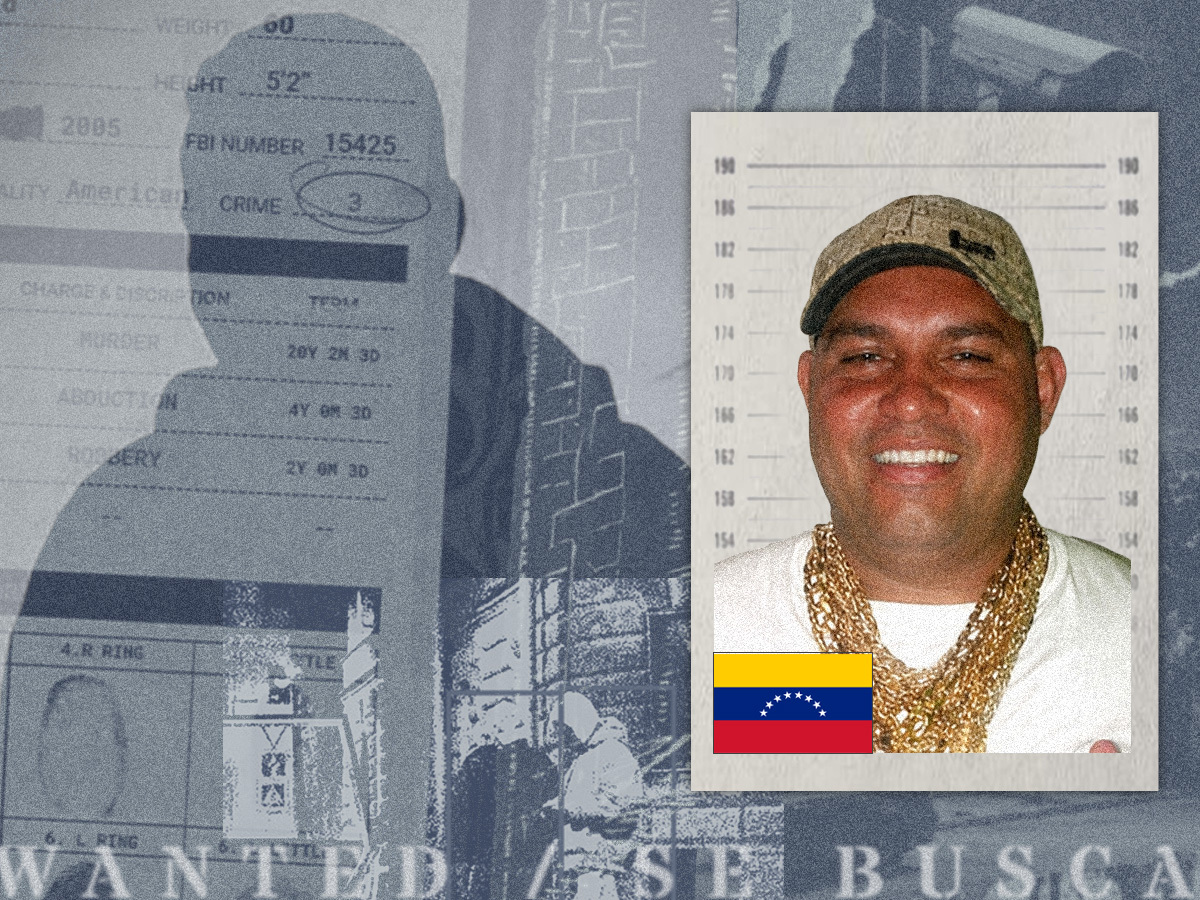
Yohan José Romero, alias “Johan Petrica,” is the leader of the criminal mining syndicate Las Claritas Sindicato as well as one of the co-founders and original leaders of Tren de Aragua, a loosely aligned Venezuelan organization that has expanded across the region.
Under Petrica’s leadership, Las Claritas Sindicato became one of the strongest mining gangs in Bolívar state, southern Venezuela. The group controls one of the country’s largest mining enclaves, including one of the world’s most lucrative gold deposits.
After operations in June 2026 near Las Claritas that left Tren de Aragua’s top leader, Hector Rusthenford Guerrero Flores, alias “Niño Guerrero,” dead, Petrica is assumed to have moved higher in the criminal ranks.
As evidence of his stature, the United States, which is leading the pursuit of Tren de Aragua, sanctioned Petrica in 2025 and is offering a $4 million reward for his capture.
Recent Johan Petrica News
June 13, 2026 – Military deployment in Las Claritas, Bolívar, kills Niño Guerrero and displaces Las Claritas Sindicato
Venezuela’s armed forces were deployed to the Las Claritas area and nearby mines on June 9, 2026, displacing artisanal miners working under the Las Claritas Sindicato. Days later, US President Donald Trump announced the death of Tren de Aragua leader Héctor Rusthenford Guerrero Flores, alias “Niño Guerrero,” during joint operations with Venezuela in Bolívar.
Table of contents
What Is Johan Petrica’s History?
Petrica was born on October 31, 1977, in Aragua state. Although it is unclear when he entered the prison system, a local media outlet reported that he was involved in a quintuple homicide in 2009 in Los Valles del Tuy. Early media reports about Petrica place him as a leader in Tocorón around 2009. Petrica managed to secure nonaggression pacts among incarcerated criminals to reduce the violence that characterized Venezuelan prisons at the time.
During his early years in Tocorón, Petrica frequently left the prison—through an agreement with the prison leadership—to oversee criminal syndicates in Aragua and Carabobo. When Niño Guerrero temporarily escaped from the prison in 2012, Petrica filled in as leader.
After Niño Guerrero was recaptured and returned to prison in 2013, Guerrero, Petrica, and Larry Amaury Álvarez Núñez, alias “Larry Changa,” established the Tren de Aragua prison gang.
Petrica played a key role in the gang’s expansion beyond the prison walls alongside its other co-founders. In 2015, the gang consolidated criminal control over the San Vicente neighborhood in Maracay, the capital of Aragua state. One of the city’s largest neighborhoods, San Vicente is strategic because of its industrial zone, high population density, and access to a lake that connects it to other parts of Aragua, including Tocorón, and the neighboring state of Carabobo.
As Tren de Aragua expanded its control in the neighborhood, there were frequent armed attacks and clashes with police. Residents—possibly following the gang’s orders—protested security force operations against the group’s members. They carried banners supporting Petrica and claiming he was an “honest man” who was “working for the good of the community.” Aragua’s then-governor, Tareck El Aissami, effectively endorsed the gang’s control by ordering the closure of police stations in the neighborhood. The neighborhood then served as the group’s secondary power base, after Tocorón, until 2023.
During the 2015 Operation Liberation of the People (Operación de Liberación del Pueblo – OLP) against Tren de Aragua’s expansion, Petrica was believed to have been killed, and he dropped off the radar for a while. However, reports of his death proved false, and years later, Petrica reappeared in Bolívar state.
In the town of Las Claritas, in the Sifontes municipality of Bolívar, Petrica expanded his criminal portfolio into a new economy: gold mining.
Las Claritas Sindicato had already been operating since at least 2010 with state approval thanks to the positive relationship between gang leader Juan Gabriel Rivas Núñez, alias “Juancho,” and Bolívar Governor Francisco Rangel Gómez. But in 2017, the state got a new governor with military ties, Justo Noguera Pietri. As part of President Nicolás Maduro’s 2016 efforts to consolidate the Orinoco Mining Arc (Arco Minero del Orinoco – AMO), Pietri changed the terms of existing agreements with Las Claritas Sindicato. The group’s solution was to bring in a fresh face to deal with Noguera Pietri: Johan Petrica.
Petrica became one of the group’s top leaders, alongside Juancho and local leader Humberto Martes, alias “Humbertico.” His identity was initially hidden, as he went by the alias “Darwin” or “El Viejo,” names also used by other local criminals.
In June 2023, Venezuela’s armed forces began targeting mining operations allegedly run by Juancho. In November, Juancho was arrested in Boa Vista, a city in Roraima state in northern Brazil, according to Venezuela’s extradition request. His detention gave Petrica room to expand and consolidate his leadership. Juancho reportedly returned to Las Claritas in 2025 after escaping house arrest in Brazil.
In 2023, the Venezuelan state took back Tren de Aragua’s headquarters, the Tocorón prison in Aragua state, sending the group’s leaders on the run. Some of them sought refuge in Las Claritas under Petrica’s protection, according to InSight Crime investigations.
During Donald Trump’s second term, the US government made Tren de Aragua a top criminal target. In 2024, the country offered a $4 million reward for information leading to the capture of the gang’s leaders, including Petrica. In 2025, it sanctioned several of the group’s leaders, including Petrica, who it said “is responsible for the group’s illegal mining efforts in Venezuela” and “provides Tren de Aragua with military-grade weapons used to control the streets of Venezuela and fight against Colombian guerrillas.”
US pressure reached its peak in June 2026. Following the US arrest of then-President Nicolás Maduro in January, Delcy Rodríguez’s interim government carried out a joint military operation with the United States in Las Claritas. The operation resulted in the alleged death of Niño Guerrero, who had reportedly been sheltering in the area. It also triggered the mass displacement of artisanal miners who worked in mining under the sindicato.
Authorities did not report on Petrica’s status or that of other criminal leaders, raising suspicions that he had fled the area.
Johan Petrica’s Criminal Activities
Petrica and Las Claritas Sindicato’s main criminal economy is mining, including coordination, taxation, extraction, refining, and trafficking. Artisanal miners must pay “taxes” or extortion fees to access the mines, as well as a percentage of the gold they extract. Merchants, cooks, sex workers, and all kinds of service providers in the mining area must also pay parallel taxes to the group to operate.
The gold received by the gang has likely either been smuggled out of Venezuela or sold to the Venezuelan state.
Petrica is also involved in supplying weapons to Tren de Aragua, according to the US Department of the Treasury’s sanctions against him. Police investigations in Brazil have reported that Tren de Aragua networks are supplying weapons to the Brazilian gang Red Command (Comando Vermelho – CV) in multiple Brazilian states, although they did not specify whether Petrica is directly involved.
Petrica and Las Claritas Sindicato exert total social and governing control over the mining enclave, presiding over businesses, criminals, and residents alike. Petrica dictates social norms, taxes, and even quasi-judicial rulings, using fear and intimidation tactics to maintain control. The group has also forced residents and miners to vote for government candidates in multiple elections.
Where Has Johan Petrica Operated?
The area controlled by the Las Claritas Sindicato is centered in the Sifontes municipality of Bolívar state, a strategic region for gold trafficking and part of the Orinoco Mining Arc.
The group controls several sections of Troncal 10, a major highway that runs through much of the municipality. However, its center of operations and the bulk of its mining activities are concentrated in and around Kilómetro 88 and Las Claritas.
Since Juancho’s arrest in 2023, the group has expanded into new enclaves along Troncal 10, such as Kilómetro 27, and into Indigenous territories with gold deposits.
Johan Petrica’s Allies and Enemies
While Petrica initially shared leadership of Las Claritas with Juancho, their power-sharing pact temporarily broke down. When Juancho was targeted and arrested in Brazil in 2023, local sources interviewed by InSight Crime hinted that Petrica had encouraged these operations. But Juancho’s later return after escaping from Brazil indicated that their pact had been reestablished.
Petrica has also shared leadership with Humberto Martes, alias “Humbertico,” and Martes’ father, who shares the same name but is known by the alias “El Viejo.” However, both exercise local leadership under Petrica.
Multiple local sources told InSight Crime that the Las Claritas Sindicato formed a nonaggression pact with other mining gangs in the Sifontes municipality to respect their areas of influence. This includes the gang led by Fabio Enrique González Isaza, alias “Negro Fabio,” in El Dorado, and the R Organization in Tumeremo, led by Eduardo José Natera Balboa, alias “Run.”
Since leaving Tocorón, Petrica had maintained strong relationships with Niño Guerrero and Tren de Aragua. Multiple sources interviewed by InSight Crime, as well as Venezuela’s Supreme Court, claim that Tren de Aragua members and Niño Guerrero spent time in Las Claritas after the Tocorón prison raid in September 2023.
Petrica and Las Claritas had enjoyed a symbiotic relationship with the Maduro government, as shown by the continued presence of state and security forces in the area without any action against the criminal group.
In exchange for the state’s blind eye, Las Claritas Sindicato has pressured residents and miners to attend Chavista demonstrations and vote for candidates from the governing United Socialist Party of Venezuela (Partido Socialista Unido de Venezuela – PSUV) in elections.
But the recent military deployment to Las Claritas under Delcy Rodríguez’s government, in coordination with the United States, could be evidence that the state’s agreement with Las Claritas Sindicato has ended. On the other hand, the fact that Petrica evaded the military forces that killed Niño Guerrero could also suggest an agreement that allowed him to escape and surrender the territory without violence or persecution. As of late June, following the operation, authorities had not reported any arrests or deaths of sindicato members.
Could Johan Petrica Be Tren de Aragua’s New Leader?
The lack of official information about Petrica’s whereabouts suggests he escaped the joint Venezuela-US operation. The presence of the military units that arrived in Bolívar in June could prevent Petrica from returning to his headquarters, paving the way for international companies interested in Venezuela’s gold sector as part of Rodríguez and Trump’s strategy to exploit the country’s resources.
Indeed, Petrica may be Tren de Aragua’s highest-ranking leader still at large, with Niño Guerrero dead and Tren de Aragua’s other founder, Larry Changa, imprisoned in Colombia.
However, taking control of the organization’s transnational operations across the region could be a difficult task for Petrica, as Tren de Aragua has been weakening for years amid pressure from security forces both in Venezuela, following the Tocorón intervention, and across the rest of South America, where multiple leaders have been arrested, cells have been dismantled, and the group’s structure has been deeply fragmented.