


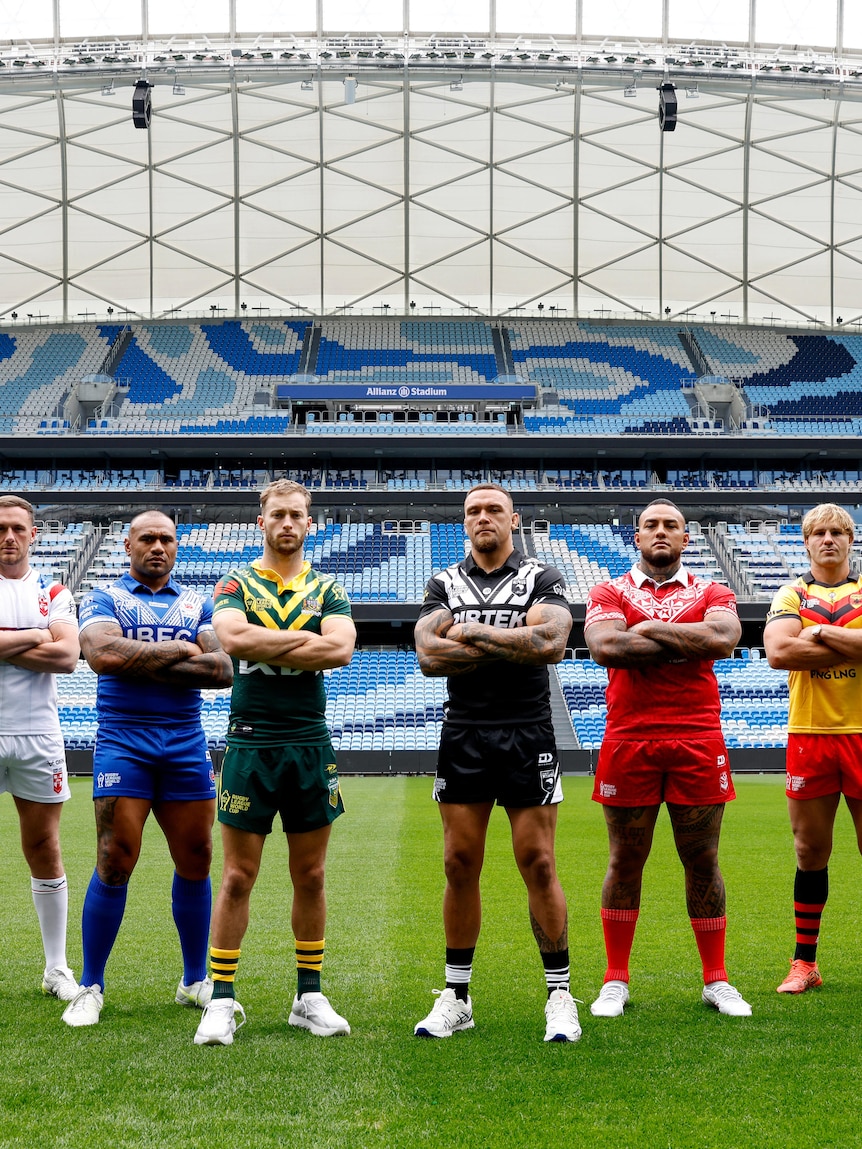
The only things that stay the same about the Rugby League World Cup are that it never stops changing and it continually has to justify its own existence.
For the third tournament in a row, there will be a different format and a different number of teams, dropping from 16 to 10, and for the umpteenth tournament in a row, the sceptics will question why it’s worth playing a Rugby League World Cup at all and compare it unfavourably to the rugby and football versions.
Those world cups exist in different universes than the league equivalent, even as nation-swapping and diaspora-heavy squads, two hallmarks of the much-maligned international rugby league, become more prevalent in their larger cousins.

The Rugby League World Cup has to prove itself anew every four years. (Getty Images: Brendon Thorne)
Measure the Rugby League World Cup against those that dwarf it in scale and it will always be miles behind. It is playing a different game, one that is carving out a place all its own.
On the back of the rise of Tonga and Samoa over the past 10 years, Test football is at its strongest and most vibrant in years, with the two Pasifika nations emerging as legitimate draws and top-class teams.
Tonga’s two matches against Australia in the 2024 Pacific Championships drew crowds of more than 33,000 and 28,000, and both Tonga and Samoa have made their first tours to England since the last World Cup.
When the ancient island rivals went head-to-head in Brisbane last year, more than 40,000 came through the gates, the second-largest non-World Cup final crowd for a Test in Australia in the last half-century.
A similar attendance is expected for the tournament opener between Australia and New Zealand on Thursday night, and if the Sydney Football Stadium can sell out, it’ll be the biggest Test crowd in Sydney since 1974.
It marks the beginning of a chance for the Rugby League World Cup to reshape itself a little more permanently and take advantage of the renewed interest by recasting itself as a pinnacle for the game rather than a starting point.
Rugby league had to make a choice whether its World Cup was a beginning or an end, a proving ground for developing nations or a battleground for the best, because it could not be both at the same time.
At the sharp end of recent tournaments, when it’s the best teams in the world having it out, the product is reliably compelling, rich and powerful. The problem is it’s just taken too long to get there.
In 2022, there was a crackerjack knockout phase, highlighted by Samoa’s epic win over Tonga in Warrington, New Zealand sneaking home against Fiji in Hull, and two brilliant semifinals, including a golden point epic that doubles as one of the best games in the tournament’s history.
But the group stage was a forgone conclusion almost all the way. Only two of the 24 preliminary matches were decided by one score or less. There were 10 scores over 60 and two scores over 90.
Australia’s 110-4 massacre of Russia in 2000 remained untouched as the most lopsided result in World Cup history, but matches from 2022 fill out the second, third and fourth spots on that list.
Developing nations have their place in the international rugby league and the emotional scenes upon qualification for Jamaica, or Greece’s epic tale of playing qualifying matches on the edge of war zones and in undisclosed locations to stay one step ahead of the authorities, are proof of the value developing nations can bring.
But it is hard to see the benefits of England nearly putting 100 points on the Greeks, or a disinterested Australia beating Scotland 84-0.
The trickle-down effects of those games, such as they are, can take decades to rise to the surface, if they ever do at all.
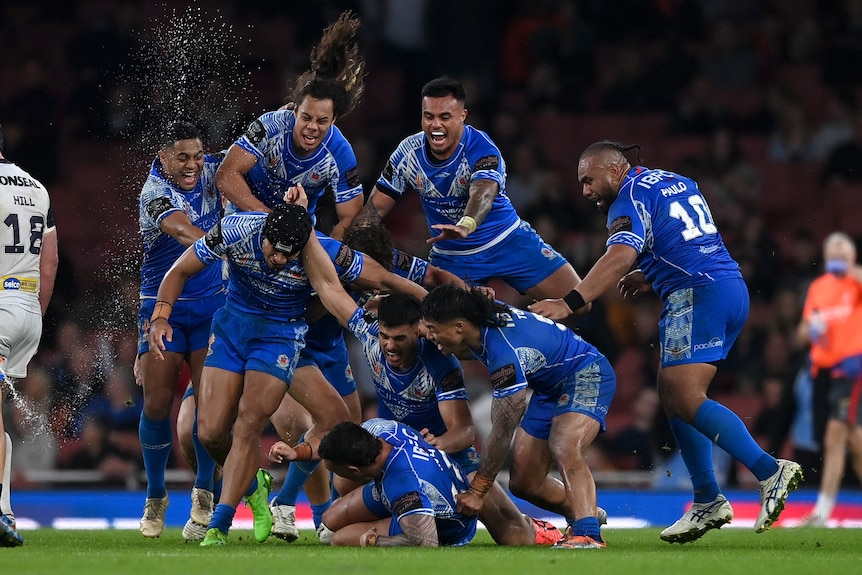
The knockout phase of recent World Cups have been rugby league dynamite. (Getty Images: Gareth Copley)
The game’s wholehearted embrace of the set restart rule and the increased speed of play makes it harder for the smaller nations to compete on a physical level, and the perfunctory nature of the group stages makes the tournament even longer.
In a world where fan interest and player fatigue are already being stretched to their limits, it adds even more to an already overstuffed season.
So while it may not please the true believers, the move to 10 teams is a good one. This tournament is leaner and has the potential to be meaner.
The lack of northern hemisphere teams — it’s just England, France and Lebanon, with none from the Americas and no other home nations after Scotland and Ireland were demoted to affiliate status and Wales failed to qualify — is regrettable, but exclusivity cuts both ways because less can be more.
This is a tournament with barely any fat on it, and as a result, it’s as open at the top as it’s ever been.
Australia is still the favourite because such is the largesse of talent available that it’s almost impossible to name a Kangaroos team that isn’t oozing with class, but it’s far from invulnerable.
Its talent pool has been diluted, and there are several squad members who are coming off indifferent or underdone seasons.
Some have made it due to coach Kevin Walters’s loyalty to the side that retained the Ashes in a 3-0 whitewash last year, but others are in because there’s a lack of other options as the eligibility rules slowly spread the talent around.
Nobody has benefited more from that spread than New Zealand, who welcome Kalyn Ponga to the squad for his belated Test debut as the herald of a new era.
On paper, it’s a better side than the one that handed Australia its biggest-ever defeat just three years ago — it has all three middles from this season’s Dally M Team of the Year — and a second World Cup title is a distinct possibility.
The bookies have Samoa and Tonga as equal-third favourites to make the final, well ahead of England, and their group-stage clash at Parramatta Stadium has been sold out for months.
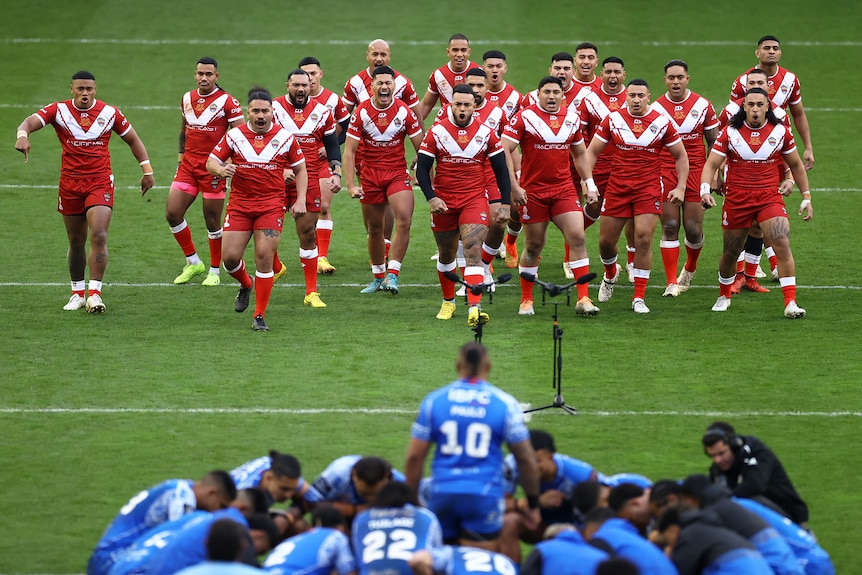
Samoa and Tonga have already sold out their group stage match. (Getty Images: Michael Steele)
The English have a little more to prove after last year’s lacklustre Ashes showing, an embrace of heritage players that has divided their fan base and the controversial exclusion of Leeds halfback Jake Connor from the squad.
Outside the top five, there’s still plenty to follow. Write off the perennially underrated Fijians, who beat New Zealand in 2017 and came within six points of doing the same in 2022, off at your peril.
France and Lebanon won’t be as dangerous, but the French have 20 homegrown players in their squad and 10 of Lebanon’s starting 13 for their first game have NRL experience.
Even the Cook Islands, which will play in front of crowds that dwarf its home’s population, will have Cronulla’s KL Iro and former Kangaroo Valentine Holmes to call upon.
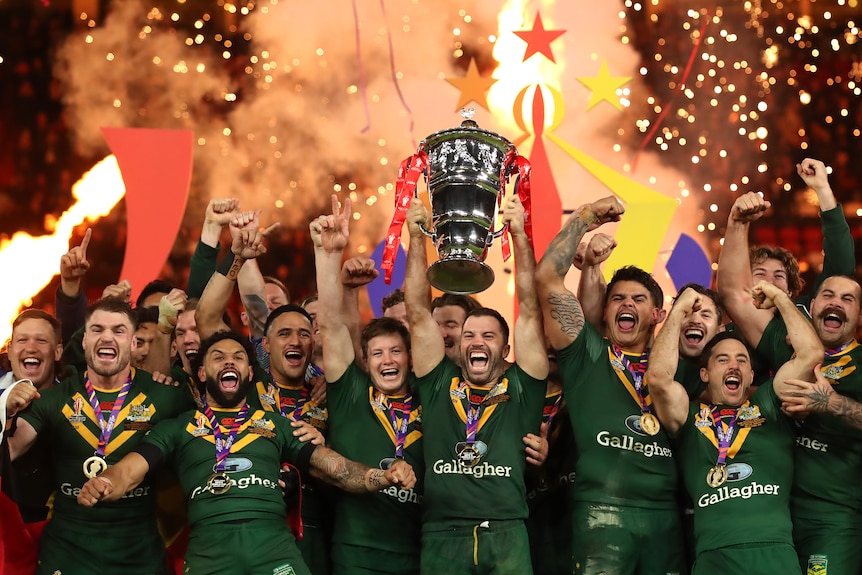
Another Australian victory is far from a guarantee in this World Cup. (Jan Kruger: Getty Images for RLWC)
Injuries have robbed Papua New Guinea of some of their biggest names, but their group matches against Samoa and Lebanon will be the Kumuls’ biggest on home soil since the PNG Chiefs were admitted to the NRL and shape as the first dress rehearsals for what awaits the game in the land where they love it most.
Through it all, this World Cup can have it all. There will still be stories of paupers taking on princes against all odds and of the unbridled passion and pride that has kept international football alive despite the many obstacles.
Those tales and teams will always have their place, but for the most part, this tournament will be collections of top-level rugby league talent crashing into each other in the fast until only the world champions are left to rise from the wreckage.
What the tournament gives up in diversity and novelty, it can win back in quality, because at some point, a World Cup has to be about the best of the best being at their best, and there are more nations who can dream of that than ever before.
Never in the World Cup’s 72-year history has the sky seemed so open. Ten teams might not seem like many, but if five have designs on the crown, it can be plenty.
dan