


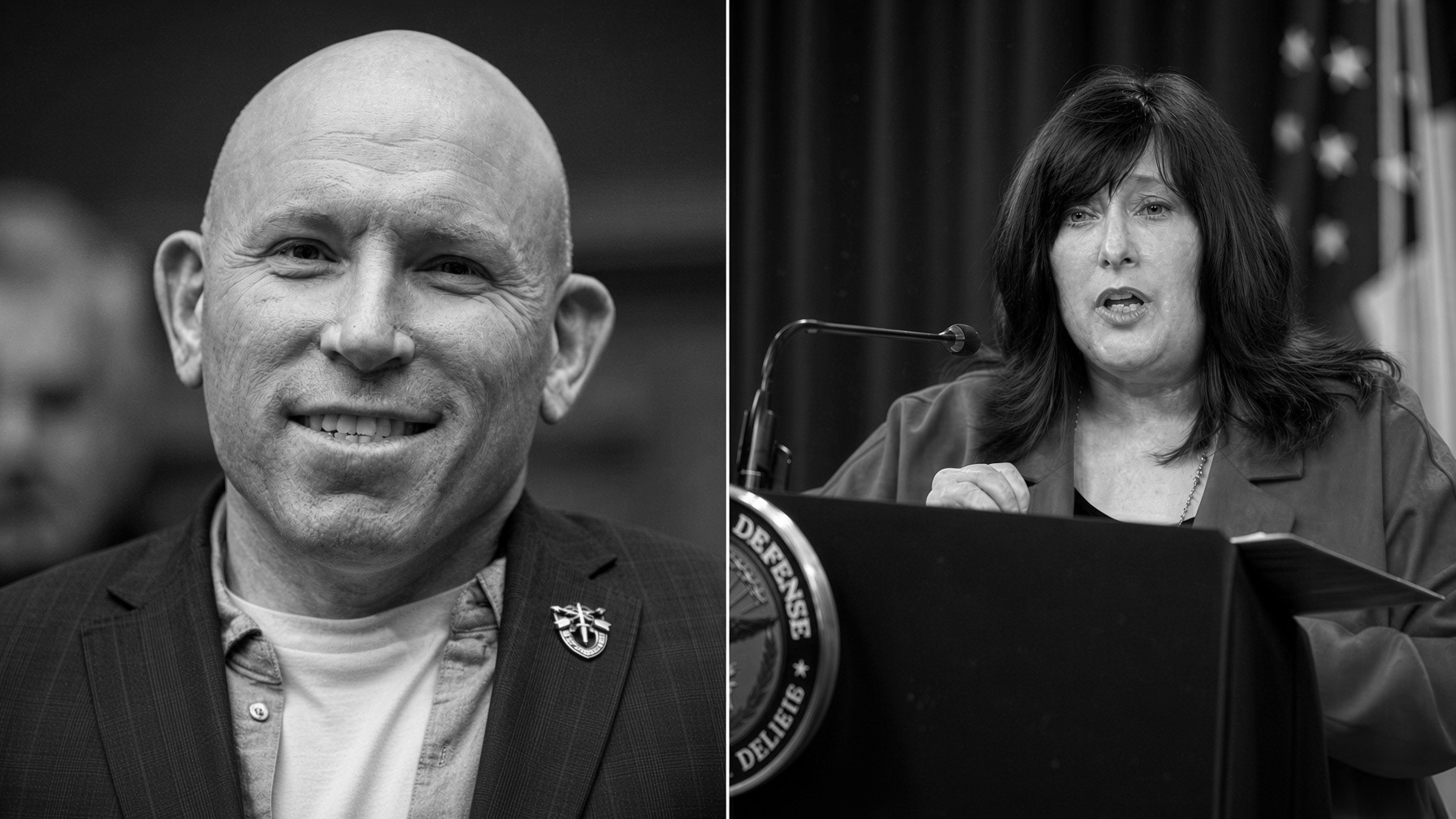
Adirim sued Raiklin over his accusations of “genocide” and “mass mutilation” tied to the mandate.
His defense argues that her personal role in signing the memo places her in the public eye—and requires her to meet the higher actual-malice standard to win her defamation claim.
Raiklin did not invent the mandate’s legal problems. The policy “was unlawful as implemented,” the Pentagon stated in May 2025 guidance.
Rep. Andy Harris accused Adirim of directing emergency-authorized shots without a presidential waiver. Adirim signed the implementation memo. Raiklin challenged her conduct. She then sought damages from him for words she alleged were defamatory.
Read the full report from AMG News below.
BREAKING — ALERT: Fired “Deep State Target” CIA Employee Just Got BAD NEWS in Court!
By Medeea Greere | AMG News | Nov. 2, 2026
Terry Adirim and Ivan Raiklin clash over vaccine-mandate criticism and free speech. Inside the court dispute over public officials and accountability.
The legal battle over pandemic-era mandates continues to evolve, shifting from the halls of the Department of Defense to the high-stakes environment of federal courtrooms. At the center of a recent significant legal battle are Dr. Terry Adirim , often described by critics as the “mandate architect,” and Ivan Raiklin , a former military officer and vocal critic of the COVID-19 policies.
The case serves as a critical litmus test for the First Amendment , the definition of public figures , and the extent to which a citizen can criticize government officials using “spicy” or hyperbolic language. Following a recent motion for summary judgment , the case has reached a pivotal juncture that could redefine how accountability and free speech are balanced in the post-pandemic era.
THE FOUNDATIONS OF THE CONFLICT: THE 2021 MANDATE
The origin of this legal dispute dates back to September 14, 2021 . At that time, Dr. Terry Adirim , serving as a senior medical officer within the Department of Defense (DOD) , signed a memorandum that became the foundational document for the military’s vaccine mandate . This memo compelled nearly two million service members to receive the COVID-19 vaccine, an order that many within the military community, including Raiklin, argued was unlawful.
The contention rests on 10 U.S.C. § 1107a , which dictates that service members cannot be forced to take a product authorized for emergency use (EUA) unless the Secretary of Defense requests a waiver from the President, and the President confirms in writing that it is a matter of national security. Critics argue this process was never properly followed, rendering the mandate an “unlawful order.”
THE “BURROWING” CONTROVERSY
Following the 2024 election , Dr. Adirim transitioned from the DOD to a senior executive position at the CIA . This move sparked significant public discourse, with observers like Raiklin questioning whether she was “burrowing” into a protected agency to avoid accountability for the policies enacted under the previous administration. Shortly after these questions were raised in public forums, including the Roseanne Barr podcast , Adirim’s employment with the CIA was terminated.
In response to her firing, Adirim filed a defamation lawsuit against several parties, including the CIA and Director John Ratcliffe . While many of those claims were dismissed, the case against Ivan Raiklin moved forward, focusing on three specific statements he made regarding her role in the mandates.
THE LEGAL BATTLE: DEFAMATION AND THE PUBLIC FIGURE STANDARD
Defamation law in the United States is governed by a high bar, particularly when the plaintiff is a public figure . During a recent hearing on a motion for summary judgment, the court scrutinized whether Dr. Adirim qualified as a “limited-purpose public figure.”
THE ACTUAL MALICE STANDARD
Under the precedent set by New York Times v. Sullivan , a public figure must prove “actual malice” to win a defamation case. This means they must demonstrate that the speaker knew the statement was false or acted with “reckless disregard” for the truth .
In a surprising turn during the hearing, the judge questioned whether Adirim was indeed a public figure, despite prior concessions from her own legal team. Raiklin’s defense argued—and the court ultimately seemed to agree—that signing a memo impacting the health and careers of two million service members inherently places an individual in the public eye. Establishing this standard is a major hurdle for any plaintiff, as it protects “spicy” political rhetoric and good-faith opinions , even if those opinions are controversial.
SCRUTINIZING THE THREE STATEMENTS
The lawsuit centered on three specific assertions made by Raiklin during a podcast appearance. The defense’s strategy was to categorize these not as statements of fact, but as protected opinions and rhetorical hyperbole .
1. THE LEGALITY OF THE MANDATE
The first statement involved Raiklin’s assertion that the mandate signed by Adirim was illegal . In a significant victory for the defense, the judge granted a motion for summary judgment on this count in open court. The judge questioned whether citizens are permitted to hold and express opinions on the legality of government policies—a fundamental aspect of democratic discourse. Because attorneys and citizens debate the legality of government actions daily, the court found that expressing such an opinion does not constitute defamation .
2. THE “GENOCIDE” ALLEGATION
The second statement involved the use of the word “genocide” to describe the consequences of the mandate. The plaintiff’s counsel argued that, as a lawyer, Raiklin should be held to a literal, statutory definition of the word. However, the defense maintained that, in the context of a comedy podcast and political discourse, the term was used as “moral equivalency” or rhetorical hyperbole to describe the scale of perceived harm.
3. THE “MASS MUTILATION” ALLEGATION
The third statement concerned the term “mass mutilation.” Raiklin explained that his subjective belief was rooted in his understanding of mRNA technology as a modification of RNA, for which “mutilation” is a synonym. He pointed to data from the Vaccine Adverse Event Reporting System (VAERS) and the Defense Medical Epidemiological Database (DMED) to justify his conviction. The defense argued that because Raiklin subjectively believed these statements to be true based on his research and conversations with military whistleblowers, he lacked the “actual malice” required for liability .
EVIDENCE AND SUBJECTIVE BELIEF
A core component of the defense was the depth of research Raiklin conducted before making his statements. He cited reliance on numerous military medical professionals, including Lieutenant Colonel Teresa Long and Colonel Pete Chambers , who reported observing adverse effects within their units.
Raiklin’s 26-page sworn affidavit included citations to dozens of hearings, medical reports, and expert testimonies. The legal significance of this is profound: even if a speaker is objectively “wrong” or “unreasonable,” the law generally protects them if they subjectively believe what they are saying. To penalize a citizen for an opinion formed through extensive, though controversial, research would create a “chilling effect” on all criticism of government officials .
THE BROADER IMPLICATIONS FOR FREE SPEECH
This case is not just about two individuals; it is about the right of the public to “watch the watchers.” If government employees who craft national policy can sue their critics into silence, the fundamental check on government power is weakened.
THE “STREISAND EFFECT”
By filing a defamation suit, Dr. Adirim may have inadvertently brought more attention to the very issues she sought to suppress. This phenomenon, known as the “Streisand Effect,” has turned a private employment dispute into a public airing of the evidence surrounding the vaccine mandates. Should the case proceed to trial in January , it would likely involve a massive presentation of evidence regarding vaccine safety, military health data, and the internal decision-making processes of the DOD.
A TURNING POINT FOR ACCOUNTABILITY
The case also intersects with ongoing investigations led by members of Congress, such as Senators Ron Johnson and Rand Paul , who are seeking transparency regarding the federal government’s pandemic response. As more internal communications—such as Anthony Fauci’s government phone records —become public, the context for Raiklin’s statements continues to shift.
LOOKING AHEAD: TRIAL OR VICTORY?
As the court prepares its final rulings on the remaining counts, the possibility of a January trial looms. For Raiklin and his supporters, a trial represents an opportunity to educate a jury on the harms they believe were caused by the mandates. For the government and the plaintiff, a trial carries the risk of a high-profile “airing of grievances” that could further damage public trust in health institutions.
Regardless of the final verdict, the dismissal of the first count regarding the “illegal” nature of the mandate is a landmark win for free speech. It reaffirms that the First Amendment protects the right of every American to look at a government policy, find it wanting, and call it unlawful without fear of a ruinous lawsuit.
The battle for “maximum accountability” continues, but for now, the court has signaled that the right to criticize our public officials remains a cornerstone of the American legal system. The outcome of this case will likely echo through future disputes where the boundaries of government authority and citizen dissent are tested.
— Medeea Greere / AMG News