


Technology today seems to be taking us in directions a lot of us couldn’t have imagined only a few years ago. One of those directions involves unmanned vehicles, and while most of us have digested news of aerial drones and even semi-autonomous ground-pounders with aplomb, the notion of an entire unmanned ship is raising a lot of eyebrows.
Advertisement
That is, though, precisely what’s happening. Now the USS Theodore Roosevelt task group will be getting an addition: an unmanned robot ship. Yes, really.
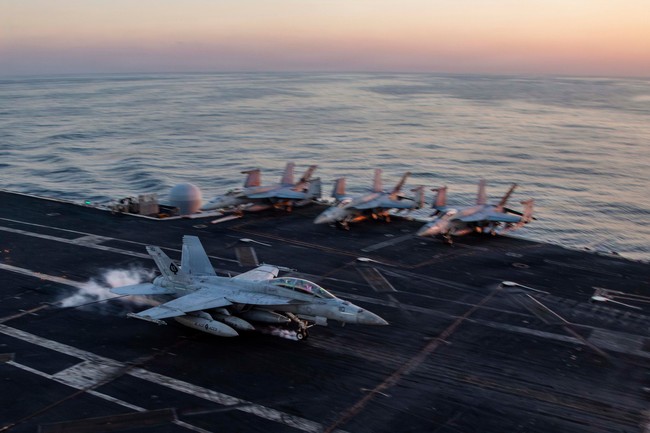
The aircraft carrier Theodore Roosevelt is gearing up for a deployment with a Seahawk medium unmanned surface vessel (MUSV) as part of its strike group for the first time — a key milestone signifying the transition of the unmanned system from an experimental to operational part of the fleet.
In fact, multiple experts told Breaking Defense that this deployment could lay the foundation for how the Navy develops its concept of operations (CONOPS) for integrating unmanned into the rest of the fleet, at a time when the Navy is still struggling to articulate how and when it will make autonomous vessels a core part of its arsenal.
A quick look at the Seahawk unmanned ship (not to be confused with the Navy’s Seahawk helicopter) indicates what looks like a human-occupied bridge, windows and all; presumably a backup system? That would seem to be prudent, but backup humans or not, this seems to be where the Navy is going.
“It is certainly a significant development,” said Bradley Martin, a retired Navy captain who is now a senior policy researcher at RAND. “Up to now, it’s all been a matter of testing, and the actual use in operational deployment is a major step. I think that what will happen as a result of this is, we won’t necessarily see immediately some big change in the way the fleet operates, but it will tell the fleet a lot about how to use this type of capability.”
The Seahawk vessel is one of Leidos’ unmanned vessels. An upgraded design of the firm’s Sea Hunter autonomous vessel, the Seahawk supports anti-submarine warfare and maritime domain awareness, and stems from a Defense Advanced Research Projects Agency initiative.
Advertisement
A quick prediction: The Navy will find ways to use these new assets in ways that the designers didn’t expect. The American military has always seemed to operate that way. Give the troops (or the sailors, in this case) a new toy, and they will start messing around with it.
Never underestimate the creativity of our service members.
Read More: Golden Fleet Incoming: US Navy Requests 34 New Ships for FY2027
The Nimitz Enters the Chat: Carrier Strike Group Arrives in Caribbean As US-Cuba Tensions Increase
The Seahawk won’t be the last of these ships. The Navy is evaluating several others.
Out of about two dozen options submitted for the MUSV marketplace, the unspecified shipbuilders will develop vessels that will be tested against Navy requirements for the robotic craft, service spokesperson Capt. Ron Flanders said in a Friday statement to USNI News.
“The Navy selected seven entrants in the Medium Unmanned Surface Vessel (MUSV) marketplace to advance to the next phase – prototype evaluation,” Flanders said. “Selected industry partners must successfully complete at-sea demonstrations to prove the maturity of their systems… After successful at-sea demonstrations prior to October 2026, the Navy plans to work with industry to have vessels available for Navy leasing or procurement in fiscal year 2027.”
These would seem to have the capability to be serious force-multipliers, whether remotely controlled or autonomous. One question:
Advertisement
What about weaponry? How will fire control work on these ships? They mention anti-submarine warfare (ASW) and maritime domain awareness. How will that work? Will these robot ships be no more than detection assets, or will they be able to act on their own? These would seem to be valuable for sonar picket duty at the fringes of a task group’s area, but in the event of any real conflict, you’d want those pickets to be armed.
It’s an interesting problem, and no doubt we will learn more as these are deployed. In the meantime, we can enjoy the “cool” factor.
Editor’s Note: Thanks to President Trump and War Secretary Pete Hegseth’s leadership, the warrior ethos is coming back to America’s military.
Help us report on Trump and Hegseth’s successes as they make our military great again. Join RedState VIP and use promo code FIGHT to receive 60% off your membership.