


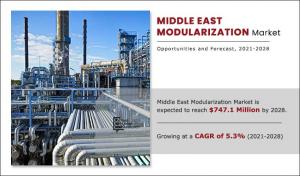

The Middle East modularization market size is expected to reach $747.1 million by 2028, At a CAGR of 5.3% from 2021 to 2028
PORTLAND, OR, UNITED STATE, June 29, 2023/EINPresswire.com/ — The Middle East modularization market is experiencing rapid growth and is poised to become a significant player in the construction industry. Modularization, with its off-site construction and assembly approach, offers numerous benefits such as accelerated project timelines, cost optimization, improved quality control, and enhanced safety conditions. The region’s ambitious infrastructure development plans, cost-efficiency requirements, and focus on sustainability are driving the adoption of modularization.
The Middle East modularization market size is expected to reach $747.1 million by 2028, from $492.1 million in 2020, registering a CAGR of 5.3% from 2021 to 2028
Download Sample PDF @ https://www.alliedmarketresearch.com/request-sample/12739
Leading market players in the Middle East modularization Market include:
Fluor Corporation, SHV Holdings N.V. (Mammoet), Arabian International Company for Steel Structures, Larsen & Toubro Limited (L & T Piping Center), ENKA INSAAT VE SANAYI (CIMTAS PIPE FABRICATION AND TRADING CO. LTD.), YENA ENGINEERING B.V., PROSAIC STEEL AND ALLOYS, Metal Forge India, Honeywell International Inc (Honeywell UOP), and ChelPipe Group.
Market Growth
Modularization involves the construction of pre-fabricated building components, known as modules, in off-site facilities. These modules are then transported to the construction site, where they are assembled to create a complete structure. This innovative approach allows for streamlined construction processes, reduced on-site labor, and faster project delivery.
Several factors are contributing to the growing adoption of modularization in the Middle East. Firstly, the region’s ambitious infrastructure development plans, including mega-projects such as stadiums, airports, and urban developments, require efficient construction methods to meet tight deadlines. Secondly, the need for cost optimization and reduced project risks has led construction companies to explore modular construction as a viable solution. Finally, the increasing focus on sustainability and eco-friendly practices aligns with modular construction’s reduced waste generation and energy efficiency.
Modularization offers numerous benefits that are reshaping the construction landscape in the Middle East. Firstly, it accelerates project timelines significantly, enabling faster completion and reduced time-to-market. This advantage is particularly crucial for sectors like hospitality and healthcare, where time is of the essence. Secondly, modularization minimizes on-site disruptions and improves safety conditions for workers. With the majority of construction taking place in controlled factory environments, safety hazards are significantly reduced. Additionally, modular construction ensures better quality control, as modules are manufactured under strict quality standards in controlled conditions.
Buy Now & Get Exclusive Discount on this Report @ https://www.alliedmarketresearch.com/checkout-final/ffa85f35b435bfe60c054fa78707f36e
Future Projections and Opportunities:
While modularization presents exciting prospects, it also faces certain challenges. Transportation logistics, design flexibility, and regulatory frameworks are some of the key areas that need to be addressed for the wider adoption of modular construction. However, these challenges open up opportunities for collaboration between stakeholders, including governments, construction companies, and modular manufacturers. By working together, they can develop solutions that address regulatory concerns, enhance transportation infrastructure, and expand design possibilities.
Modularization is transforming the Middle East construction market, offering a range of benefits, from cost and time savings to improved quality control and enhanced safety. With the market expected to reach $747.1 million by 2028, it is evident that modular construction is here to stay. By harnessing the potential of modularization and overcoming the associated challenges, the Middle East can unlock new opportunities, revolutionize the construction industry, and achieve its ambitious infrastructure goals.
Regional Analysis:
Region-wise, the Middle East modularization Market analysis is conducted across North America (the U.S., Canada, and Mexico), Europe (UK, France, Germany, Italy, and rest of Europe), Asia-Pacific (China, Japan, India, South Korea, and rest of Asia-Pacific), and LAMEA (Latin America, the Middle East, and Africa). In 2020, Asia-Pacific was the highest contributor to the Middle East modularization Market share, and LAMEA is anticipated to secure a leading position during the forecast period.
Purchase Inquiry Before Buying @ https://www.alliedmarketresearch.com/purchase-enquiry/12739
David Correa
Allied Analytics LLP
+ 1-800-792-5285
email us here

You just read:
News Provided By
June 29, 2023, 05:23 GMT
Share This Article
EIN Presswire’s priority is source transparency. We do not allow opaque clients, and our editors try to be careful about weeding out false and misleading content. As a user, if you see something we have missed, please do bring it to our attention. Your help is welcome. EIN Presswire, Everyone’s Internet News Presswire™, tries to define some of the boundaries that are reasonable in today’s world. Please see our Editorial Guidelines for more information.