


A Holy Cross Church event paired smudging and prayers toward four directions with a saint whose conversion rejected Mohawk religion.
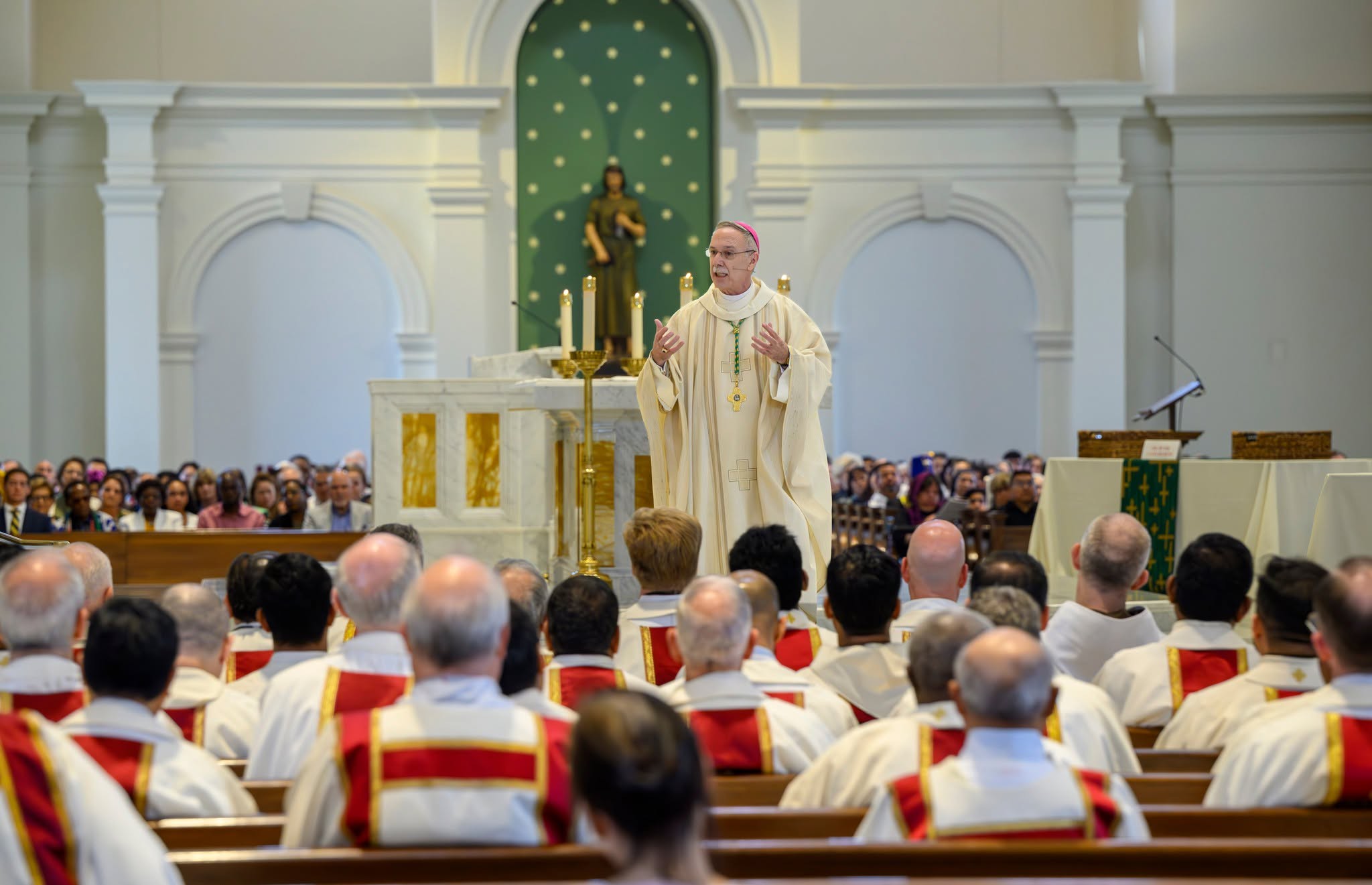
Raleigh’s Bishop, Luis Rafael Zarama, offered lighthearted remarks to those gathered for the shamanistic ceremony at Holy Cross Catholic Church in Durham, which is in the Diocese of Raleigh.
After cracking jokes about not being able to dance, Bishop Zarama invoked the ecumenical and DEI-style theme of the shamanistic ceremony by encouraging people to listen to others and “see who is at the other table.”
Absent from the Diocese of Raleigh’s press release celebrating the event is Bishop Zarama’s explanation on how Shamanism dovetails with the Gospel of Jesus or the Law in the Old Testament Jesus fulfilled.
National File has reached out to the Diocese to inquire as to whether there was some explanation connecting shamanism to the Old or New Testament.
Shockingly, the Diocese of Raleigh’s own website proudly trumpets news of the shamanic celebration, which, incidentally, entirely skews the story of Catherine Tekakwitha.
Rather than focusing on Jesus, as Catholic dogma requires, Bishop Zarama’s focus was the false religion of multiculturalism.
SAINT TEKAKWITHA
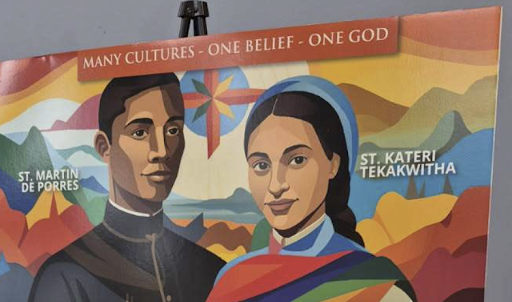
St. Catherine “Kateri” Tekakwitha, who was renamed Catherine, after St. Catherine of Siena, was a Native American who belonged to the Mohawk Indian Nation.
She left her Mohawk tribe, and later moved to St. Francis Xavier, a Christian Indian mission in Sault Saint-Louis, present-day Caughnawaga or Kahnawake, near Montreal, Canada.
Continued practice of non-Catholic religion would’ve certainly been opposed by Saint Tekakwitha.
Tekakwitha left her pagan tribe to join the Catholic Church, and she prayed for the conversion of her former tribesmen and tribeswomen.
Despite this clear change in direction for St. Tekakwitha, four hundred years after St. Catherine Tekakwitha’s conversion, modern Americans in Durham, North Carolina seek to construct a post-modern weapon against the institution of the Catholic Church, and they bastardize St. Tekakwitha’s lived experience in order to do it.
SMUDGING IN THE CATHOLIC CHURCH? WHY THE FUSS?
IT’S SHAMANISM.
Native American leaders, including a representative from the controversial Lumbee Tribe in southeastern North Carolina, led those present in he native American ceremony of “Smudging.”
Smudging is a “Shamanic cleansing ritual,” according to Chinook Shaman John Joseph.
Post-modern practitioners of smudging claim that there is no difference between smudging and the offering of burnt incense or myrrh.
The God worshiped in the Smudging ceremony is a wholly different God to the monotheistic God worshiped by orthodox Christians and Catholics.
During the event at Holy Cross in Durham, for example, a Catholic priest called David Miller “offered a traditional prayer in the four directions.”
The “prayer in the four directions” is not one prayer, it is multiple prayers, to multiple Gods, represented by Air, Fire, Water, and Earth, as well as to the Spirit, or the Akasha.
“They are commonly used in Indigenous traditions and modern earth-based or pagan spiritual practices to ground the spirit and express gratitude for life,” according to the website Progressive Christianity.
Unitarians recognize and celebrate the Prayer in the Four Directions to be overtly Pagan.
According to the Unitarian Universalist Association, The Prayer in the Four Directions is “a pagan prayer (often called “calling the quarters” or “elements”).”
It “is a ritual used to open sacred space, honor the natural world, and invite elemental energies to balance a ceremony.”
“Calling the Quarters,” or “Calling the Corners,” is a foundational ritual practice for Wiccans.
Central to the Wiccan understanding of the Four Directions is the so-called “Sacred Feminine.”
Concurrent with the effort to redefine the institute of the Catholic Church is the Wiccan effort to supplant the idea of Saint Mary with the Wiccan notion of the “Sacred Feminine.”
“Smudging” is a practice whereby a “cleansing smoke” is shared with people as an act of prayer and spiritual connection.
Google indicates that Smudging ceremonies “focus on connecting with the Creator (or the Great Spirit/Kitchi Manitou).”
Traditional native belief systems hold that everything in creation—including plants, rocks, and the elements—possesses a spirit. Smudging, they claim, respects these living spirits to restore balance and harmony. [1, 2, 3]
Specifically, however, Smudging involves the burning of plant herbs and resins in either a clay or shelled bowl while prayers are being done. This results in a smoke cloud formation that is believed to cleanse the air and those within it.

Smudging, according to the natives, is the bridge between mortal life and higher realms, bringing in good spirits and eliminating any negative, stagnant ones.
The “ceremony lifts away any sadness, impurities, and anxieties, and remediates poor health, leaving nothing but peace and harmony for both individuals and the environment after the cleansing.”
A “smudging kit” includes two white sage smudge sticks, two palo santo sticks, an abalone shell bowl and a rose quartz crystal.
While the definitions of Shamanism vary, it is widely agreed upon to refer to “anybody who contacts a spirit world while in an altered state of consciousness,” and originated in Siberia, rather than with indigenous natives in the West.
Bizarrely, the DEI-obsessed Diocese decided it was a good strategy to attempt to ride the plight of African Americans into the realm of shamanistic Smudging.
Given the Siberian-based origins of shamanism, the musical prelude of African American spirituals led by Harry Taylor, director of the Holy Name of Jesus cathedral’s spiritual choir, doesn’t seem to be a natural fit, upon examination.
For his part, Taylor retired from a career working for Democrat Secretary of State Elaine Marshall.
It shall be left up to the reader to determine whether the Democratic patronage system at play with taxpayer dollars in Raleigh is also endeavoring to march through the institution of the Catholic Church.
Kiersten Abernathy Brown is employed as the Director of Faith Formation and Religious Education at Holy Cross Catholic Church, on Alston Ave. in Durham, North Carolina.
(This reporter attended elementary and middle school within mere miles of Holy Cross, at Lowe’s Grove Elementary and Middle Schools.)
It is unclear why Holy Cross felt the need to try to fuse minority efforts to bolster black-focused DEI programs in such a ham-fisted manner together with efforts to preserve Native and Indigenous culture.
The answer in the case of this particular shamanistic ritual clearly lies with the organizing entities:
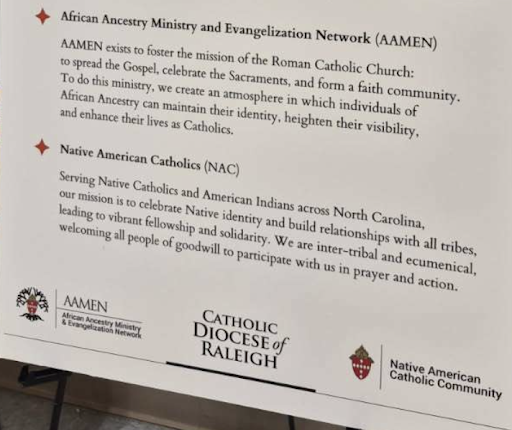
A Black-focused organization clunkily calling itself the African Ancestry Ministry and Evangelization Network (AAMEN), and another vehicle focused on Native Americans and indigenous peoples calling itself the Native American Catholic Community (NAC).
A woman from Ohio named Jennifer Jones is the administrator of both of these entities.

The AAMEN claims it seeks to “create an atmosphere in which individuals of African Ancestry can maintain their identity, heighten their visibility, and enhance their lives as Catholics.
The phrase “heighten their visibility” is a clue that AAMEN is a Bolshevik, progressive entity.
Google explains:
“Heightening visibility” is a core strategic objective in leftist and progressive social movements, designed to bring marginalized issues, systemic inequalities, or suppressed narratives into the public eye. Because leftist political theory often operates from the premise that dominant societal institutions (like corporate media or state structures) inherently obscure systemic oppression, activists utilize visibility as a disruptive tool to force public acknowledgment and policy concessions.
Jones’s other organization, Native American Catholics, seeks to promote “solidarity,” another Bolshevik buzzword. They welcome “all people of goodwill to participate with us in prayer and action.”
The word solidarity is widely recognized among God-hating groups to symbolize joined efforts to fight injustice and “address the root causes of oppression.”
INTERCONNECTED LIBERATION
Key to Solidarity is the term Interconnected Liberation.
Interconnected Liberation, according to Bolsheviks who seek to impose Critical Theory upon society using the Hegelian Dialectic, recognizes that the “freedom and well-being of one group depend on the freedom and well-being of others.”
“Effective solidarity requires people with social privilege to support and elevate those who are directly impacted by injustice rather than taking over.“
This Bolshevik playbook is widely known and practiced among professional practitioners on the left who seek to infiltrate institutions and re-imagine them.
Action and Solidarity Work Together
-
Collective Power: Working in unison scales up campaigns and proves the strength of a movement. Research by social scientists shows that nonviolent campaigns with active, widespread participation achieve lasting change more effectively. [1, 2]
-
Sustaining Energy: Shared community support, emotional care, and mutual validation prevent activist burnout and build long-term resilience. [1]
-
Cross-Movement Coalitions: Historical figures like Yuri Kochiyama modeled cross-racial and cross-issue solidarity by uniting Asian American, Black liberation, and anti-imperialist movements. [1]
Former Yale professor and Harvard Thinktank Chair Charles Euchner explains that elevating “invisible and forgotten” people is a must in his book Rules of Activism.
Euchner’s rule 10 reads, in part,
Activists aim to transform the minds of people, both inside and outside the movement. To do so, they need to gain visibility and speak with a clear moral voice. People gain power and courage when they state their demands, in public view and with the support of others.
In other words, the very act of holding an event during which Catholics are invited to practice the shamanistic smudging ritual is geared at transforming Catholic minds toward acceptance of non-catholic practices specifically by hosting the event.
Unsurprisingly, Euchner’s book is praised by Bolshevik climate activist Bill McKibben and Barry Bluestone, a highly regarded New England academic who infamously wished Donald Trump dead. (Good luck finding the video of that remark online.)
Many of Euchner’s writings center on overthrowing tyrants.
WHO IS JENNIFER JONES?
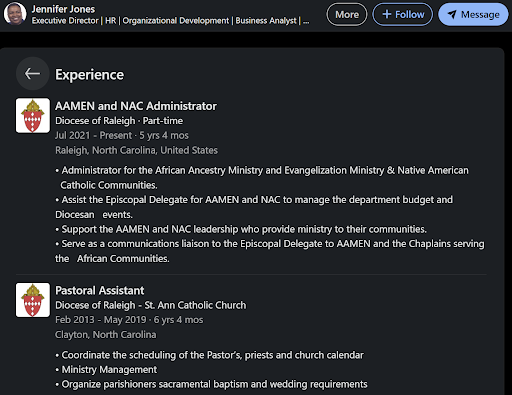
Jennifer Jones, administrator for the African Ancestry Ministry and Evangelization Network and Native American Catholic Community.
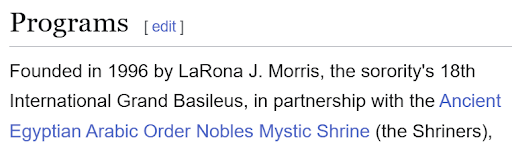
Jennifer Jones formerly worked for Sigma Gamma Rho Sorority, a black-only greek fraternity that has partnered with the Ancient Egyptian Arabic Order Nobles Mystic Shrine (the Shriners), according to WikiPedia.
The New York Times has reported on two hazing incidents involving the Sigma Gamma Rho.
In 2008, a pledge at San Jose State University filed a civil suit against the sorority after being severely beaten, harassed, and threatened to keep the abuse a secret.
Four sorority members were arrested and served 90 days in county jail. In 2010, at Rutgers University, six Sigma Gamma Rho women were arrested and charged with a felony after striking one pledge over 200 times. The victim sought medical attention.
In March 2022, the Sigma Gamma Rho was expelled from Bowling Green State University following reports of “severe hazing.”
Sigma Gamma Rho violated six BGSU Code of Student Conduct policies, including aggravated assault and forcing pledges to steal alcohol and marijuana.
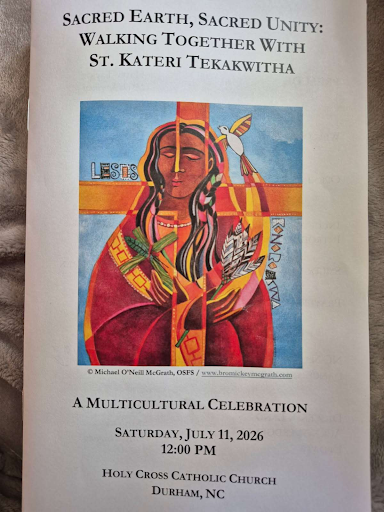
The Diocese of Raleigh hosted its first multicultural celebration honoring St. Kateri Tekakwitha — the first North American Indigenous saint — July 11 at Holy Cross Church. Discussions, prayer, native traditional dance, presentations and even the lunch menu were built around the theme: Sacred Earth, Sacred Unity: Walking Together with St. Kateri Tekakwitha.