


Even as the infamy of the Tren de Aragua grows in the Americas, its cohesion and organization are weakening.
The assertion by the regime of Nicolás Maduro that Tren de Aragua has been wiped out in Venezuela is fiction. The taking of the prison of Tocorón, the gang’s headquarters, was a huge blow to the criminal enterprise. The group has been significantly weakened and lost much of its political top cover and state allies. But there are still redoubts of the gang, especially that of Yohan Jose Romero, alias “Johan Petrica,” in Las Claritas, Bolívar state. Las Claritas reveals that Tren de Aragua elements still have some state backing, enjoy impunity and are earning money, in this case from gold, while working with elements of the Maduro regime.
Turning to the US assertions about Tren de Aragua, that it is a growing regional threat, staging some kind of invasion of the United States, and is directed from above by Maduro, also does not ring entirely true.

*This article is the eighth in a nine-part investigation, “Tren de Aragua: Fact vs. Fiction,” analyzing the truth about the gang, as well as its evolution, current operations and how it may change in the future. Read the full investigation here.
While the activities of Venezuelan criminals in Latin America may be increasing, that is more linked to sanction-busting and cocaine, where Tren de Aragua plays no major role. Nor is there convincing evidence that most of this activity abroad is being directed by any centralized Tren de Aragua leadership. Yes, two of the gang’s founders are still at liberty, Hector Rusthenford Guerrero Flores, alias “Niño Guerrero,” and Johan Petrica, but are they stage managing all the different Venezuelan gangs that operate abroad?
Sources in Las Claritas and within Tren de Aragua state that both men travel. Colombian intelligence sources indicated that Niño Guerrero has not only been in Colombia but traveled up as far as Mexico before returning. This shows that Tren de Aragua has enough criminal infrastructure to allow one of the region’s most wanted to travel unhindered and undetected through multiple countries. This would make sense since human smuggling and trafficking, combined with control over border crossing points, lies at the heart of the Tren de Aragua business model.
Sources in Bolívar state and Tren de Aragua members have revealed that Johan Petrica regularly crosses into Brazil, but not much further afield, preferring to remain in his criminal fiefdom in Las Claritas. His recent sanctioning by the US government, and the offer of a $4 million reward for information leading to his capture, will likely make him even more cautious.
SEE ALSO: Niño Guerrero: The Prison Kingpin Who Took Tren de Aragua Transnational
So, these two leaders could still be coordinating international operations of Tren de Aragua. However, it is hard for them to move around, especially now, and thus provide direct leadership and organizational skills. Long study of different criminal groups around Latin America and the Caribbean by InSight Crime reveals that a lack of direct and present leadership weakens any criminal enterprise over time. Criminals are not by nature especially loyal and are driven primarily by greed and personal enrichment. Tren de Aragua has no ideology or central ethos and little organizational unity now that Tocorón is gone. While Las Claritas is clearly a gang stronghold, it is a town in a remote part of Venezuela, without the transport and communications hub needed to run a transnational criminal enterprise, unlike the prison of Tocorón, which was in the heart of Venezuela, connected by motorways to the rest of the country, and less than two hours from Caracas.
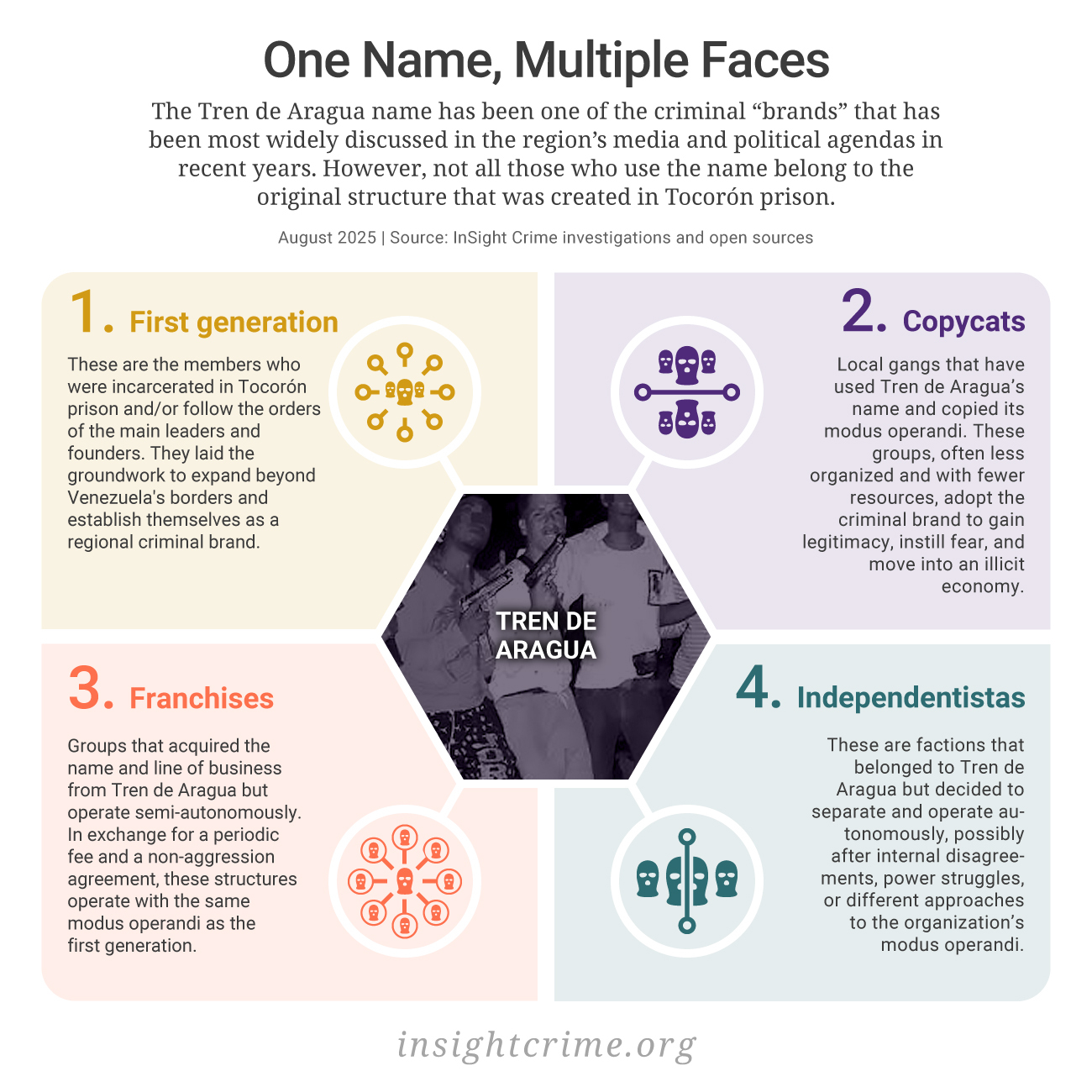
Police and judicial sources from Colombia, Peru, and Chile all say the same thing. Tren de Aragua has been weakened since the closing of Tocorón, and the different affiliates are acting with increasing autonomy, with less evidence of coordination or even cooperation between them. Add to this a wide range of copycat gangs that use Tren de Aragua’s name to project fear, but have nothing to do with the group.
The old guard of Tren de Aragua, recruited and formed in Tocorón, is being decimated through captures and deaths. And with the loss of the gang’s central corps, any unity the organization once enjoyed, which was always fragile, is fast being eroded.
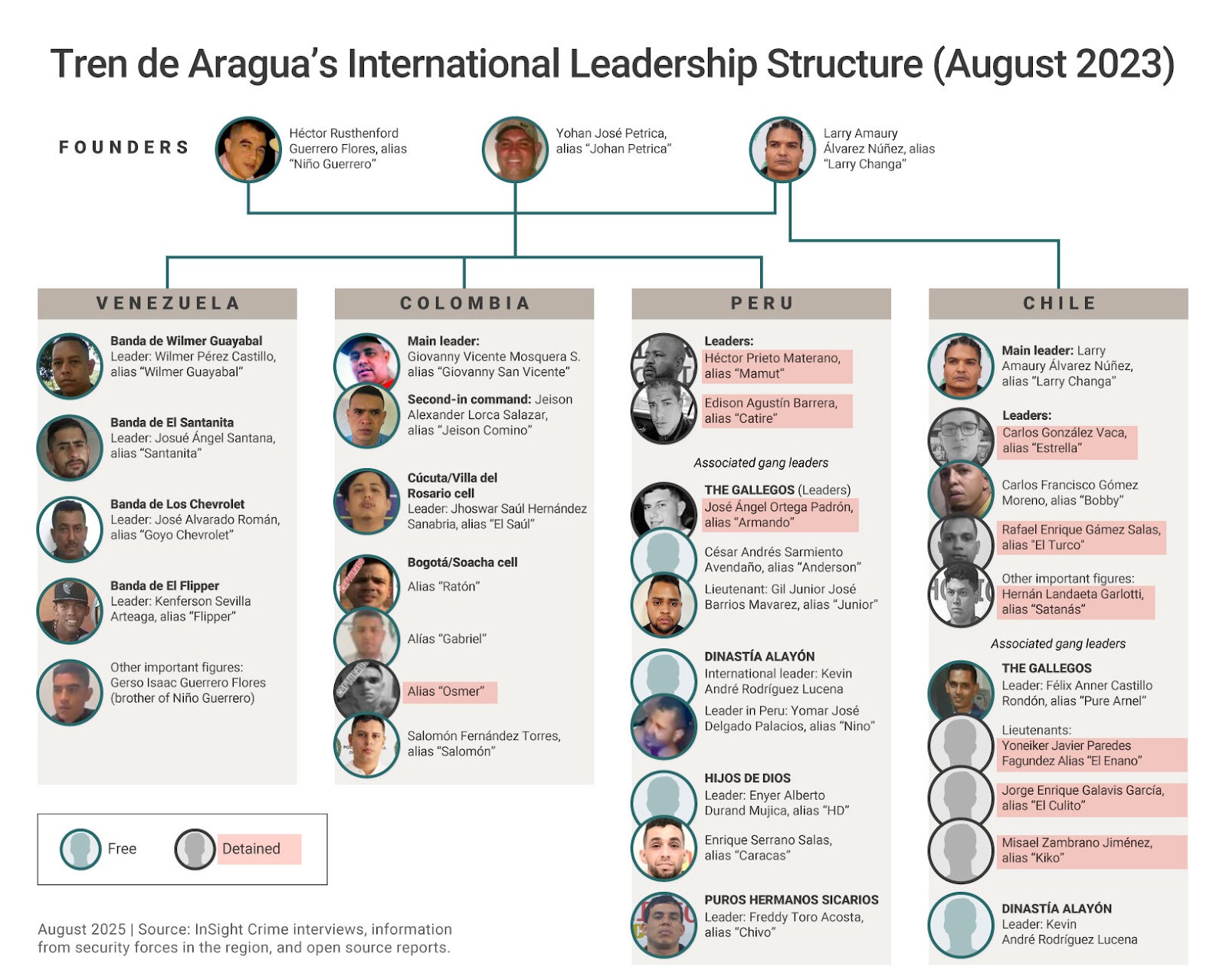
The upper echelons of Tren de Aragua in August 2023, before the takeover of prison of Tocorón, were clear, organized and relatively cohesive. While different gangs had large amounts of autonomy, there was contact between the different factions and often mutual support, although it would be false to suggest that the three founders exercised authority, or any significant level of control, over all the affiliated gangs.
However, by August 2025 there was a very different picture.
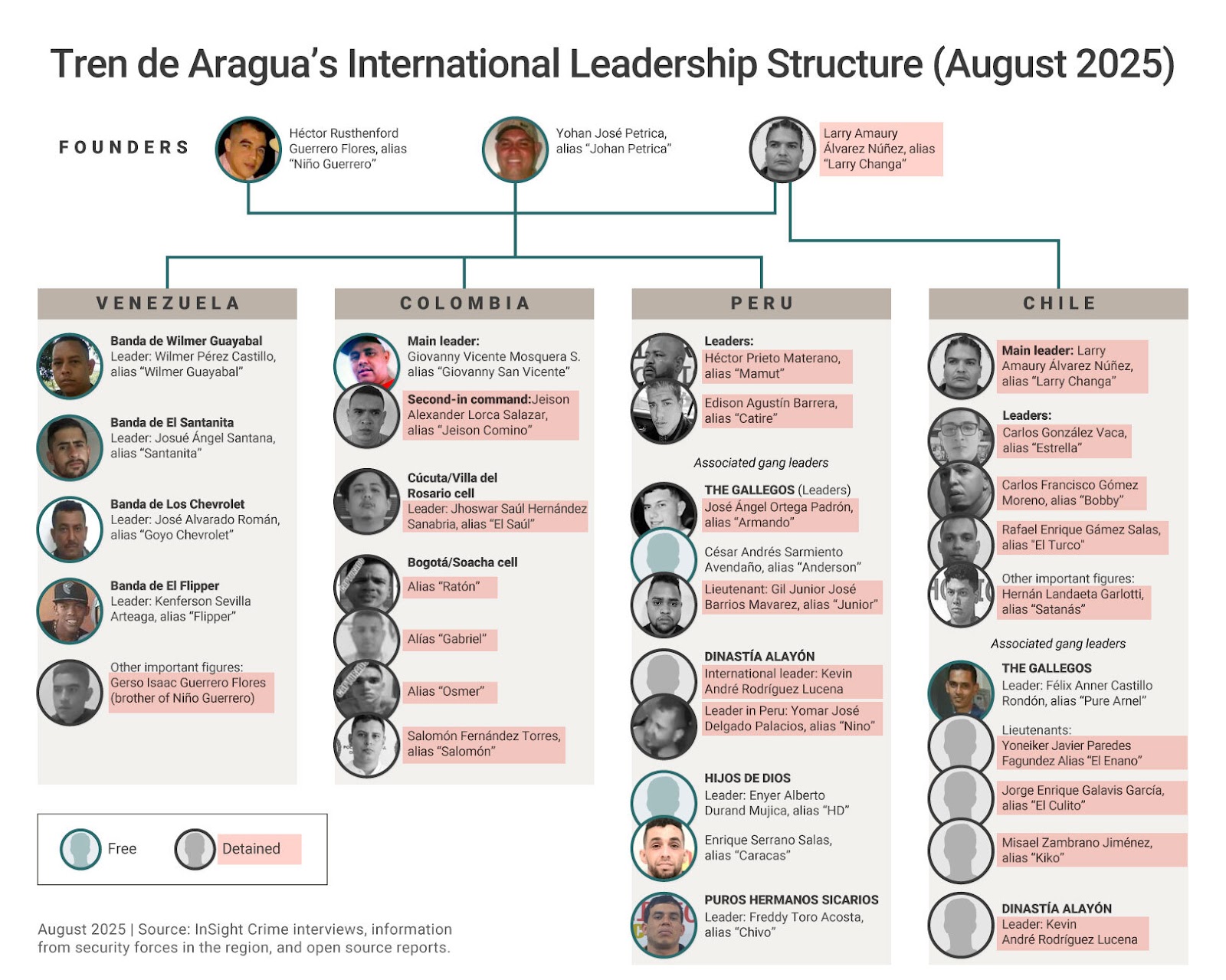
While the leadership in Venezuela was still largely intact, rebuffing the Maduro regime’s claims of having dismantled the gang, more than half of the identified leadership abroad had been captured. This reveals the growing capacity of, and cooperation between, law enforcement in Chile, Colombia and Peru. While the gangs themselves still exist, much of the new generation of leaders do not have the same personal relationship to Tren de Aragua founders and did not serve time in Tocorón.
While the United States has a large Venezuelan diaspora, many now fearful of deportation and therefore less likely to work with state or federal authorities, there is no evidence of a deliberate dispatching of Tren de Aragua members by senior gang leadership, let alone orders to set up organized and coordinated cells. While the presence of Venezuelan criminals in the United States is undeniable, with some having affiliations with Tren de Aragua, or having spent time in Tocorón prison, there is no evidence of a strategically planned, or concerted attempt, to invade the US mainland and establish permanent and coordinated gang presence. This did not even happen in Colombia or Peru. Tren de Aragua presence there was initially haphazard and uncoordinated, with links to Tocorón and the central Tren de Aragua leadership occurring after the first wave of criminal colonization by Venezuelan delinquents.
So who are all these Tren de Aragua members being arrested in the United States, with some deported to El Salvador’s notorious Terrorism Confinement Center (Centro de Confinamiento del Terrorismo – CECOT)? How has US law enforcement determined they are really members of the gang? The Venezuelan authorities are not sharing much information on criminal antecedents, nor records showing which criminals served time in Tocorón under the rule of Niño Guerrero become available, if they exist. Much has been made of tattoos. Now while tattoos constitute a criminal uniform in prison gangs like El Salvador’s Mara Salvatrucha and Barrio 18, and the Russian mafia of “Thieves in Law” (Vory v Zakone), Tren de Aragua has no such code.
US accusations that Tren de Aragua is being used by Maduro to infiltrate into the United States and import tons of cocaine are also hard to substantiate. That Maduro has facilitated the production and trafficking of cocaine is beyond doubt. A US indictment recognizing Maduro and the regime’s number two, Diosdado Cabello, as heading a drug trafficking organization, described as the Cartel of the Suns, attests to this. However, the statement by the US Attorney General Pam Bondi claiming that Maduro has used Tren de Aragua to smuggle drugs is questionable. Tren de Aragua has, so far, not become a transnational drug trafficking organization. Elements of the gang certainly engage in the retail sale of narcotics, and there have been sources talking about migrants and gang members carrying small amounts of drug across borders in Latin America, but so far there are no cases of large cocaine shipments being linked to Tren de Aragua, especially not in connection with the US market. There may be cases where Venezuelan criminals, perhaps affiliated to Tren de Aragua, have acted as hired muscle or subcontracted labor for drug trafficking organizations.
That the Maduro regime works closely with criminal groups is beyond doubt. Indeed Maduro has set up a sophisticated system of hybrid criminal governance, developing symbiotic relationships with several criminal groups. The criminals give senior members of the Maduro regime access to criminal rents, while repressing opposition activity in their areas of influence. The Maduro regime in return offers sanctuary, space to grow, recruit and increase revenue and reach. Ties to Colombian rebel groups like the National Liberation Army (Ejército de Liberación Nacional – ELN) and dissidents of the now demobilized Revolutionary Armed Forces of Colombia (Fuerzas Armadas Revolucionarias de Colombia – FARC) have been consistently proven and many date back to the founder of the Bolivarian Revolution, President Hugo Chávez, who died in 2013, passing the political torch to Maduro.
However, this association with criminal groups has so far been largely restricted to Venezuelan territory, although the Colombian rebel groups certainly project themselves into Colombia.
There is however one example of a link between the Maduro regime and Tren de Aragua operating abroad. Ronald Ojeda, a dissident Venezuelan army officer who had fled to Chile, was allegedly kidnapped and murdered by Tren de Aragua affiliates. Chilean prosecutor Héctor Barros has directly linked the abduction and murder to Diosdado Cabello, the Maduro regime’s number two.
If true, this would mean that the Maduro regime has engaged in geo-criminality, that is the strategic use of organized crime and criminal actors by states to achieve foreign policy objectives. This lends some credence to the US accusation that Maduro could use Venezuelan criminals abroad, including in the United States. It is a stretch however to describe this as any kind of invasion.
The vilification of Tren de Aragua by the Trump administration seems to be motivated more by politics than any growing threat to the national security of the United States. But could the Venezuelan gang undergo yet another evolution and increase its power and reach? Or is it now, as the top Latin American boogeyman, condemned to irreversible decline?