


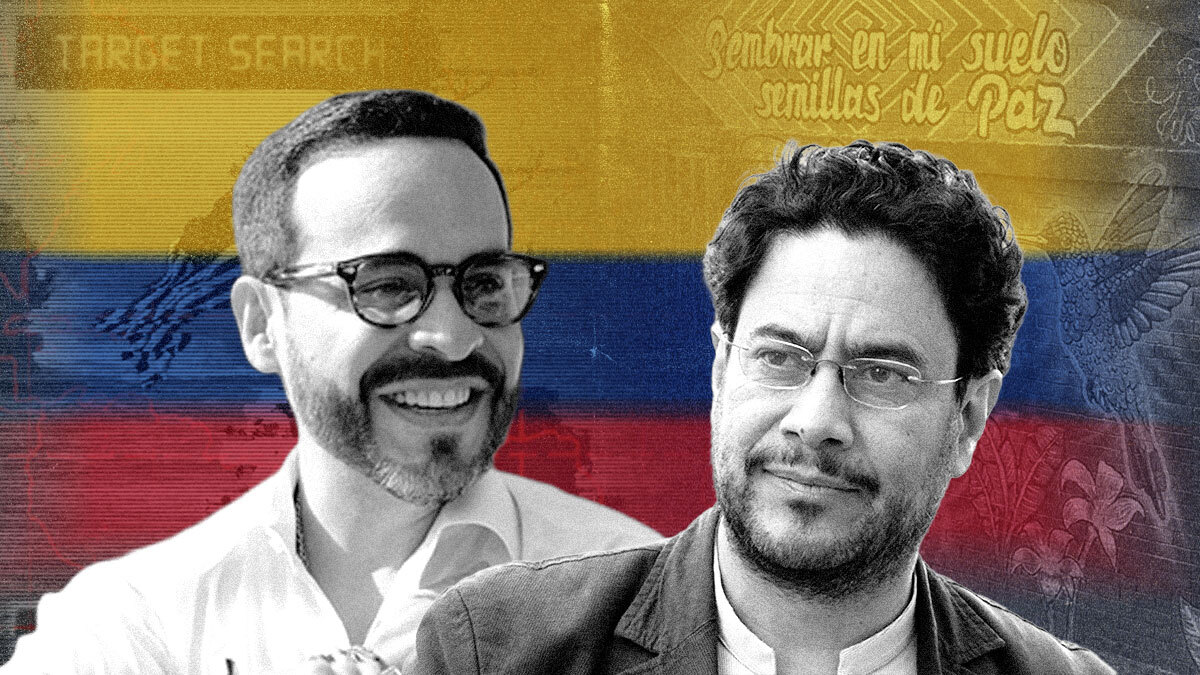
Iván Cepeda and Abelardo de la Espriella, two candidates with opposing visions for Colombia’s future on security, drugs, and peace, are set to face off in the presidential runoff this weekend.
Cepeda, a left-wing senator, philosopher, and peace advocate, will go up against De la Espriella, a lawyer, businessman, and admirer of US President Donald Trump who has promised to give security forces free rein against Colombia’s illegal groups.
Security, as always, is among Colombian voters’ top concerns. The first round of elections on May 31 made that clear, as centrist candidates focused on other social issues failed to win even 6% of the vote.
Voters are now left with two extreme options on June 21. Cepeda promises to continue the Petro government’s policies, with some changes. De la Espriella, who defeated the traditional right-wing parties in the first round, has promised to deploy security forces against the country’s many criminal actors, in line with the doctrine promoted by Washington.
InSight Crime presents the candidates’ main proposals on security, drug policy, and peace.
Cepeda and De la Espriella on Security
These presidential elections come at a critical moment for Colombia, with multiple fronts of conflict open, weakened security forces, and deteriorating relations with key security allies.
SEE ALSO: What Criminal Challenges Does Colombia’s Next President Face?
Given that violence varies widely by region, Cepeda proposes a territorially differentiated security approach, concentrating security force operations and state services in areas facing the most complex threats, such as ports, borders, and strategic corridors for illegal economies. This would be accompanied by efforts to strengthen the security forces, especially their logistical, operational, technological, and intelligence capacities.
To combat criminal groups, Cepeda wants to attack their economic structures through financial intelligence, criminal investigations, tax and fiscal oversight, more agile asset forfeiture mechanisms, and international cooperation.
Cepeda’s prison policy focuses on the rehabilitation of people who are incarcerated through opportunities for social and labor reintegration, as well as combating criminal economies and recruitment networks inside prisons.
Abelardo de la Espriella, meanwhile, has bet on a hard-line security approach that involves a direct offensive on organized crime. The candidate has spoken of “rebuilding” the security forces in rural areas and cities, and using additional capacities such as intelligence networks and new technologies.
His strategy also includes reclaiming the prison system by building 10 mega-prisons in remote areas of the country, inspired by the policies of other presidents in the region, such as Nayib Bukele and Javier Milei.
Finally, De la Espriella is considering reestablishing security relations with the United States, which deteriorated over the last year amid differences between Trump and Petro on security and drugs. He has also expressed affinity with the United States’ National Drug Control Strategy, which pressures countries such as Colombia to deliver tangible and quantifiable results.
Cepeda and De la Espriella on Drug Policy
Colombia remains the world’s largest cocaine producer, placing drugs at the center of the presidential debate.
President Petro’s drug policy sought to move away from traditional drug war approaches, setting aside the emphasis on the weakest links in the chain, such as coca growers, and prioritizing efforts to affect the transnational criminal networks behind drug trafficking through seizures, the destruction of drug production infrastructure, and increased capacity to investigate money laundering and corruption.
However, his strategy faced major challenges in practice, including opposition from the US government, which led to Colombia’s decertification on drug control in 2025.
SEE ALSO: US Pressures Colombia With Threat of Anti-Drug Aid Cuts
Despite this, Cepeda wants to continue along this progressive path, moving away from a prohibitionist approach.
“These dynamics are embedded in an international geopolitical structure that has treated the drug problem as a matter of global security, privileging militarized responses and placing a disproportionate burden on producer countries, while the largest profits are concentrated in international markets,” his government plan states.
He proposes addressing drugs through regulation, initially of cannabis, while leaving the door open to the regulation of other substances, such as coca leaf and opium poppy. He also proposes regional alliances to combat money laundering and corruption, which help transnational criminal networks function.
De la Espriella places the aerial eradication of coca crops at the center of his strategy. Although he has clarified several times that he would not use glyphosate, due to a Constitutional Court ban, he would seek to eradicate all coca hectares in Colombia. He has mentioned manual eradication, drones, and artificial intelligence among the tools to destroy crops and drug production laboratories, alongside illicit crop substitution, although it remains unclear how the latter would be implemented.
“The fundamental thing is to start fumigating all the sources of violence in Colombia, that is, the coca hectares,” the presidential candidate said in an interview with Noticias Caracol.
De la Espriella has argued that the fight against illegal economies is a fundamental component of recovering territorial control and weakening criminal structures. The candidate also supports targeting drug traffickers’ capital, expedited asset forfeiture, and extradition to attack other links in the drug trafficking chain. These measures have been used by previous governments, including Petro’s, but have failed to stop the economies that feed the country’s illegal groups.
Cepeda and De la Espriella on Peace Plans
The question of continuing or ending talks with illegal groups under Total Peace (Paz Total) has also polarized the candidates.
The policy, one of the Petro government’s flagship initiatives, has been widely criticized for contributing to the strengthening of illegal armed groups, for its legal gaps, and for the increase in violence, among other issues.
SEE ALSO: GameChangers 2025: Colombia’s Total Peace Remains in Pieces
While Cepeda leaves the door open to peace talks with armed groups, he distances himself from Total Peace. In response to criticism of Petro’s initiative, he proposes what he calls “Integral Peace,” aimed at producing concrete, verifiable, and measurable results, and at requiring clear commitments from groups to ensure respect for civilians and social leaders.
“We will not allow dialogue to be used as a strategy for the military or economic strengthening of armed organizations; peace is built with verifiable actions, not empty promises,” his government plan states.
Finally, Cepeda proposes reactivating implementation of the Havana accords by mobilizing state capacity, coordinating with the international community, and strengthening participation from the territories.
De la Espriella has been blunt: “There will be no negotiations with criminals.” The candidate has said on several occasions that, if elected president, he will end the peace talks launched by Gustavo Petro’s government through its Total Peace policy. Instead, he will prioritize the recovery of territorial control through a first line of security.
“Colombia is suffering a pandemic of insecurity today; crime has skyrocketed. What is happening is a true disaster. We need to recover security by reason or by force, within the framework of the Constitution,” the candidate said in an interview with CNN en Español.
De la Espriella proposes direct military operations against Colombia’s main organized crime groups and the dismantling of militias.