


The US government’s new sanctions against Venezuela’s so-called “Cartel of the Suns” incorrectly portray it as a hierarchical, ideologically driven drug trafficking organization rather than a profit-based system of generalized corruption involving high-ranking military figures.
The US Treasury Department’s Office of Foreign Assets Control (OFAC) sanctioned the Cartel of the Suns (Cartel de los Soles) as a “Specially Designated National” on July 25. The agency claimed the group works with the Venezuelan gang Tren de Aragua and the Mexican criminal group, the Sinaloa Cartel, to use drug trafficking as a “weapon” against the United States.
SEE ALSO: Maduro Consolidates Criminal Power in Venezuela Municipal Elections
The designation places financial sanctions against those accused of being part of the organization, including President Nicolás Maduro and other high-ranking Venezuelan officials. But many of the officials the Treasury Department targeted have previously been sanctioned, and so have already effectively been blocked from the US financial system.
As a result, the new measures are unlikely to impact them personally. However, by naming the organization as a whole, instead of specific individuals, the sanctions could allow OFAC to more broadly target businesses or individuals suspected of financially interacting with Venezuelan officials.
The sanctions came shortly after the United States and Venezuela engaged in a prisoner swap and the day after Maduro announced the United States had allowed the oil company Chevron to renew its operations in Venezuela, suggesting that President Donald Trump seeks to present a tough posture toward Maduro without closing off relations with the country completely.
While considerable evidence has shown that Venezuelan government and military figures do profit from drug trafficking, the latest US sanctions presented an inaccurate image of how the Cartel of the Suns operates.
The Cartel of the Suns Is Not a Hierarchical Organization
The Treasury Department claims that Maduro heads the Cartel of the Suns, but that is an oversimplification.
Rather than a hierarchical organization with Maduro directing drug trafficking strategies, the Cartel of the Suns is more accurately described as a system of corruption wherein military and political officials profit by working with drug traffickers.
SEE ALSO: Debunking 3 Myths About Tren de Aragua
Officials are not necessarily directly involved with drug shipments, though in certain cases military vehicles may be used to move drugs. More often, officials use their positions to protect traffickers from arrest and ensure that shipments pass through a territory.
Maduro and other high-ranking officials permit this kind of corruption to ensure the loyalty of lower ranks. But the decentralized nature of its structure means that the removal of individual high-ranking officials would likely have zero impact on how the broader network operates.
The Cartel of the Suns Does Not Use Drugs As a ‘Weapon’
The sanctions present the Cartel of the Suns as an organization that seeks to undermine the integrity of the United States by pushing its citizens into drug addiction. But it is a system driven by pragmatism and profit, not ideology.
Maduro, like former President Hugo Chávez before him, has bought the loyalty of the military by allowing its members, from the poorly paid rank-and-file to the high-ranking officials whose support he needs in order to stay in power, to profit from drug trafficking.
The drugs that flow from Venezuela to international markets support that system, but they do little to contribute to instability in destination countries. Moreover, the drugs’ destination is determined by profitability first; the shipments flow to European countries with less openly hostile relations with Venezuela as well as supposed ideological enemies like the United States.
The Cartel of the Suns Does Not Support Tren de Aragua
The latest sanctions erroneously link the Cartel of the Suns to Tren de Aragua, the transnational gang of Venezuelan origin that Trump recently designated as a foreign terrorist organization.
Although Tren de Aragua once enjoyed political protection within Venezuela, the government retook control of Tocorón prison, the gang’s de facto headquarters, in September 2023, and since then, the remnants of its associated factions that remain in Venezuela have been the targets of security force operations. A declassified memo from April showed that US intelligence agencies doubt that Maduro is directing the activities of Tren de Aragua.
Additionally, there is a lack of evidence to suggest the gang is a major player in trafficking drugs to the United States. Although some cases demonstrate Tren de Aragua’s involvement in transnational drug trafficking, it is more commonly linked to extortion, human trafficking, and migrant smuggling.
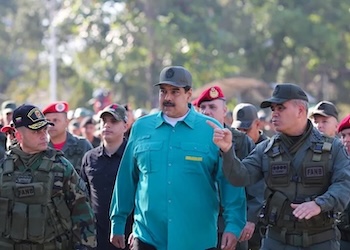
Featured Image: Venezuelan President Nicolás Maduro and Defense Minister Vladimir Padrino López at a military event. Credit: Reuters