


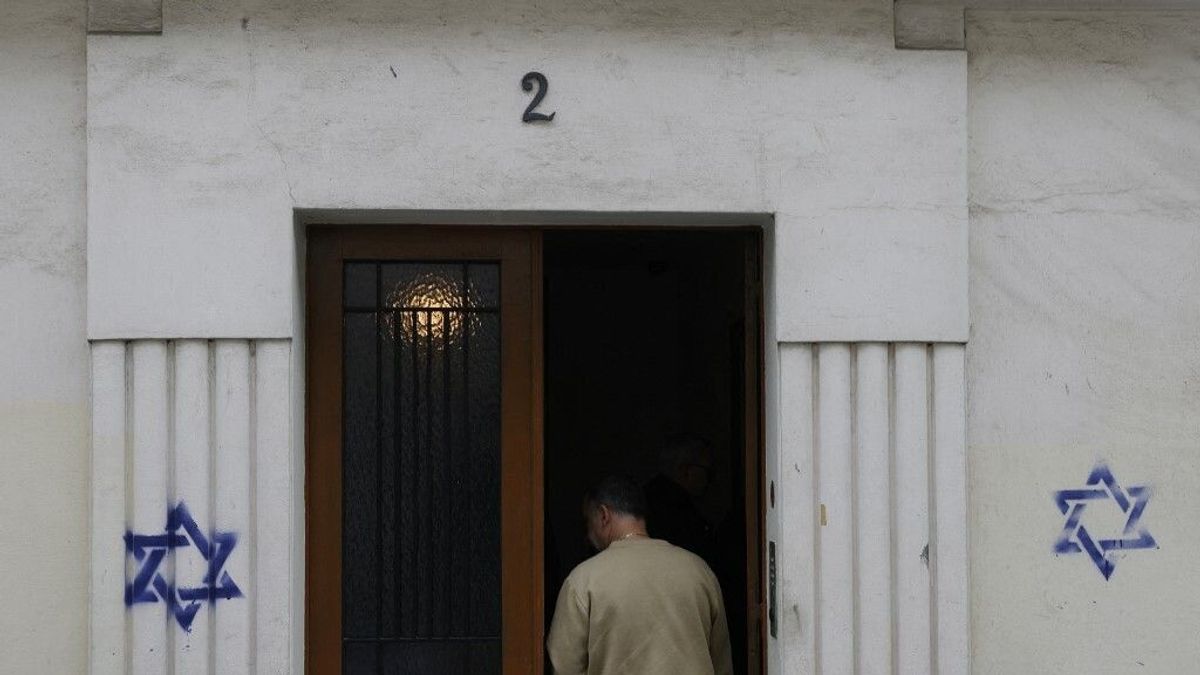
In the quiet of the night, the streets of Paris and its suburbs became the canvas for a campaign of Star of David graffiti, sparking outrage and fears of antisemitism within the community. This act, consisting of 60 identical stars, emerged in the wake of the harrowing conflict between Israel and Hamas, a detail that did not go unnoticed. As the investigation unfolded, French authorities have pointed the finger at an unexpected perpetrator: Russia’s Federal Security Service (FSB), implicating international espionage in acts of vandalism that seemed, at first glance, to be driven by local or individual antisemitism.
The Investigation Unravels
The graffiti, which started appearing in late October, quickly drew condemnation from across the political spectrum in France, as well as concern from Jewish communities. A Moldovan couple was soon apprehended, linked to what French authorities described as a pro-Russian Moldovan intermediary. This connection hinted at a broader narrative, a suspicion further fueled by the revelation from France’s international security service, DGSI, that the FSB, Russia’s main intelligence agency, was believed to be the orchestrator of this campaign. According to a report, the operation was seen as part of a larger disinformation campaign also targeting several other European countries.
The use of the Star of David, a symbol deeply engrained in Jewish identity and history, particularly in the context of the Nazi occupation of France during World War II, was interpreted as a direct threat to the Jewish community. However, this narrative was complicated by the ongoing conflict in the Middle East and the diverse reactions it elicited within France’s population, including its significant Muslim community.
A Complex Web of Motives
Attributing the graffiti to the FSB raises more questions than it answers. In a landscape already fraught with tension from the Middle East conflict, the motives behind Russia’s alleged involvement remain speculative. France, with its vocal support for Ukraine amidst the Russian invasion, has found itself in a precarious position, navigating accusations of Russian aggression in various forms, from cyberattacks to propaganda. The alleged FSB operation, as reported, seems to aim at amplifying divisions within French society, leveraging the sensitive context of the Israel-Hamas conflict to sow discord.
Yet, the narrative is not without its skeptics. The quick attribution to a foreign intelligence agency, without public evidence, echoes the broader Western narrative of Russian meddling. This skepticism is compounded by the complex dynamics within France itself, including the tensions between different community groups and the diverse opinions on the Israel-Palestine conflict.
Implications and Reactions
The response to the graffiti and the subsequent investigation has been a mix of outrage, concern, and skepticism. The French government’s accusations against the FSB, if proven true, highlight a brazen act of international espionage and interference. Yet, they also reflect the ongoing challenges in distinguishing between internal and external threats, especially in a world increasingly interconnected and fraught with geopolitical tensions.
As the investigation continues, the graffiti serves as a stark reminder of the complexities of modern geopolitics, where acts of vandalism can become entangled with international intelligence operations, and the lines between domestic and foreign interference blur. For the Jewish community in France, and indeed for all French citizens, the incident is a call to remain vigilant against threats, both seen and unseen, and to foster unity in the face of attempts to divide.