


One of Mexico’s most powerful crime groups, the Jalisco Cartel New Generation (Cartel Jalisco Nueva Generación – CJNG), is employing forced disappearance and exploiting corruption to build up a burgeoning local drug market on its home turf of Guadalajara.
Drug use, in particular of crystal methamphetamine, has skyrocketed in recent years in and around Guadalajara, the capital of the CJNG’s home state of Jalisco. In 2022, over two-thirds of people seeking help for addiction at Jalisco’s non-governmental treatment centers said crystal meth caused them most harm, according to the Mexican government’s Epidemiological Surveillance System for Addictions (Sistema de Vigilancia Epidemiológica de las Adicciones – SISVEA).
As the market has expanded, the CJNG has corrupted local officials and ramped up its use of forced disappearances to maintain social and territorial control, activists, academics, and authorities told InSight Crime.
While the CJNG has made extreme violence one of its hallmarks, in Guadalajara, however, it has opted to keep overt violence to a minimum.
“Outside of Jalisco it seems like a very bellicose group,” Jorge Ramírez, a sociologist at Guadalajara University, told InSight Crime. “But here it exercises a much finer control.”
Fighting for Control of the Local Drug Trade
The CJNG is heavily involved in Guadalajara’s local drug market. By controlling the market, and thus controlling territory, the group also accesses the areas it needs to exploit other criminal economies, including extortion and drug production.
The city’s thriving local drug market is made of a network of points of sale, or “puntos,” stretching across the city. In addition to locations that sell drugs, these spots serve to provide a constant flow of information to criminal groups of the whereabouts of rival groups and authorities. But while the CJNG is the most powerful criminal group in Guadalajara and acts as an umbrella organization for several local cells, it does not have total dominion over the city’s drug trade.
Drug consumers told InSight Crime there are places to buy drugs everywhere and access to drugs is easy.
SEE ALSO: How a Priest in Mexico Resists the CJNG’s Incursions
“Wherever you want there are puntos … including in bars and restaurants, even family restaurants,” said a source who collected extortion payments from bars for the CJNG, whose name we are withholding for security reasons.
The accessibility of drugs has contributed to an increase in consumption locally, particularly of crystal methamphetamine, a higher-purity form of methamphetamine, according to Federico Topete, a clinical psychologist at the Guadalajara Youth Integration Centers (Centro de Integración Juvenil – CIJ), which help at-risk youth.
“We’ve had 12-year-old kids consuming crystal … Middle schools have become pivotal,” he said.
Many adult users take it to boost their energy during long workdays, consumers and experts told InSight Crime.
As the local drug market has grown, so has the competition between criminal groups that operate under the umbrella of the CJNG, but who are nonetheless often at odds with each other.
The city is broken into different zones of territorial control. Each group sells drugs with specific colored packaging. In doing so, the groups create a proxy territorial map, marking which groups control which area. Users who are caught consuming drugs from a rival group, or who buy from the wrong dealer, are threatened, killed, or disappeared, sources said.
“Buying wherever you want is delicate because it could be said that you’re buying from a rival criminal organization,” said the extortion manager.
Forced Disappearances
Forced disappearances are central to the CJNG’s control of Guadalajara’s drug market.
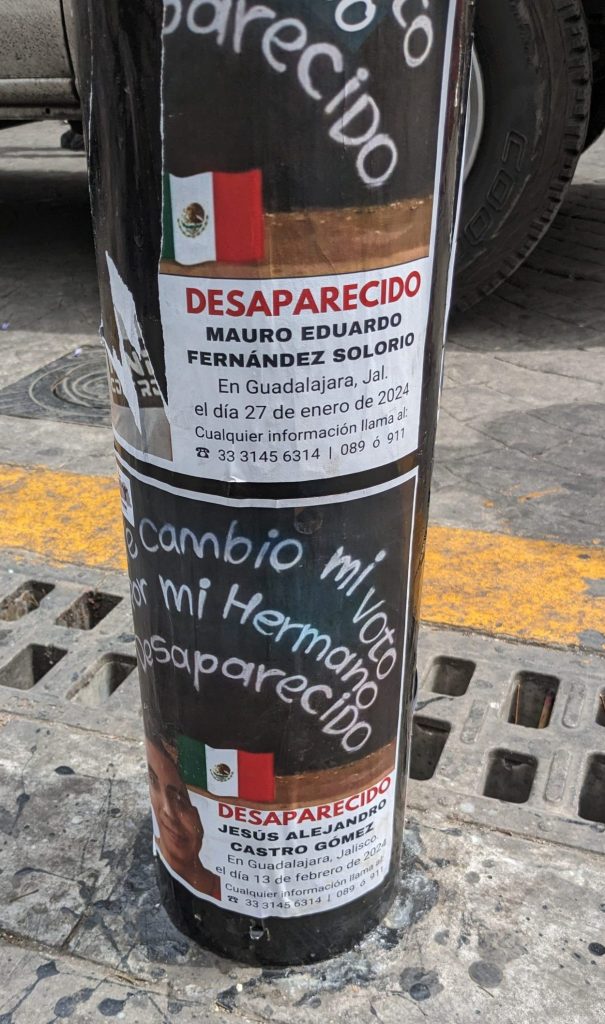
There are more than 115,000 disappeared persons in the Mexican government’s registry. Jalisco is at the heart of this crisis, topping the list of states with the most disappeared. Here, over 15,000 people are currently missing, according to state figures.
The majority of these cases are likely connected to organized crime, local experts told InSight Crime.
SEE ALSO: Facing Death and Dismissal, Mexico’s Mothers Keep Searching
The CJNG often disappears people in Guadalajara as punishment for infractions like not paying debts, buying drugs from an unauthorized supplier, or for committing unauthorized petty crimes like robberies. Some victims are disappeared for allegedly belonging to rival groups, while others may be forcibly recruited into the CJNG’s ranks. The group may also kidnap drug users to question them and retrieve information about rival gangs, and then kill and disappear them after that, according to sources consulted by InSight Crime.
Disappearances began to surge in 2009 when 96 people were registered as disappeared. This was around the time the CJNG emerged as a criminal organization in its own right, following internal divisions and war between factions of the group’s forerunner, the Milenio Cartel.
As the CJNG established its rule in Jalisco, disappearances in the state climbed steadily. They peaked in 2019, with 1,754 disappeared, likely due in part to reprisals between different CJNG factions. Yet high levels of disappearances continue. Last year, the state registered 1,574 disappearances. The vast majority of those missing are men.
During this period, homicides also increased in Jalisco. But the increase in homicides was nowhere near as steep as the climb in disappearances.

The disparity may be due to the desire of state authorities to keep murder rates down.
“The general tendency of increasing disappearances is due to the anxiety of the state and federal government to control homicides,” said Ramírez, the sociologist.
Open displays of violence put pressure on authorities to act, and neither side has any interest in an escalating confrontation.
“I’m not sure if that has led to express agreements [with criminal groups], but it has made very clear that this [open violence] is not acceptable … the essential idea is that bodies should not be seen,” he added.
The vast majority of murders in Mexico are never solved, but the lack of physical evidence like a body in disappearance cases impedes the justice process even further, lessening the likelihood of prosecution.
Forced disappearances also have a psychological impact on civil society in Guadalajara.
The emotional turmoil of not knowing what happened to your loved one is destructive and changes lives forever, Héctor Flores, who is searching for his son Daniel who disappeared in 2019, told InSight Crime.
“Although you’re with your family, you carry your pain … It’s difficult to spend time with other people,” he said.
Many victims, such as Daniel, have no connection to organized crime but are disappeared regardless, leaving families in limbo and authorities nonplussed. In some cases, discarded bodies or remnants of the individuals are discovered much later, often in clandestine graves. In other cases, no trace of the person is ever found.
Corrupt Law Enforcement
The corruption of Guadalajara’s security forces has enabled the CJNG to disappear victims with impunity and dominate the city, sources suggested.
The city has a history of police abuses and links to organized crime. In 2020, protests erupted in Guadalajara after the death of Giovanni López, a day laborer who was arrested for allegedly not wearing a face mask and died a day later while in police custody. Dozens of protestors were allegedly kidnapped by disguised police officers. Some were beaten while others faced death threats before being dumped miles away.
Relatives of at least two of the officers arrested in the aftermath campaigned against their arrests, stating that the officers were only following orders from their superiors, who had instructed them to disrupt the protests by organized crime groups, Proceso reported.
Nationwide, security forces have regularly been accused of human rights abuses, often working hand-in-hand with the criminal organizations they are supposed to confront.
Flores is convinced that state authorities were involved in his son Daniel’s disappearance. Daniel’s girlfriend, who was there on the night of the kidnapping but was left behind because she was pregnant by two alleged CJNG members who were armed, claimed that a member of the Jalisco’s Attorney General’s Office was present.
A series of strange and contradictory pieces of information from state authorities, including that Daniel had been taken to a nearby prison, which prison authorities immediately denied, alarmed Flores.
Institutional failures have plagued the case. Police arrived at the scene two and a half hours after the kidnapping was first reported, Flores said. Then, the Attorney General’s Office took almost a year to present a search plan for Daniel.
Earlier this year, the Jalisco State Human Rights Commission (Comisión Estatal de Derechos Humanos Jalisco – CEDHJ) documented “irregularities” in Daniel’s case, including a lack of due diligence, transparency, or rigor in police investigations, according to El Diario Guadalajara. Those leading the investigation failed to carry out basic procedures, such as checking Daniel’s social media accounts and emails, or even searching for him on police databases, the CEDHJ said.
Ramírez, the crime expert at Guadalajara University, said he would “not doubt one bit” that security officials could be involved with criminal organizations in local forced disappearances.
For the last three years, Flores has continued searching for his son. In doing so, he has received multiple death threats, has been forced to move his home due to intimidation, and wears two panic buttons around his neck at all times, intended to alert federal and state authorities to any threat he might face.
Despite the harassment, he said he will carry on with his search for Daniel.
“He’s my son,” he said. “I’m not going to stop.”
*Analy Nuño contributed reporting for this article.
The featured image was partially created with the help of AI. The graphic design was an original creation of InSight Crime’s design team.