


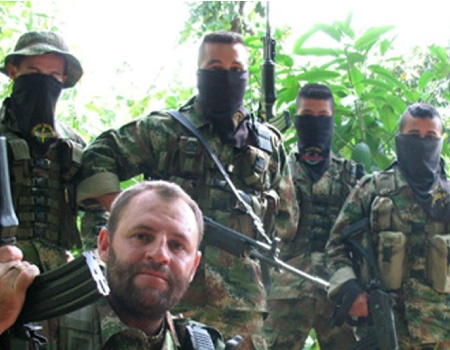
What is known today as the Popular Liberation Army (Ejército Popular de Liberación – EPL), or the Pelusos, is a dissident faction of the original EPL’s Libardo Mora Front that refused to demobilize with the rest of that guerrilla group in 1991. Its main area of operation is located in the Catatumbo region of the Norte de Santander department, where it is involved in drug trafficking and extortion.
History
The EPL was formed in 1967 as an armed wing of the Colombian Communist Party (Partido Comunista Colombiano Marxista Leninista – PC-ML), under the Maoist ideology of a protracted people’s war, which aimed to take it from rural to urban areas by setting up revolutionary governments or juntas patrióticas.
Established in the department of Córdoba, in northern Colombia, the EPL was nearly eradicated by the government’s offensives in 1960 and 1967. But the rebel group survived the military operations and during the 1970s expanded towards Antioquia, particularly the Urabá region. Its expansion continued into the 1980s, when the group settled in important agroindustrial areas and was present in several departments.
On March 10, 1984, the EPL began peace negotiations with then-President, Belisario Betancur (1982-1984), but talks quickly broke down in 1985 due to the murder of the group’s negotiator and his brother. After the failed talks, the EPL joined the Simón Bolívar Guerrilla Coordinating Board (Coordinadora Guerrillera Simón Bolívar – CGSB), an umbrella group of guerrilla organizations that sought to strengthen their political leverage in future negotiations. The board included the Revolutionary Armed Forces of Colombia (Fuerzas Armadas Revolucionarias de Colombia – FARC), the National Liberation Army (Ejército de Liberación Nacional – ELN), the M-19, the Comando Ricardo Franco Frente Sur, the Quintín Lame Armed Movement (Movimiento Armado Quintín Lame), and the Revolutionary People’s Army (Ejército Revolucionario del Pueblo – ERP).
After a new round of negotiations with the government of Julio César Gaviria Trujillo (1990-1994), the EPL, which by then had about 2.556 members, demobilized in 1991 and created the Hope, Peace, and Liberty political movement.
However, a group of fighters did not demobilize. Among them was one of the EPL’s founders and top commanders, Francisco Caraballo. Confrontations with other more powerful guerrilla groups like the FARC and paramilitary groups like the United Self-Defense Forces of Colombia (Autodefensas Unidas de Colombia – AUC), along with military operations and the arrest of Caraballo in 1994, impeded the consolidation of the dissident group.
The only faction that remains is the Libardo Mora Front in Catatumbo, in the municipalities of Teorama, Hacarí, Convención, San Calixto, and Ocaña. In 2015, the government troops killed the EPL’s leader, Víctor Navarro Serrano, alias “Megateo.” After his death, the EPL suffered from a lack of leadership, and the FARC’s demobilization in 2016 led the group into a territorial dispute with the ELN in 2018. By 2019, the EPL had fractured into two distinct factions: one along the border with Venezuela and another one in the municipalities of Ábrego and Ocaña.
In 2021, the Ministry of Defense reclassified the EPL as an Organized Criminal Group (Grupo Delictivo Organizado – GDO) of less significance.
Leadership
After Francisco Caraballo’s arrest and repeated blows to the newly formed EPL dissidence, Megateo led the group from 2005 until his death in 2015. His successor, Guillermo León Aguirre, alias “David León”, was arrested on December 15, 2016, in Medellín.
Jader Navarro Barbaso, alias “Caracho”, then assumed the group’s leadership, but he is presumed to have been killed days later.
Over the past two years, the EPL has suffered from internal divisions. One guerrilla-like faction operates in Catatumbo and another, more criminal faction, is present on the border with Venezuela and in Cúcuta’s metropolitan area. This fracture has led to the death of several top leaders: in October 2019, the army killed the group’s main leader, Luis Antonio Quiceno Sanjuan, alias “Pácora”, and in March 2020, Jesús Serrano Clavijo, alias “Grillo”, was killed by his own men in a revolutionary war council. In October of that year, Pácora’s successor, Richard Arley Díaz Garay, alias “Cóndor”, was arrested in Norte de Santander.
The EPL’s most recent commanders, Robinson Quintero, alias “Macho”, and Eliécer Acevedo Barón, alias “Manuel”, were arrested in 2021 and 2024, respectively. The group’s current leader is unknown.
Geography
Before its demobilization, the EPL was present in several departments, such as Antioquia, Córdoba, Bolívar, Atlántico, La Guajira, Norte de Santander, Cesar, Tolima, and Putumayo.
After signing a peace agreement in 1991, the Libardo Mora Front’s dissidence retreated to the Catatumbo region in Norte de Santander. Its criminal strongholds were the municipalities of San Calixto, Hacarí, El Tarra, La Gabarra, and la Playa de Belén. However, confrontations with the ELN forced the group into Ocaña and Ábrego, as well as Cúcuta’s metropolitan area and Puerto Santander.
Allies and Enemies
Megateo established a pax mafiosa governance model in Catatumbo. Keen to maximize the profits from drug trafficking, he allied the EPL with the FARC and the Gaitanist Self-Defense Forces of Colombia (Autodefensas Gaitanistas de Colombia – AGC) to traffic drugs.
In 2018, the EPL began a territorial dispute with the ELN for control over key areas and criminal economies in Catatumbo. In this area, the EPL divided into two factions, one which allied with the Rastrojos – which have now been absorbed by the AGC– in Cúcuta and Puerto Santander.
Prospects
After losing its war with the ELN, suffering internal divisions, and the arrest and deaths of its leaders, the EPL’s capacity for action has become extremely limited. The future of its factions – both on the border with Venezuela and in the center of Norte de Santander – is uncertain.