


The United States government has sanctioned members of Mexico’s the Línea criminal group for their involvement in fentanyl trafficking, again revealing the importance of this deadly trade to Washington.
On October 31, the US Department of the Treasury announced sanctions against four individuals and two companies associated with the criminal group the Línea, holding them responsible for smuggling fentanyl and “other lethal drugs” from Mexico to the United States.
SEE ALSO: DEA’s Emphasis on Defeating Cartels Oversimplifies Fentanyl Industry
Among those implicated are Jorge Adrián Ortega Gallegos and Jesús Salas Aguayo, who were named in a 2015 indictment from the District of New Mexico for facilitating the trafficking of various narcotics from Chihuahua into the United States.
Also sanctioned were Josefa Yadira Carrasco Leyva, an alleged high-ranking member; Adrián Aguayo, believed to operate as a plaza boss; and Herber Nieto Fierro, who is accused of money laundering and managing two companies tied to the case.
In the announcement, authorities stated that the Línea formalized an alliance with the Jalisco Cartel New Generation (Cartel Jalisco Nueva Generación – CJNG) in September 2023, through which the group would receive supplies of cocaine, methamphetamine, and fentanyl.
“If the Línea continues directly contributing to the lethal spread of fentanyl in our communities, the Treasury Department will continue to use all of our resources to pursue them,” said Deputy Treasury Secretary Wally Adeyemo.
The Línea is a criminal group that originated in the 2000s as the armed wing of the Juárez Cartel, the latter weakened over the last decade by the deaths and arrests of its main leaders. Today, the Línea operates independently and is one of the most notorious groups in Chihuahua, where it has been locked in a years-long dispute with factions and gangs associated with the Sinaloa Cartel.
The group’s presence is particularly notable in Ciudad Juárez, along the border with El Paso, Texas, where it controls the local drug market in the city center and access to border crossings, imposing fees on networks that move drugs or people through the area.
With these recent sanctions, the Línea joins the list of criminal organizations held responsible by the United States government for the fentanyl crisis that has caused hundreds of thousands of overdose deaths across North America, alongside factions of the Sinaloa Cartel, CJNG, and the Nueva Familia Michoacana.
InSight Crime Analysis
The Treasury Department sanctions suggest that fentanyl trafficking has expanded beyond traditional trafficking areas.
Seizure data for fentanyl in Mexico and the United States show that from 2018 to 2021, trafficking routes were mainly concentrated in the northwest of Mexico. Production has been centered in Sinaloa with routes leading to border crossings with California and Arizona, areas dominated by networks associated with the Sinaloa Cartel and, to a lesser extent, the CJNG.
However, since around 2021, authorities have observed an exponential increase in fentanyl seizures at Texas border crossings, including territories operated by other criminal networks like the Línea.
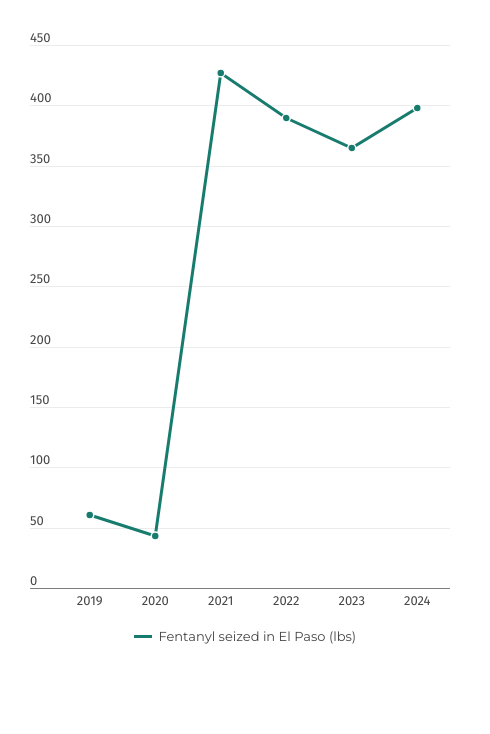
In Ciudad Juárez, the Chihuahua State Prosecutor’s Office, the National Defense Secretariat, and municipal police went from detecting no fentanyl in 2019 to seizing hundreds of thousands of pills beginning in 2021. In El Paso, the Customs and Border Protection Office also noted an increase of over 800% in seized amounts between 2020 and 2021.
.título-del-gráfico{font-family: ‘Noto Sans’,sans-serif;color: #3B3B3B;font-weight: bold;margin-top: 0;padding-top: 0;font-size: 28px;}.subtítulo-del-gráfico{font-family: ‘Noto Sans’,sans-serif;color: #3B3B3B;font-style: normal;}.subtítulo-con-color{font-family: ‘Noto Sans’,sans-serif;color: unset !important;font-style: bold;}.fuente-del-gráfico{font-family: ‘Noto Sans’,sans-serif;color: #B3B3B3;margin-top: 0;padding-top: 0;}.annotation-group{font-family: ‘Noto Sans’,sans-serif;color: #3B3B3B;font-size: 12px;}.etiquetas{font-family: ‘Noto Sans’,sans-serif;text-shadow: -1px 0 #FAFAFA,0 1px #FAFAFA,1px 0 #FAFAFA,0 -1px #FAFAFA;color: #3B3B3B;font-size: 14px;font-weight: bold;}.eje-x path{stroke: #3B3B3B;stroke-width: 2;}.eje-x text{font-family: ‘Noto Sans’,sans-serif;font-size: 13px;}.eje-x-título{text-anchor: middle;font-family: ‘Noto Sans’,sans-serif;font-size: 15px;font-style: italic;fill: #B3B3B3;}.eje-y text{font-family: ‘Noto Sans’,sans-serif;font-size: 13px;fill: #B3B3B3;}.eje-y-título{font-family: ‘Noto Sans’,sans-serif;font-size: 15px;font-style: italic;fill: #B3B3B3;}.eje-y line{stroke: #b3b3b3;stroke-width: .03em;}.eje-y2 line{stroke: #B3B3B3;}.eje-y path{stroke: none;}.plot-subtitle{font-size: 17px;font-family: ‘Noto Sans’,sans-serif;fill: #3B3B3B;}.logo-ic{font-family: ‘Georgia’;font-size: 18px;font-style: italic;letter-spacing: 1px;fill: #A5A5A5;}.flex-container{display: flex;flex-wrap: wrap;justify-content: space-between;}.flex-item{flex-basis: 200px;flex-grow: 1;flex-shrink: 1;margin: 10px;margin-bottom: 0px;padding-bottom: 0px;}
Fentanyl seizures began to increase at the Juarez – El Paso border crossing from 2021
Number of fentanyl pills seized in Ciudad Juarez and pounds of fentanyl seized in El Paso, 2019 – October 2024

While authorities believe that a significant portion of fentanyl trafficked across that border is tied to the Sinaloa Cartel, they acknowledge that other networks, including the Línea, play an increasing role, according to several security officials interviewed by InSight Crime in Ciudad Juárez in September.
“We’re seeing a fentanyl boom in Ciudad Juárez […] shipments arrive in bags with at least a thousand pills, destined for the United States,” said Jesús Moctezuma Sánchez, coordinator of the municipal police in Ciudad Juárez.
Nevertheless, the surge has not been accompanied by a rise in fentanyl consumption in the city, as seen at other border crossings, and the Línea may be playing a role in regulating this market.
SEE ALSO: Mexico Fentanyl Production Migrates North as Chapitos Death Threats Loom
Dozens of drug users and staff at treatment centers interviewed by InSight Crime in Ciudad Juárez claimed that the Línea enforces strict penalties on the sale and use of fentanyl.
While some users reported encounters with the substance, they said the Línea has lookouts at drug sale and consumption points and uses violence against those openly seeking fentanyl.
“It’s very dangerous; you need strong connections. I’d be signing my death sentence if I looked for it,” said a heroin user who requested anonymity out of fear of reprisals.
The reasons behind this prohibition are unclear. A retail heroin dealer told InSight Crime it could be the Línea’s way of preventing overdose spikes, as seen in other cities.
Other sources, including security officials, speculated that the restriction stems from the ongoing conflict between the Sinaloa Cartel and the Línea in Chihuahua, where territorial boundaries are enforced, and the sale of certain substances in local markets is restricted to avoid disputes.
“The most important thing for criminal groups in Ciudad Juárez is that fentanyl reaches the United States,” said Moctezuma Sánchez.
Mike LaSusa and Angélica Ospina contributed to this article.
Featured Image: Southern entrance to Ciudad Juárez, México, with the Umbral del Milenio sculpture in the background. September 11, 2024. Credit: Mike LaSusa