


It was well after dark in southeastern Arizona, and the temperature had dipped close to freezing. Outside the Cochise County Sheriff’s Office in Bisbee, Sheriff Mark Dannels and one of his sergeants discussed reports of a large group of migrants traversing a steep mountain pass and moving through the county.
Dannels, who was born in Iowa, sports a beige suede cowboy hat befitting of his role. To blunt the chill, he wore a heavy jacket with the Cochise County Sheriff’s insignia on his arm. Chasing undocumented migrants is not his job, but he has made it so, and on this night, it had become personal: The projected trajectory of these particular migrants was his neighborhood.
Dannels knew their route because he had set up hundreds of cameras and microphones to pick up their movements. It was part of a larger effort, he told us, to combat “dangerous cartels” that have made this part of Cochise County “cocaine alley.”
In an area where many regard immigration as an existential as well as a criminal threat, Dannels considers himself a front-line defender of the United States. In interviews, he has equated migration with drug trafficking and rampant crime in the country. Although his own county’s statistics do not back up many of these claims, he insists the situation remains dire.
“Right now, we’re in ugly times,” he told InSight Crime.
Dannels’ views differ sharply with some of his fellow lawmen, most notably David Hathaway, the sheriff of the neighboring county of Santa Cruz. In fact, the two cut a striking contrast. While Dannels spends nights combing the mountains for migrants, Hathaway is focused on defending their right to seek a better life.
“The people that come across, and I’ve met and talked to them my whole life, they’re coming because they have a job lined up, or they’re wanting to go work,” he said in an interview with InSight Crime.
SEE ALSO: Desperation in the Desert: The Industrialization of Migrant Smuggling on the US-Mexico Border
In many ways, Dannels and Hathaway are a microcosm of the larger debate about immigration and crime in the United States. And as US voters prepare to select their next president on November 5, few issues are more important to the electorate.
This is especially true in Arizona, where the border is not an abstract political issue but an everyday reality. Pulled off just to the south of Highway 92, two officers sat in the back of a parked mobile command vehicle on that cold evening we accompanied them. They were part of the Southeastern Arizona Border Region Enforcement (SABRE) team. Formed in mid-2013 and now commanded by Tim Williams, who served as our guide, the special operations unit includes full-time members from the sheriff’s office, Homeland Security Investigations (HSI), and US Border Patrol.
Equipped with several monitors and a two-way radio system, the inside of the vehicle functions as a small command center to monitor imaging produced by the high-tech thermal camera mounted on top. With his hand on a joystick to control the camera’s 360-degree movements, one of the officers panned the horizon, hunched over as he closely scanned the screen.
The camera can pick up heat signatures from something as small as a rabbit moving in the open terrain, or as large as a horse. And at one point, a large, blurred mass appeared. With his other hand, the officer grabbed his radio and alerted his colleague patrolling the foothills to search around the edge of a bush. But when he arrived, he found a cow, grazing.
For nearly three hours that night, the SABRE team sought to locate one, possibly two groups of some 30 migrants moving through the area, presumably towards Sheriff Dannels’ own neighborhood. It was hard work with little payoff. After about half an hour without any activity, the surveillance truck moved to a different location, but still, nothing. Frustrated, Sergeant Williams drove to a local park, staring down a night vision monocular with the truck headlights off. But still, nothing.
Finally, two civilians on mountain bikes appeared and told Williams the migrants were spooked by their lights and movement and had scattered in different directions. As Williams approached a trailhead leading into the darkness, an exasperated Border Patrol agent outfitted in camouflage tactical gear emerged from the brush with two migrants in tow. Later, another migrant, exhausted and limping through the freezing air, turned himself in.
The three were left with Williams, who handcuffed them and loaded them into the back of his pickup truck where they shivered for hours until a CBP van arrived to process them and take them back to Mexico. In all, after about five hours of this game of cat and mouse, SABRE picked up seven migrants.
‘It’s Not Scary’
Almost 140 kilometers west of Bisbee, Santa Cruz County Sheriff Hathaway towers over his desk. Standing over two meters and wearing a large cowboy hat that covers his square face and dark eyes, Hathaway cuts an intimidating silhouette of a border sheriff. Still, he doesn’t carry a weapon or sport a bulletproof vest, and he shuns uniforms. On the day we met him, he wore a shorn jean jacket, which hid a blue, buttoned-up shirt he’d tucked into his black jeans. Instead of boots, he wore faded New Balance sneakers.
On his office walls are newspaper clippings, plaques commemorating his achievements during his more than 30 years as a Drug Enforcement Administration (DEA) agent, and photographs of his family, including one of his grandfathers playing polo with the Mexican army.
Hathaway grew up on the border. His father was part of a long line of cattle ranchers and civil servants. His grandfather was a state senator, as was one uncle; another uncle was head of the Arizona highway patrol, and his father was the district attorney and later a state judge.
The family had hundreds of hectares spreading up and down the border, and as a kid Hathaway said he was in near constant contact with migrants. Some worked in his family’s ranching business. Others were passing through. But he did not consider any of them threatening. They were part of life in Nogales.
“It was never scary,” he told InSight Crime. “You just kind of walk home, walk to work, you know, just walk around town at night. We’d walk across into Mexico to go see movies because it was cheaper down there. … And it just seemed like small-town USA to me. Like it still does. It’s not scary.”
The uptick in migrant crossings has not changed his views. In fiscal year 2024, US Customs and Border Protection (CBP) agents encountered more than 463,000 migrants in the Tucson sector — the busiest along the US-Mexico border that year encompassing Cochise, Pima, and Santa Cruz counties. More than two million migrants were encountered along the entire southwest border by year’s end.

While Sheriff Dannels has dedicated substantial time and resources to aiding federal agents confront irregular migration with the help of a fleet of motion-sensor cameras and other technology in Cochise County, Sheriff Hathaway was not dedicating resources to tracking them. When he did get extra resources, such as cameras or listening devices, he said he sent them to Sheriff Dannels in Cochise County.
The sheriffs have significantly different challenges. Both counties act as transit corridors for migrants that end up primarily in Maricopa County to the north, according to census data, where large cities like Phoenix are located. But Cochise County has more than 16,000 square kilometers and around 150,000 residents. With a little less than 50,000 residents and covering only about 3,200 square kilometers, Santa Cruz is the smallest county in Arizona. It is also mountainous and cold, which act as natural deterrents to migration.
“We kind of have unique terrain here,” Hathaway explained. Santa Cruz County is home to the Santa Rita Mountains, as well as desert grasslands and the Santa Cruz River, which can make for dangerously hot days and frigid nights.
For Hathaway, any deployment of law enforcement to track run-of-the-mill migrants moving through this area takes away from other priorities, most notably the flow of synthetic drugs like fentanyl, which he told us is his top priority. And, in contrast to Dannels, he does not associate this trafficking in any way with migration.
Indeed, the two sheriffs’ differences have played out in public forums, most notably within the 15-county Arizona Sheriffs Association, where Dannels was president until June 2024. The organization has issued numerous public statements condemning the Joe Biden administration’s border policies. And while Hathaway does not openly support Biden, he says the association has frequently crossed a line with some of the statements.
“I’m like, ‘Well, in your personal life, you can have positions like that,’ but it sounds like you’re speaking officially as a politician. … You know, we don’t make the law, sheriffs don’t make the laws,” he told InSight Crime. “I think, as much as possible, it’d be good to just be politically neutral and don’t look like you have baggage.”
‘I’m a Realist’
Although born in Iowa, Dannels grew up in a small town on the Illinois side of the Mississippi River. His father was good friends with the local sheriff, who would come by his house for coffee. The sheriff made an impression, Dannels told us.
Dannels, meanwhile, excelled in wrestling, but instead of accepting one of several college athletic scholarship offers he said he had, he joined the army, where he was assigned to Fort Huachuca in Cochise County. He never left.
After serving just a few years in the military, he moved into law enforcement — first to the police, later to the sheriff’s office. In 2012, he was elected Cochise County sheriff. The county is a good fit for Dannels. It is known as a retirement community. Many “snowbirds” — as the temporary and full-time transplants are often referred to — come from the Midwest like him.
For his part, Dannels says he is responding to the needs of these constituents. And border security, he insisted, was one of theirs and his priorities.
“I’m a realist,” he told InSight Crime. “I’m not going to hide behind politics on this. I don’t play politics well. The nonpolitical stats say we have a problem on this border.”
When we asked Dannels what he perceived as the main danger, he emphasized the uptick in car accidents related to migrant smuggling. Specifically, he said, US citizens were being drafted to pick up migrants and drive them to other counties or states, and when law enforcement sought to stop them, they sometimes sped off. The high-speed chases had led to accidents, some of them fatal.
“This is real to the citizens of my county,” he said.
SEE ALSO: Human Smugglers Outsourcing Drivers, Wreaking Havoc on US-Mexico Border
Other threats are more ephemeral. Dannels frequently talks broadly about fentanyl and “cartels,” but little is specific to Cochise County. In one notable exception in 2023, Dannels told a congressional committee that one of his deputies had been threatened by the Sinaloa Cartel, a claim he repeated to local media and in public forums with residents of the county. But he did not give any more details of the threat.
Dannels also regularly veers into the political. He has vilified the Biden administration for what he termed “intellectual avoidance” of the border “crisis.” And while he did not endorse Donald Trump, he told Fox News that Trump “made a difference” on the border.
“You have two different candidates: You have President Trump. He worked. He engaged. He prioritized this border,” he said to the news channel’s morning program. “You have Vice President [Kamala] Harris and President Biden that have not. They are the would-of, should-of of the border.”
In September, Dannels met privately with Harris during one of her campaign stops in Arizona. And, as the current chair of border security for the National Sheriffs Association, he presented her with a letter outlining their concerns, which included stopping what the association called ”known or suspected terrorists.”
The statement also bundled irregular migration with drug trafficking, which are unrelated.
Dannels was more direct in an April 2022 resolution in which the Arizona Sheriff’s Association expressed “no confidence” in Vice President Harris’ handling of the border.
“For some, reaching the United States marks the beginning of years of drug distribution, modern-day slavery, and sex trafficking to pay back the criminal cartels for the privilege of being smuggled into the United States,” the association wrote.
Dannels, then the president of the association, signed it.
Hathaway, who is a member of the association, did not.
A Border of Contradictions
Like Dannels, Hathaway is a complex character. While we were visiting, former Maricopa County Sheriff Joe Arpaio – infamous for detaining undocumented migrants and holding them in open-air camps – visited Nogales to hawk his new book.
After we spoke with him in his office, Hathaway excitedly made his way through the cobblestone streets to see the former sheriff who had parked his vehicle at a Burger King along Grand Avenue. Arpaio’s handler had propped up a display table across the street between a casa de cambio and a shuttle service to Mexico, and the visibly aged Arpaio sat silently in the mid-day sun as Nogales’ residents absent-mindedly passed him.
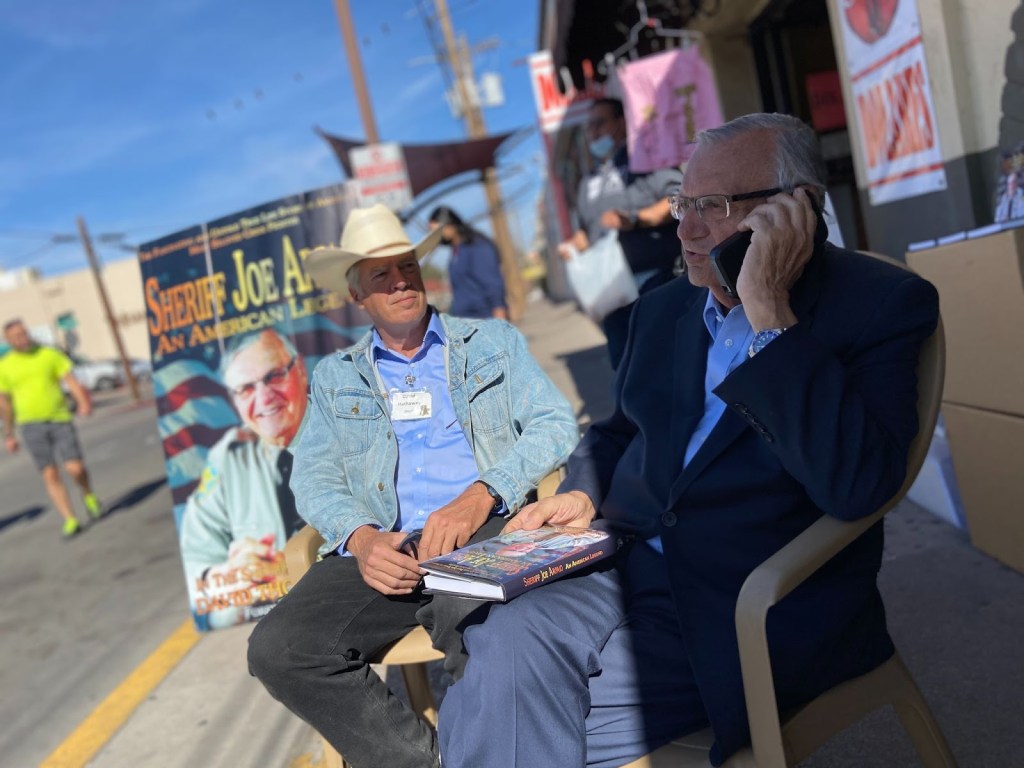
Hathaway approached Arpaio slowly, then asked the 92-year-old to autograph a copy of his autobiography, “Sheriff Joe Arpaio: An American Legend.” Wearing an oversized navy blue suit jacket that hung off his shoulders, hiding his frail frame, Arpaio struggled into a plastic chair and signed the first inside page.
At one point described as the “toughest sheriff in America,” Arpaio’s autobiography details the “political witch hunt foisted upon him by his opponents to unsuccessfully destroy him.” In it, he highlights his use of an infamous outdoor jail known as Tent City, where inmates were forced to wear pink underwear. He later bragged about it being a “concentration camp.”
Arpaio had always been antagonistic to the Hispanic community, to which more than 80% of Santa Cruz County’s residents belong. Hathaway said he wanted to “see it in person,” referencing the possibility of a tense encounter. He also called a local radio station in Nogales, Mexico, and put Arpaio on the line. Hathaway speaks Spanish. Arpaio does not.
“I’ve got the legendary Sheriff Joe Arpaio here on the line in Nogales,” Hathaway said in Spanish.
Arpaio thanked Sheriff Hathaway, but then fell silent after he passed him the phone and the radio host began asking questions. The irony was sharp: a bilingual sheriff trying to facilitate an interview in Spanish with a former sheriff who made a career out of demonizing migrants who spoke that very language.
Before leaving, Hathaway requested a photo to accompany his newly autographed book. Arpaio happily obliged as passersby sidestepped them on the narrow sidewalk, oblivious to the divergent lawmen.
Like Hathaway, Sheriff Dannels also contradicts himself.
In our conversation with him, and his missives to federal officials, Dannels emphasized that migrants are victims of criminal groups. He has at times also been more nuanced in his analysis regarding the criminal economies. He made a point, for example, to separate drug smuggling from human smuggling.
“If we see smugglers, they know what they’re smuggling. I mean, it’s not like, ‘Hey, carry this.’ … We don’t see that a lot,” he said.
Featured image: An aerial view of the US-Mexico border separating the states of Arizona and Sonora, which has become a focal point for irregular migration. Credit: Parker Asmann