


On the night of May 4, the phones and social media of migrant rights activists in Nashville lit up with alerts, some with shaky cell phone videos all showing similar scenes: the multilane transport arteries that slice through south Nashville’s immigrant districts illuminated by the flashing red and blue of state trooper vehicles and the fuzzy yellow glow from the headlights of unmarked cars. Men in khaki shirts and wide-brimmed hats approached cars, while murky figures in tactical vests lurked over their shoulders in the distance.
The pattern soon became clear: Tennessee Highway Patrol (THP) were pulling people over, then Immigration and Customs Enforcement (ICE) agents were detaining them. The 150 stops they made that night were part of a “public safety operation,” the THP said, targeting “areas with a history of serious traffic crashes and suspected gang activity.”
The sweep was part of a national effort to deliver on the campaign promise of President Donald Trump to launch “the largest deportation campaign in history.” That campaign, Trump claimed, would prioritize violent criminals and organized crime: drug traffickers, sex traffickers, and gangs with roots in Latin America.
The administration has called it the “worst first” strategy. And among their leading targets were the legendary Los Angeles-born Mara Salvatrucha, or MS13, and Tren de Aragua, the Venezuelan prison gang that has spread throughout the Americas by preying on the exodus of people fleeing poverty, insecurity, and political oppression in Venezuela.
“All of these criminals, these murderers, these drug dealers — we’re getting them out. I will put these vicious, bloodthirsty criminals in jail, or I will get them out of the country,” Trump had said.
But if these operations were meant to dismantle criminal groups, there was little in the public record to show for it. During the Nashville sweeps, authorities detained just one alleged member of the MS13 and one from the Tren de Aragua. The operation also stirred up political controversy, sparked a community backlash, and has left many in the city’s migrant community living in constant fear.
The Tennessee operation was a microcosm of the conflicts caused by a national immigration crackdown that has been justified with the threat of Latin American organized crime. With two of the most prominent criminal groups in the Americas at the center of it, InSight Crime sought to determine the nature of these networks and the threat level they pose in Tennessee and measure it against the response by the government — as well as the impact of that response on local communities.
This is the first of three articles resulting from that effort. It chronicles the crackdown and the reverberations from it. The other articles profile the Tennessee operations of the criminal groups in question: the MS13 and Tren de Aragua, two of the most violent gangs in the Americas. The reports are based on dozens of interviews with law enforcement and judicial officials, community workers and activists, family members of the detained, immigration lawyers, political leaders, and experts on all sides of the debate. We also read through dozens of court filings and public statements by officials across the country and analyzed crime and immigration data stretching back decades.
SEE ALSO: Trump Blurs the Line Between Immigration and Organized Crime
The effects of these crackdowns are still being felt. While the government claims it has deported record numbers of gang members, and supporters of these policies say these operations are a critical tool for combating transnational criminal networks, authorities refuse to share the crucial details needed to corroborate these efforts.
Instead, the information released suggests the scope of the operations has widened considerably beyond the “worst first” mission, undermining trust between some of the communities most affected by organized crime and the law enforcement agencies tasked with stopping it. But more than that, the operations are the most visible manifestation of tectonic shifts in the US government’s approach not only to immigration but also to combatting organized crime that could have a lasting impact on US security policy.
Immigration and Gangs in Tennessee
ICE’s sweeping new national approach began in early February with a series of “enhanced immigration enforcement operations” in multiple cities across the country. The statement announcing the raids included few details, but a series of photos showed arrests of alleged MS13 and Tren de Aragua members in Maryland and South Carolina.
Within a month, ICE was carrying out similar operations around the country. Most took place over several days and were carried out alongside other federal agencies or state and local law enforcement. They arrested tens, even hundreds, of people at a time. The operations hit Texas, California, New Mexico, Virginia, Kentucky, North Carolina, Georgia, Massachusetts, Alabama, New York, Florida, and Maryland before reaching Tennessee.
Tennessee was a logical target. Located in the southeastern United States, the state typifies many of the organized crime and migration dynamics that have risen to the top of the Trump administration’s security agenda. Foreign-born residents account for around 6% of the state’s total population and 15% in Nashville, according to 2024 census figures. While accurate figures on the number of undocumented migrants are difficult to calculate, the American Immigration Council estimates a total population of around 156,000 living in the state, where they work in sectors such as construction and hospitality in urban hubs and in the agricultural sector that forms the backbone of the state’s rural economy.
But Tennessee also has gang problems and high murder rates in its major cities, human trafficking, and high levels of fentanyl addiction. And gangs such as the MS13 and Tren de Aragua are present in migrant communities, where they commit serious crimes, mostly against members of those same communities.
Of the two, the MS13 has a much deeper history. The gang has been in Nashville for more than two decades, and the city has seen two major criminal conspiracy investigations leading to multiple convictions on charges ranging from murder to kidnapping.
Tren de Aragua’s presence, however, is harder to pin down. State law enforcement first warned of the advances of Tren de Aragua across Tennessee in late 2024. While they have since faced criticisms for overplaying the threat posed, in 2025, federal prosecutors brought sex trafficking charges against what they allege is the first organized Tren de Aragua cell in the state.

Casting a Wide Net
From the beginning of the Nashville operation, it was clear that ICE and state police were casting a wide net. Legal observers described to InSight Crime how THP troopers pulled drivers over citing minor traffic violations. The THP would approach the cars first, then ICE officers would demand to see proof of immigration status. If any of those in the vehicles couldn’t provide it, ICE bundled them into their vehicles and whisked them away.
The ICE officers sometimes demanded to see people’s tattoos, but activists who spoke to InSight Crime said they did not see any authorities doing criminal background checks on the scene, and little more was done to establish any criminal affiliations or record. Beyond concentrating operations along the main roads of the town’s immigrant neighborhoods, there was scant evidence to suggest the stops were targeting specific individuals, they said.
“I don’t think they had any rhyme or reason. It was just whoever they decided that looked Latino at that instance and could be pulled over,” Jazmin Ramírez, a migrant rights activist and community organizer who witnessed two arrests while carrying out legal observer work, told InSight Crime.
SEE ALSO: What Trump’s Hardline Immigration Policy Means for Crime on the US-Mexico Border
Both state and federal authorities have refused to release all but a snapshot of data on the background of those stopped, which was obtained by local journalists. That snapshot provided details on the ethnicity of 34 of the drivers who were stopped: 29 of them were Latino, two Asian, two Black, and one white.
Homeland Security Secretary Kristi Noem, who heads ICE’s parent agency, pushed back on allegations of racial profiling in the operation.
“Do you have any indication that anybody was targeted just specifically because of what their race or creed was?” she responded when questioned by journalists in Nashville. “Every single enforcement operation that we have conducted has been based on case work and investigative reports of criminal activity.”
Activists, though, said anyone caught in the dragnet risked arrest. On one occasion, legal observers documented ICE pulling a mother from her children. On another, they detained a man in front of school children waiting for a bus.
During the operation, much of Nashville’s migrant community essentially went into lockdown, only leaving their homes when they had little other choice.
“It was this weird, eerie silence. People not on the streets, businesses completely empty — this hyper alertness of ‘could that be the car?’” said Ramírez.
Despite the claims the operation was targeting gangs, there were few signs of the authorities trying to gather intelligence or build cases after making arrests. Instead, they denied many detainees the due process and rights they would have been entitled to in the US criminal justice system, including access to a lawyer or the right to a phone call.
Many of those detained were shunted around jails in Tennessee before being transported to an ICE detention center in Louisiana, 500 miles away. Some spent time chained and shackled and did not get adequate food and medical care, according to multiple accounts by detainees, relatives, and activists.
“They were treated like they weren’t human,” said Chelsea White, whose Mexican husband, Hilario Martinez Garcia, was detained during the operation by THP working with ICE on the outskirts of Nashville.
While some of those detained were able to contact their families, many others were not. The first time some families heard from their loved ones was when they received phone calls from Guatemala, El Salvador, or Mexico.
White heard nothing about her husband for a week.
“I had no idea where he was, what was going on, what was happening, if he was okay,” she said.
Since the operation, there is no sign authorities have brought criminal charges against those arrested in the operation. Instead, in many cases, immigration officials pushed detainees to sign self-deportation papers, which many did not understand as they were only offered in English, activists and relatives told InSight Crime.
White’s husband eventually signed those papers after a court hearing in which a judge told him he would be held in ICE detention indefinitely if he decided to fight his legal case.
“There were people that had been there for months already and didn’t even have a court date, and he was scared that was going to be his fate,” she said.
White, a US citizen who has lived her whole life in Tennessee, moved to Mexico with her three children to keep her family together. As she tries to rebuild her life, she bristles at the suggestion that the operation that tore it apart was taking aim at organized crime. When Trump said his government would target gang members and violent criminals, she had believed it, she said during a telephone interview from Mexico.
“But he’s not just getting those people. He’s getting normal, everyday people that go to work and come back. He’s getting family people.”
Hundreds of ‘Aliens,’ but Few Gang Members
The Nashville operation lasted a week, after which ICE reported that agents had arrested 196 “criminal illegal aliens.” Of these, 95 — fewer than half — had prior criminal convictions or pending cases.
While ICE has refused to release any information on the case history of the 95 with criminal records, it did provide some details on seven “notable arrests.” Their rap sheets included rape, domestic abuse, sex with a minor, aggravated assault, drug possession, and intent to supply. Headlining the list were two alleged gang members.
One of them was Franklin Velásquez, an alleged MS13 member from El Salvador. Velásquez had been convicted in the US for drug possession, failure to appear at judicial proceedings, and criminal impersonation, and he is wanted in El Salvador on aggravated murder charges. However, no information was provided on what role, if any, Velásquez had with the MS13 in Nashville, and his name had not come up during an MS13 case that concluded in July 2024 with the conviction of 18 gang members.
The other detainee with alleged links to organized crime, according to the statement, was an unnamed 37-year-old Venezuelan who ICE claimed was a Tren de Aragua “affiliate member.” A later statement issued by the Department of Homeland Security (DHS) providing further information on the “notable arrests” made no mention of the alleged Tren de Aragua member.
SEE ALSO: Trump Official Headed Organization That Spread Fake News About Tren de Aragua
Federal authorities stonewalled efforts to provide more. ICE declined to provide details on the alleged Tren de Aragua member or any further information on the other detainees to the media, and it did not respond to InSight Crime’s request to discuss the operation. DHS sent InSight Crime a link to its press release.
When the legal department of Nashville’s mayor’s office asked DHS and THP for the details of those detained, THP responded that no such documents existed, while DHS did not respond at all. The THP also refused to release all but heavily redacted dispatch records on the traffic stops made from the first night, making it impossible to verify where, when, why, or how Velasquez and the alleged Tren de Aragua member were detained.
The results of ICE’s special enforcement operation in Nashville reflected the patterns seen on the national stage. Between March and late May, when new orders led to a change in ICE tactics, ICE reported carrying out 22 special enforcement operations. Of those, gangs and transnational criminal networks were explicitly named as priority targets in more than half of the cases. But of the total of 6,022 people detained in these operations, only 27 were alleged to be gang members or have gang ties – less than 0.5%. And only 8 of those were actually named.
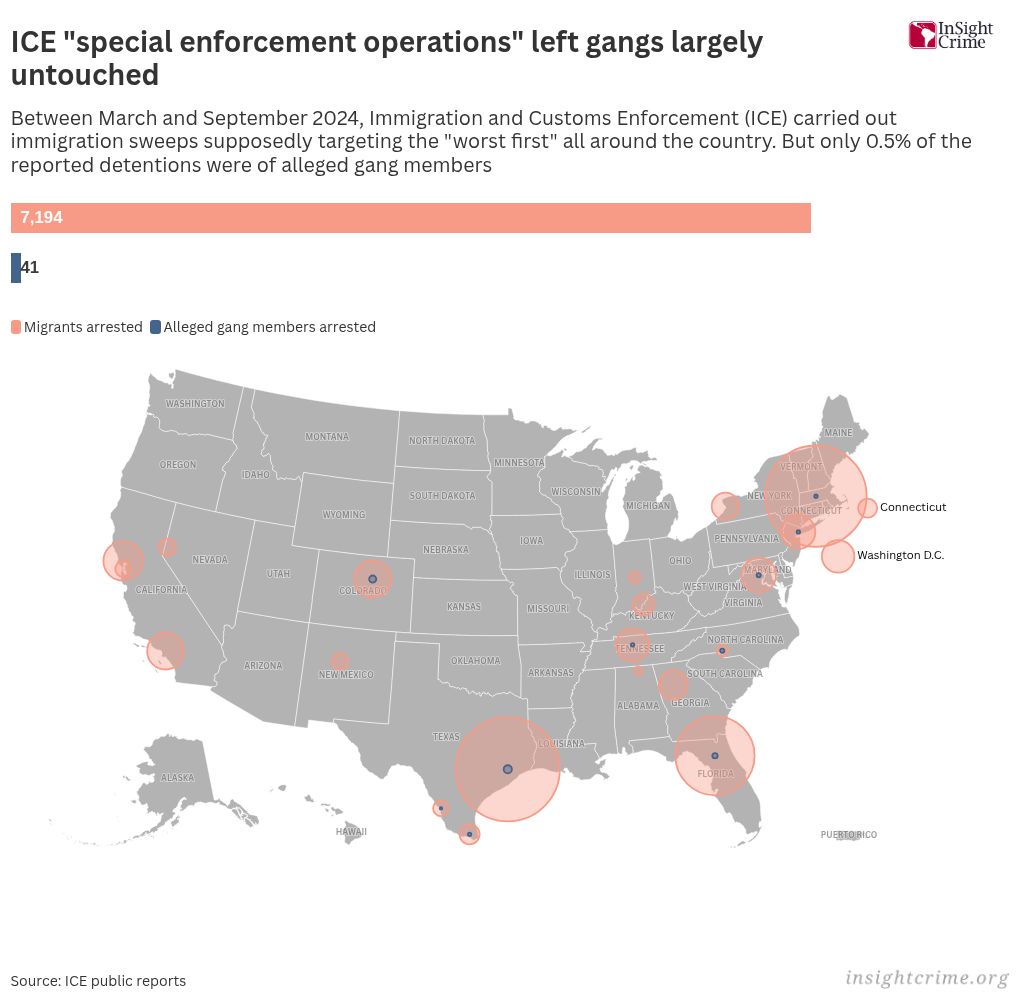
ICE’s public statements may only offer the highlights of the overall panorama, and those arrested during the operations were not the only alleged gang members detained over the period. But the complete datasets available paint a similar picture.
According to an analysis by the Cato Institute that combined publicly available government data with internal ICE data, ICE detained 204,297 people between October 2024 and June 2025. Of those, 65.4% had neither convictions nor pending criminal charges. While the data did not include information on the number with alleged organized crime ties, records showed 6.9% were detained for violent crimes and another 4.5% for “vice” crimes — drugs, gambling, and the sex trade — sometimes linked to gang activity.
Among Law Enforcement, A Mixed Reaction
Backlash to the Nashville ICE operation was immediate. Activists organized patrols of legal observers, blockaded ICE facilities where detainees were being held, and organized solidarity campaigns. The city’s liberal mayor, Freddie O’Connell, also spoke out.
“What’s clear today is that people who do not share our values of safety and community have the authority to cause deep community harm,” O’Connell said.
But the reaction among law enforcement and judicial officials to the sweep was mixed. Thomas Jaworski, a former federal prosecutor who in 2024 rose to the position of acting US Attorney for Middle Tennessee, told InSight Crime that while the numbers of serious criminals detained may be low, those individuals are likely major drivers of crime locally.
And while the operation in Nashville may not have directly weakened gangs or other transnational criminal networks, it may reduce their operational capacity, he added. The street presence of ICE and the threat of deportation, he said, will likely force these groups to keep a low profile.
“You’re going to see a slight dip going forward simply because of the immigration enforcement activities. That is not to be ugly about it. That’s just a fact of life,” he said.
Scott Mechkowski, a former ICE Deputy Director for New York City, told InSight Crime such broad operations can be an effective tactic for dismantling gangs by picking up what often gets left behind by slow-moving, costly investigations.
SEE ALSO: Gangs, Tattoos, and the Roots of the US Due Process Crisis
“Some of it may have shifted into wrapping it up in your daily local enforcement,” he told InSight Crime. “Why build the case if we know these guys are gangbangers and they’re illegal. Just lock them up and get rid of them.”
The operations, Mechkowski added, are likely not as indiscriminate as they can appear from the outside.
“It’s using intelligence and data collection to help you focus on your mission, your priorities,” he said. “You’re not racially profiling, but you are profiling.”
“You become experts on what to look for or what’s out of the norm,” he added.
Mechkowski sees the approach as a corrective to years of policies under the previous US administration of President Joe Biden that shackled law enforcement.
Under Biden, he said, ICE was restricted by protections for migrants lost in the never-ending asylum backlog or with protected immigration status, who could not be removed and had to be cut loose after arrest. He also highlighted the difficulties working in “sanctuary cities,” like New York and Los Angeles, where municipal authorities protect migrant communities by placing limits on the cooperation between local law enforcement and federal immigration authorities.
“Under the Biden administration, it was hard to lock anybody up,” he said.
In May, Mechkowski testified at a House Judiciary subcommittee hearing on the protection of ICE officers during such operations. Also speaking that day was another former official that saw the issue very differently.
In his testimony, former ICE Chief of Staff Jason Houser labeled the operations as “designed for media optics rather than public safety.”
“When resources are diverted toward the arrest of low-priority individuals, enforcement becomes a dragnet,” he told the committee. “That may generate high arrest numbers for press releases, but it pulls ICE personnel away from complex, high-risk cases that improve public safety. It creates a false sense of security while leaving human trafficking, narcotics operations, and violent criminal networks less disrupted.”
Houser did not respond to InSight Crime’s request for an interview. Other former officials, though, similarly questioned both the tactics and the results.
A former senior DHS official who spoke to InSight Crime on condition of anonymity expressed doubt that authorities are tracking down people whom they know have direct contacts with MS13 or Tren de Aragua in operations such as the one in Nashville.
“All the highway patrol operations and random traffic stops, that’s just to increase fear, it’s a fishing expedition,” he said.
Rather than a concerted crackdown on organized crime, the former official said, the results in Nashville and beyond point to agencies scrambling to deliver the numbers the Trump administration needs to keep its ambitious deportation promises. That pressure could also explain the lack of transparency over the allegations of gang affiliations.
“There are incentives to characterize somebody falsely or to err on the side of assuming that there’s activity with TdA or trying to conflate TdA or MS13 activity with stuff that’s pretty benign or routine,” he added.

A Law Enforcement Overhaul
While special enforcement operations such as the ICE sweep in Nashville have been the most eye-catching aspect of the convergence of crime and immigration under Trump, they are just one part of much deeper changes that could radically alter how transnational organized crime is investigated and prosecuted in the United States.
In March, the government announced its new “Take Back America” initiative. At the top of their new list of priorities was immigration — or, as the Department of Justice (DOJ) memo announcing the change put it, to “repel the foreign invasion.” To facilitate quick removals, the memo directs prosecutors to prioritize charging “the most serious, readily provable offense” over building cases.
The new priorities were then reinforced in funding plans. In 2026, the DHS will see a 65% increase in its budget. This will be the start of an unprecedented surge in funding planned for the next few years, much of it funneled to ICE, where billions of additional dollars will be allocated to recruiting new enforcement officers, building and operating detention facilities, and removals. With a projected budget of nearly $28 billion a year over the next four years, the changes will make ICE by far the most well-funded federal law enforcement agency in the United States.
At the same time, the DOJ faces billions of dollars in budget cuts. And the federal agencies traditionally tasked with investigating organized crime — the Federal Bureau of Investigation (FBI), Drug Enforcement Administration (DEA), and the Bureau of Alcohol, Tobacco, Firearms and Explosives (ATF) — have already seen their budgets slashed by hundreds of millions of dollars and their agents pulled from their duties to support ICE immigration enforcements.
As if to put an exclamation point on the new strategy, one of the main tools used by the DOJ to bring local and federal law enforcement together to target criminal networks — Organized Crime Drug Enforcement Task Forces (OCDETF) — is being dissolved altogether.
The changing panorama has caused alarm among some of those who have been leading efforts to take on transnational organized crime in Tennessee, where recent cases brought against MS13 and Tren de Aragua have been built on slow-moving, complex investigations carried out by multiple agencies, including through the organized crime task forces that are now being disbanded.
One recently retired Tennessee organized crime prosecutor, who spoke to InSight Crime on condition of anonymity, doubts the effectiveness of prioritizing immigration enforcement and worries it could undermine efforts to investigate criminal networks.
“It’s having the reverse effect of what the administration claims that it should have and what most people think that it should have when you end up just arresting people based on their immigration status,” the former prosecutor said.
Not only are such operations unlikely to reach top-level criminals, they may also undermine the community relations that are key to prosecuting such actors.
“I’m sure that it has put a damper on people willing to serve as informants, because if you have some kind of status that might subject you to enforcement, you’re certainly not going to willingly go talk to anybody and provide information,” the former prosecutor added.
In some cases, such tactics could even strengthen the hold of criminal groups over their victims. The former prosecutor pointed to a recent sex trafficking case authorities connected to Tren de Aragua, where the alleged traffickers used their victims’ immigration status as leverage.
“It makes that even easier, [they can say] ‘you see these arrests out here? That’s what will happen to you unless you continue to do this,” the former prosecutor said.
The pulling of resources away from investigative agencies and to immigration enforcement will also undermine capacity to build cases, the ex-prosecutor added.
“The time and resources that [agents] have to put into these immigration arrests makes them completely unable to perform any of their long-term investigations, so you just completely hamstring them.”
However, ex-ICE officer Mechkowski believes this prioritization of immigration enforcement does not have to come at the expense of building cases against transnational gangs and criminal networks.
SEE ALSO: 3 Criminal Impacts of Revoking TPS for Venezuelans in the US
“I think they can exist side by side,” he said. “I don’t think they’ve abandoned dismantling gangs, just that maybe right now the focus has changed a little bit. And I still think they’re doing those investigations.”
The deployment of investigative agents to immigration enforcement operations, he added, is likely a temporary measure that will no longer be necessary with the surge in ICE funding and recruitment.
Security Policy and Politics: Worlds Apart
While security and justice officials and experts debate the effectiveness of immigration enforcement as a tool to combat organized crime, on the political stage, the two political parties occupy different realities. And again, Tennessee has seen its local version of the conflict playing out nationally.
Local Democrats called the ICE operation “white supremacist terror.” Republicans, meanwhile, accused Mayor O’Connell of shielding gang members after he criticized ICE tactics. In September, one local representative upped the stakes further by calling for the National Guard to be deployed to Nashville because the mayor was “using the city as an outpost for international gangs to set up shop in our neighborhoods.”
Nationally though, the Trump administration has moved away from the threat of organized crime in its orders to ICE. Several US media outlets reported on a meeting in late May in which Stephen Miller, the White House deputy chief of staff who is leading the administration’s immigration crackdown, tore into ICE leaders from around the country for not making enough arrests.
“What do you mean you are going after criminals?” Miller angrily told them, according to an account of the meeting in the Washington Examiner. “Why aren’t you at Home Depot? Why aren’t you at 7-Eleven?’”
Within days, that is exactly where ICE went, as well as to construction sites, farms, and other workplaces that rely on migrant labor. The number of migrants with no criminal record being detained soared. And whatever remained of a “worst first” policy targeting gangs and organized crime fell away.
“At this point, I can’t see any strategy other than harassment, discrimination, and racism,” the former DHS official said.
While ICE reports since the Miller meeting reflect a pivot to worksite enforcement, special operations have continued, with four carried out between June and September that declared gangs and transnational criminal networks as their targets or that they were based on a “worst first” approach. In those three operations, ICE reported making 1,172 arrests. Just 14 of them were suspected members of organized crime groups.