


Mexico’s largest criminal groups are expanding the sophistication and profitability of their involvement in illicit fuel markets, moving beyond local schemes to cross-border smuggling networks that affect the US energy sector.
Traditional oil theft involves drilling into and siphoning off fuel from the pipelines controlled by the state-owned oil giant Petróleos Mexicanos (Pemex) that crisscross Mexico. Thieves also target fuel trucks and steal directly from Pemex fuel installations, including refineries and storage facilities.
This is the third of a three-article special series detailing the changing dynamics of Mexico’s multi-billion-dollar fuel theft industry. Read part one and part two.
Now, black market fuel increasingly comes from large-scale clandestine imports from the United States – a major innovation in how organized crime profits from illicit fuel that allows them to grow illegal earnings far beyond what stealing fuel from Pemex allows.
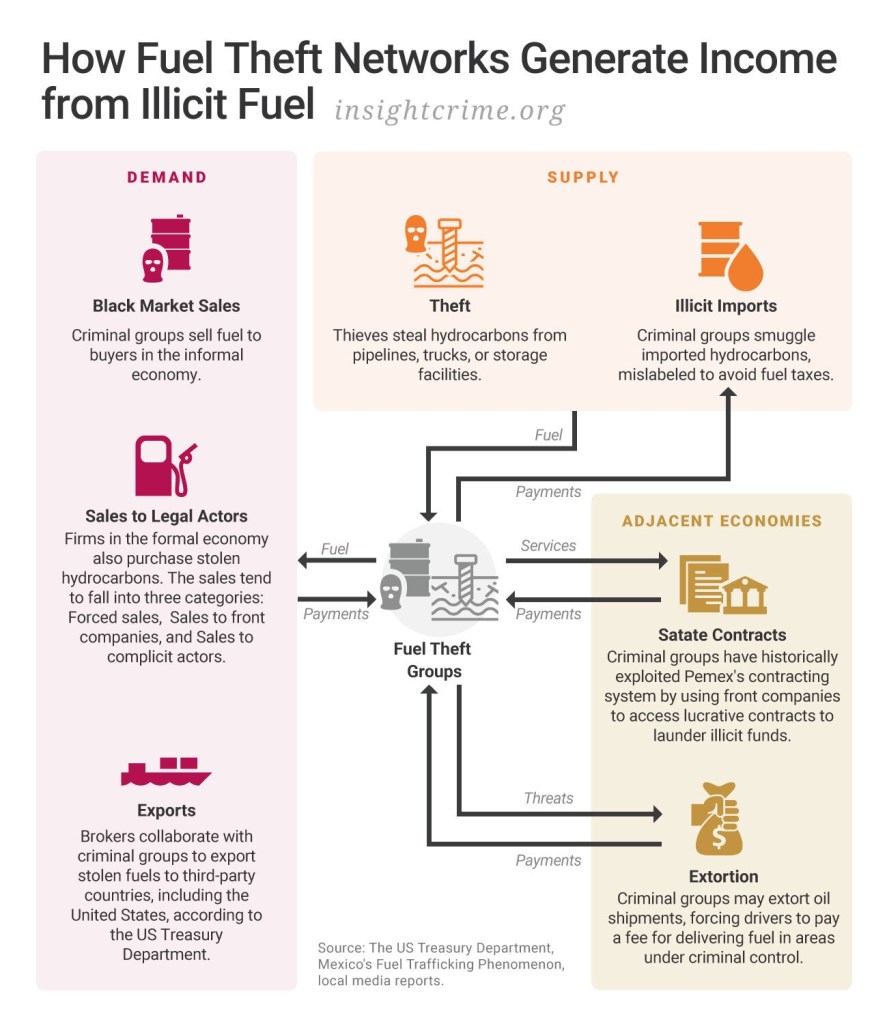
The schemes essentially amount to a lucrative form of tax evasion. Criminal groups co-opt and corrupt customs and law enforcement to facilitate the illicit imports, which are mislabeled to evade a levy called the Special Tax on Production and Services (Impuesto Especial sobre Producción y Servicios – IEPS).
The tax currently accounts for about 40% of fuel costs in Mexico. It is used to stabilize pump prices and generate revenue for the government. But the levy also creates a sizable opportunity for criminal groups that can undercut legitimate sellers with much cheaper smuggled fuel. Local media have coined the term “fiscal huachicol” to distinguish the tax evasion from conventional fuel theft operations.
Fiscal huachicol favors larger crime groups, said David Soud, head of research and analysis at the international security consulting firm IR Consilium.
“You need to be pretty sophisticated and have a command of key relationships and border dynamics to be able to pull that off,” he told InSight Crime.
Huachicol networks also include so-called gray actors that help legitimize illegal and corrupt activity, including powerful companies and corrupt state officials.
“There are a lot of autonomous actors profiting. It is chaotic,” fuel theft expert Samuel León Sáez said.
Jerry Cans to Oil Tankers
One of the most important recent actions against fiscal huachicol came in March 2025, when the Mexican army seized the Challenge Procyon, a 46,000-ton oil tanker docked at the port of Tampico, located along the Gulf Coast of the oil-rich state of Tamaulipas. The ship had sailed from the port of Beaumont, Texas, allegedly loaded with low-sulfur diesel that was fraudulently declared as “industrial lubricant” to evade the IEPS.
In the days that followed, the Mexican navy raided the warehouses of a transport company in the nearby city of Altamira. They seized weapons, vehicles, and 10 million liters of diesel. In a separate operation, a further 7.9 million liters of fuel were discovered in the state of Baja California on a property belonging to a former senator close to a fuel pipeline. In both raids, authorities found trucks belonging to Mefra Fletes, a transport company with longstanding alleged links to the Jalisco Cartel New Generation (Cartel Jalisco Nueva Generación – CJNG), according to a report by Contralínea.
Then, in September, authorities detained 14 people allegedly linked to the illicit imports onboard the Challenge Procyon, including nine members of the Mexican navy, which controls the country’s ports. Soon after, another high-ranking navy captain accused of accepting bribes to allow the illicit import of fuel at the port of Altamira died by suicide.
The operation marked the first major strike against fuel smuggling networks in Mexico in recent years.
“I don’t think they will disappear, but this is the type of action that raises the cost for these networks,” Sáez said.
The use of oil tankers like the Challenge Procyon was not an isolated incident. In the months leading up to the tanker seizure, Mexican news outlet Código Magenta reported that smugglers unloaded up to 400 million liters of fuel each month from tankers from the United States into the port of Altamira alone – about five times the monthly quantity of fuel stolen from Pemex nationwide in 2024, according to the company’s estimates. The imported fuel was reportedly unloaded onto waiting convoys of fuel trucks in an “industrial wasteland” adjacent to the port.
The Buyers
Demand for black market fuel in Mexico is robust, especially as global energy prices continue to rise. As much as 30% of sales from Mexico’s gasoline stations are of contraband or illicit fuels, according to Mexico’s Tax Authority (Servicio de Administración Tributaria – SAT). A report by Petrointelligence, an energy think tank, pegged lost government revenues as a result of fuel theft, smuggling, and tax evasion as high as 177 billion pesos ($9.7 billion) in 2024, roughly the size of Mexico’s federal security budget.
There are as many as 22,000 unlicensed fuel vendors across the country, according to research by the Mexican Association of Service Station Providers (Asociación Mexicana de Proveedores de Estaciones de Servicio – AMPES), more than 1.6 for every legal gas station. Many, though not all, sell fuel stolen, smuggled, or adulterated by huachicol groups.
Sophisticated criminal organizations sell a variety of fuel products to networks of brokers, shell companies, and legitimate gas stations under criminal control.
SEE ALSO: CJNG’s Fuel Theft Empire in the Crosshairs of US Treasury Sanctions
For example, in September 2024, the US Treasury Department sanctioned 11 gas stations and accused a senior CJNG leader named Iván Cazarín Molia, alias “El Tanque,” of making tens of millions of dollars per year from selling stolen fuel through a network of ostensibly legitimate gas stations under CJNG control in Veracruz. One of the properties linked to the network contained six industrial oil cylinders with the capacity to store over a million liters of stolen fuel.
Other brokers working on behalf of the CJNG also exported crude oil, fraudulently labeled as “waste oil,” to complicit energy companies in the United States, according to US officials. The exports allowed the network to profit from the large-scale theft of Mexican crude, a sticky, unrefined product that is tricky to process and difficult to sell on the black markets in Mexico. The revenues, which Treasury officials estimated to be worth hundreds of millions of dollars, were then wired back to Mexican criminal groups using brokers and shell companies.
Featured image: Mexican authorities seize rail cars with millions of liters of illicit diesel. Credit: Security Chief Omar García Harfuch