


In a year where cocaine and fentanyl garnered international attention, marijuana continued to play a key role within the regional criminal landscape. During 2025, marijuana was again one of the most promising criminal markets in Latin America and the Caribbean, evidenced by record seizures, the expansion of illicit cannabis crops, and internal demand that has yet to slow down.
More than 244 million people — or 4.2% of the global population between the ages of 15 and 64 — consumed marijuana last year, making it the world’s most consumed drug, according to the latest World Drug Report published by the United Nations Office on Drugs and Crime (UNODC).
SEE ALSO: Security Boost to Tackle Brazil’s Flood Chaos Led to More Marijuana Seizures
Across the Americas, around 82.7 million people consumed the drug: 67.9 million in North America, 12.1 million in South America, and 2.7 million in Central America and the Caribbean. In North America, that meant that around 17% of the 388 million people who live there consumed marijuana. Consumers represented almost 6% of the population in this part of the world.
There is a complex criminal web behind this regional demand, where organized crime groups oversee both small and large marijuana plantations, control the primary trafficking routes, and oversee distribution networks that connect rural cultivators with consumers in major urban centers.
While Mexico was one of the world’s top marijuana producing countries in 2015 with more than 1,000 tons seized annually, today the largest seizures take place in South America. In 2024 alone, authorities in Colombia, Paraguay, and Brazil seized more than 2,000 metric tons of marijuana.
In December, Paraguayan officials seized 89 tons of marijuana as part of Operation Umbral, marking the largest bust in the country’s history. While the seizure itself was exceptional, the case also revealed the key role security forces play in facilitating large-scale marijuana trafficking across the continent.
At the same time, the expansion of the industrial-sized medical marijuana industry and the decriminalization of recreational use of the drug in various countries around the region gave rise to a sort of hybrid market that toed the line between legal and illegal.
The result of these seismic shifts is a more fragmented, but also profitable, criminal panorama, new types of increasingly potent marijuana, consolidated control of trafficking routes, the emergence of transnational criminal groups, and growing regional consumption.
‘Creepy’ Marijuana Boom
From the mountains of Cauca to the favelas of Brazil and the Caribbean islands, one specific strain of marijuana from Colombia expanded across Latin America, driven by high demand and its powerful hallucinogenic effects.
Known locally as “creepy,” or “cripy,” the strain has built a more attractive reputation than other types of marijuana seen in the region. Around 80% of the illegal marijuana cultivated in Colombia is for export, according to the Center for Security and Drug Studies (Centro de Estudios sobre Seguridad y Drogas – CESED) at the Universidad de los Andes.
At the end of August, Colombia’s military seized 8.6 tons of marijuana hidden in a truck hauling food in the southwest department of Huila. It was the largest shipment trafficked overland in the last four years.
Colombia’s marijuana epicenter is located in the northern department of Cauca, specifically in the Andean mountain range that cuts through the west of the country. In the municipalities of Toribío, Miranda, and Corinto — known as the so-called “Marijuana Triangle — different dissident factions of the former Revolutionary Armed Forces of Colombia (Fuerzas Armadas Revolucionarias de Colombia – FARC) charge cultivators a tax to operate and control the primary trafficking routes in this region.
Over the last decade, the industry has grown substantially. Authorities seized an average of 370 tons during that time, with peaks of 534 tons in 2020 and 453 tons in 2024, according to data from the Colombian drug observatory.

Consumption of Colombian-grown creepy also expanded around the region to countries like Brazil, where it is sold simply by the name “Colombia.” It has even displaced other strands that were once more popular in the north of the country. In 2024, the military police in Amazonas state seized 28.2 tons of marijuana, a 36% uptick from 2023. Of that total, more than 11 tons were potent strands like the creepy grown in Colombia.
“It’s been 20 years since Colombian marijuana became available and 15 years since it became abundant. It has completely replaced other varieties in the north. Nothing else is smoked there anymore: only Colombian marijuana and higher-quality products,” said Bruno Pantaleão de Oliveira, an investigator at the Getulio Vargas Foundation’s Center for Economics and Public Policy.
Chilean authorities have also intercepted Colombian creepy marijuana shipments trafficked by sea or via land border crossings with Bolivia, highlighting the country’s role as a transit and destination point. In November, Chile’s Carabineros seized 4 tons of marijuana in the Antofagasta region, which they described as the largest drug bust in the country’s history.
Caribbean nations like Trinidad and Tobago and the Dominican Republic, as well as Panama, also saw record marijuana seizures in 2025. Some of these shipments originated in Venezuela, which has emerged as a key transshipment point for Colombian marijuana due to its geographic proximity and connections to key consumer markets.
Paraguay Floods the Southern Cone
Despite its rise in the marijuana trafficking world, Colombia has yet to displace Paraguay as the main provider of the drug in South America.
Paraguay has held this position for more than a decade. The combination of its expansive cannabis cultivation due to low production costs, as well as its proximity to important consumer markets in Brazil and Argentina, have made it a key supplier of marijuana in the region.
SEE ALSO: Corruption Looms Over Record Marijuana Seizure in Paraguay
Its production model combines small farmers, criminal organizations, and local corruption networks. Cannabis plantations are camouflaged among legal crops, and marijuana shipments are loaded onto boats, tanker trucks, and shipping containers.
However, this traditional model has shown signs of slowing. Marijuana cultivation is declining as some 40% of small farmers once involved in the trade have abandoned their operations due to having to pay expensive bribes, according to investigator Carlos Peris. Other illicit economies, such as the cocaine trade, have also become more profitable.
In December, Paraguay’s anti-drug force seized the largest marijuana shipment ever seen in the country’s history: nearly 89 tons trafficked by a convoy of vehicles that had entered the country from Brazil. Up until that point, the previous record was held by a 57-ton seizure authorities made in December 2024.
More than 90% of Paraguay’s marijuana is cultivated in the country’s northeast, primarily in the municipalities of Pedro Juan Caballero, Capitán Bado, and Bella Vista Norte. From there, the drug crosses into Brazil’s Mato Grosso do Sol state, where the First Capital Command (Primeiro Comando da Capital – PCC) and Red Command (Comando Vermelho – CV) control the distribution chains leading to urban centers like São Paulo and Rio de Janeiro.
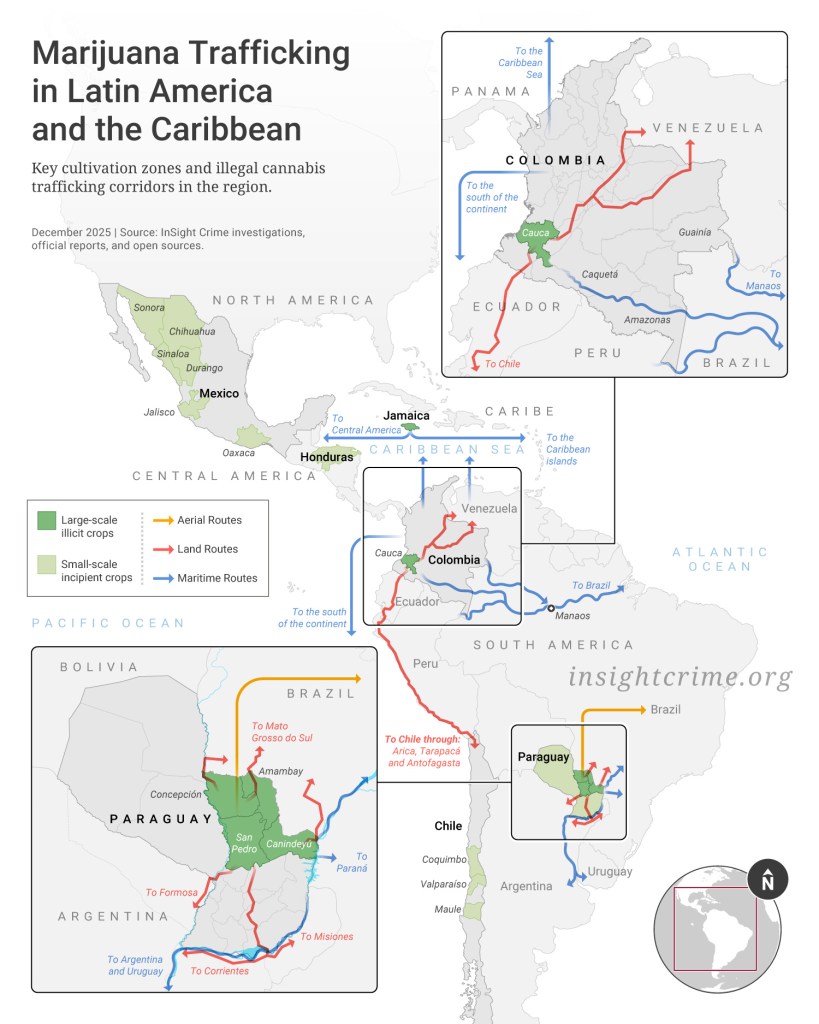
In 2025, Brazil’s Federal Police saw a 45% uptick in marijuana seizures compared to the year before. The majority of marijuana came from Paraguay, entering the country via the Paraná River and Lake Itaipú. From there, the drugs are distributed in several different states. Between January and September 2025, Brazilian authorities seized 97.3 kilograms of different drugs, more than 96 kilograms of which was marijuana. During the same time period in 2024, marijuana accounted for 67 kilograms of the 69 kilograms of total drugs seized.
Marijuana shipments from Paraguay also crossed the Paraná River and entered into the Argentine provinces of Misiones and Corrientes, from where they were moved to urban centers like Buenos Aires, Rosario, and Córdoba. Marijuana seizures during the first semester of the year increased 35% compared to the same time period last year, according to ex-Security Minister Patricia Bullrich. In November, authorities seized a historic 10-ton marijuana shipment that had entered the country from Brazil.
And in Chile and Uruguay, marijuana from Paraguay continued to circulate, albeit in smaller quantities. While marijuana legalization in Uruguay has drastically reduced demand for illegal marijuana from Paraguay, in Chile, Colombian marijuana and marijuana that is increasingly produced locally have largely displaced Paraguayan marijuana.
This shift in Chile’s market can be seen in the growth of cannabis crops, particularly in the regions of Coquimbo, Maule, and Valparaiso. Illicit crop seizures increased from 679,319 plants in 2023 to nearly 720,000 in 2024, according to data from the country’s investigative police.
Impacts of Legalization
Marijuana legalization and decriminalization in countries like the United States, Uruguay, and Canada has had a direct impact on the illegal market in Latin America.
Over the last decade, marijuana seizures along the US-Mexico border have fallen by more than 95%. In 2013, US Customs and Border Protection (CBP) seized around 1,100 tons of marijuana. By 2023, seizures had plummeted to just about 28 tons.
Mexican marijuana has largely been replaced by high-quality marijuana produced in the United States, which has drastically reduced illegal marijuana flows into the country, according to the US Drug Enforcement Administration (DEA).
For more than five decades, cannabis and poppy cultivation were the main illicit economies in rural drug-producing regions of Mexico. In the 1970s and 1980s, marijuana trafficking emerged as the top criminal economy for the country’s organized crime groups. But as demand disappeared in the United States due to legalization in several states, Mexican crime groups were forced to diversify.
Many of these groups, including the Sinaloa Cartel, shifted their focus to the large-scale production of synthetic drugs like methamphetamine and illicit fentanyl, which offered greater returns on their investment and did not require large swaths of farmland. At the same time, some of these groups also got involved in the legal marijuana industry, taking advantage of regulatory gaps and their own existing distribution networks.
However, legalization also impacted distribution networks, especially where the drug is still illegal. At the start of 2025, for example, authorities in the Dominican Republic seized more than 800 packages of marijuana smuggled into the country from Canada and the United States.
Further south, in Uruguay, the black market for marijuana has grown significantly smaller in the face of legalization. Of the 250,000 estimated marijuana consumers in the country, 39% of them obtain marijuana legally, according to the Institute for Cannabis Control and Regulation (Instituto de Regulación y Control de Cannabis – IRCCA). This transition has separated consumers from illicit markets often linked to organized crime networks.
That said, this dynamic is evolving at varying speeds across Latin America. Colombia, Argentina, and Chile have progressed in establishing partial legal frameworks centered around medicinal use. But Brazil and Paraguay continue enforcing more hard-line, prohibitionist measures despite the growing costs of interdiction and the evolution of criminal markets. Although the push for legalization continues to grow, the lack of any regional consensus continues to limit the ability of authorities to effectively root out illicit markets.
In this year’s event, we’re looking back at the last year and the last decade to better understand what’s to come in 2026. Our donor-exclusive event will brief you on the most important criminal shifts in the region and what to expect in the coming year from organized crime and the governments tackling it in the Americas.