


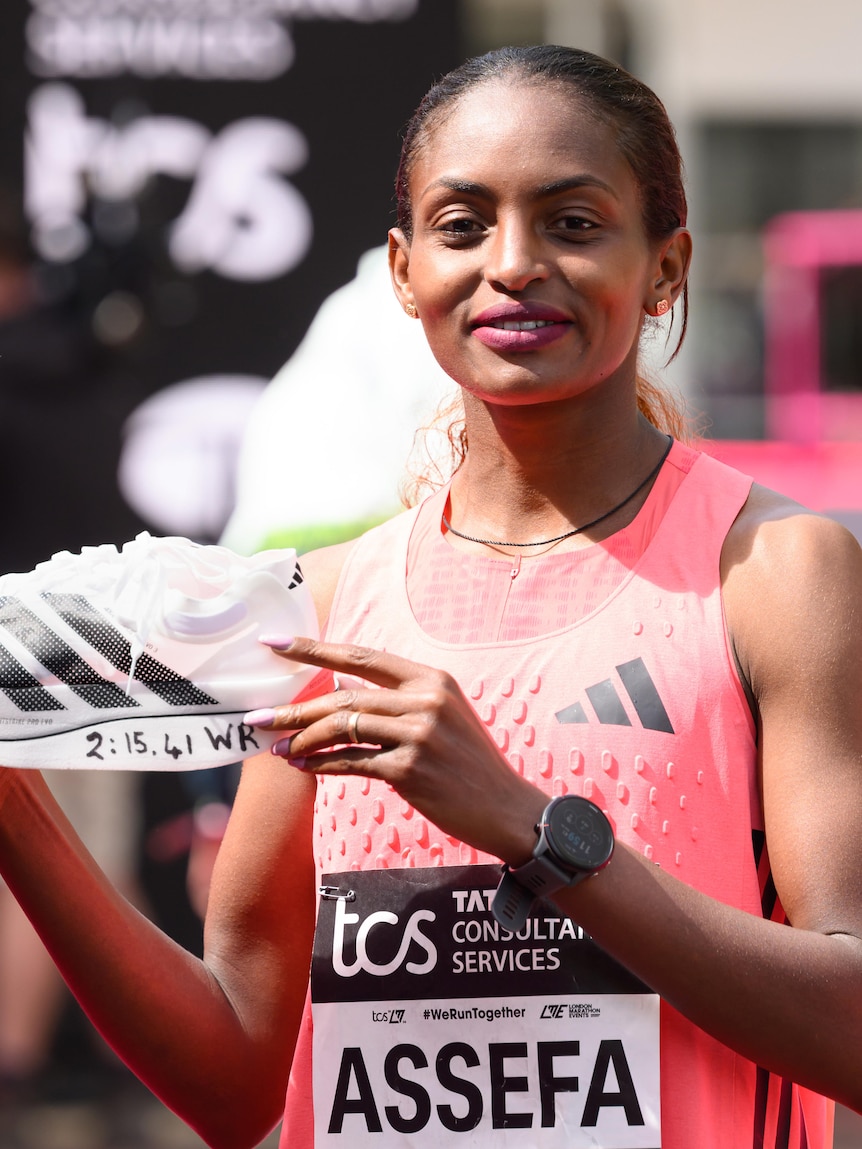
World Athletics boss Lord Sebastian Coe said he will not “strangle” the innovation that has led to a new market in super shoes.
However, the two-time Olympic 1,500-metres champion told the BBC that the governing body had a “regulatory responsibility” to the sport.
Super shoes have come under the spotlight again after last weekend’s record-breaking London Marathon, where Sabastian Sawe became the first man to run sub-two hours for the 42.2-kilometre distance in an official race.
Not only that, but second-placed Yomif Kejelcha also broke the once-mythical mark, while Tigst Assefa set a new women’s only world record in the women’s race.
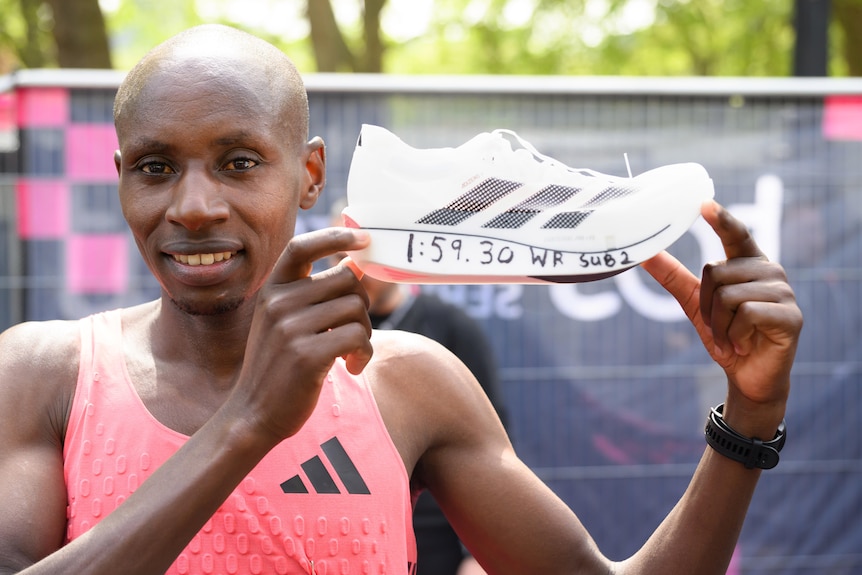
Sabastian Sawe holds up the new Adidas super shoe. Someone once wrote that “it’s not about the bike”. Athletics’ challenge is to ensure it’s not about the shoe. (Getty Images: Karwai Tang)
All three were wearing Adidas’s new Adizero Adios Pro Evo 3 shoe, the first to weigh less than 100 grams.
Adidas claims the technology within the latest version of its super shoe, including advanced foam and carbon-infused “energy rods” assists in generating high energy return and improves running economy by 1.6 per cent.
There is no doubt we are in a different world to when Ethiopian runner Abebe Bikila set the world record of 2:15.16 on the streets of Rome to win Olympic gold — all the while running barefoot.
But World Athletics is treading a fine line between technological advancement and remaining true to its roots. This is one that swimming, too, once trod, leading to the much-heralded and maligned super-suit era between 2008 and 2010, which saw 200 world records tumble in the space of two years before the cat was wrestled back into the bag and those polyurethane full-body suits were banned.
Adidas’s new shoes are expected to retail at $US500 ($694) when they are made available to the general public later this year.
Some athletes have complained that super shoes are tantamount to “technological doping”, while and Australian marathon great Robert de Castella called for the “ludicrous” shoes to be banned as they go against the “spirit” of athletics.
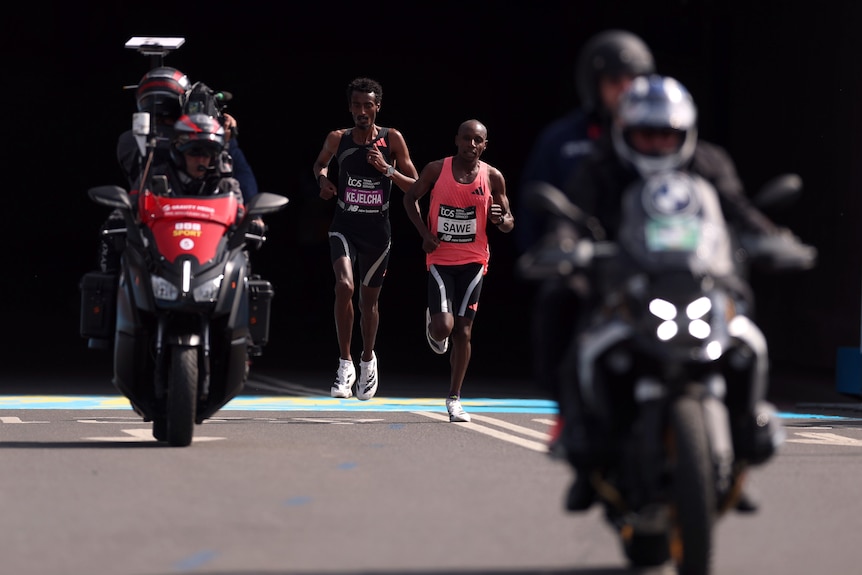
Both Yomif Kejelcha (left) and Sabastian Sawe broke the two-hour mark in Adidas’s new shoe. (Getty Images: Warren Little)
However, World Athletics president Lord Coe said his organisation had a duty to “enable” innovation.
“I don’t think any society, any civilisation, any sector of the economy has been served well if you try to strangle innovation,” Coe told the BBC.
Loading…
“The role of World Athletics is very clear: we want to enable, but we also have a regulatory responsibility.
“Yes, shoes play a part, but not the biggest part.
“The biggest part is the mentality of the athlete, the physicality of the athlete, the world-class coaching, the world-class programmes that are now being run through federations to support their athletes. That’s all a part of the improved performances.”
Critics say the rapid advancement in shoe technology and associated decrease in times meant that it was impossible to assuage whether improvements were legally achieved or assisted by doping.
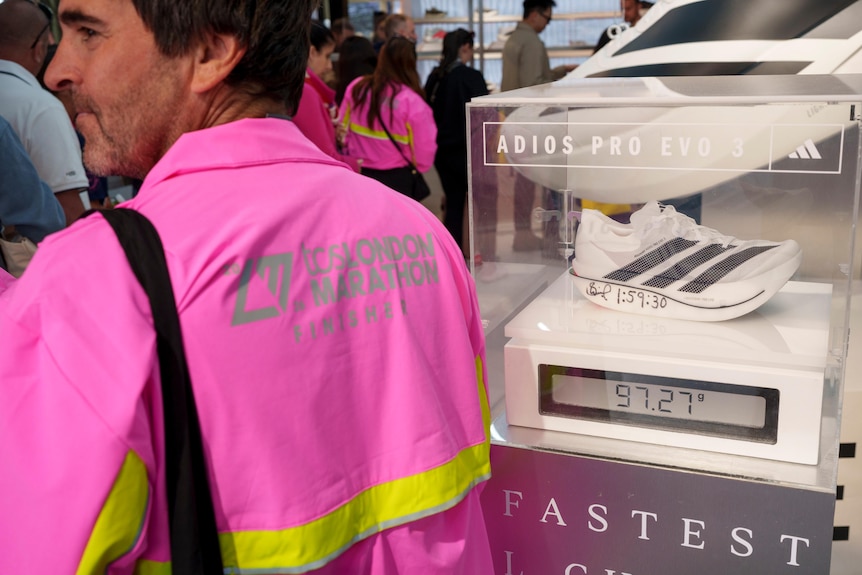
The world-record-breaking super shoe was lauded the day after the London Marathon. (Getty Images: In Pictures/Richard Baker)
Professor Ross Tucker, host of The Real Science of Sport podcast, wrote on X that the new super shoes “confound the analyses and make the doping issue harder to assess”.
Sawe, it should be noted, has taken proactive steps to remove any doping suspicion by funding enhanced testing through the Athletics Integrity Unit.
That has been funded to the tune of $US50,000 by Adidas, who are desperate to ensure that any improvements in Sawe’s time — and, as a result, the part their shoes played in it — are not tainted by the stench of performance enhancing drugs.
World Athletics has installed limits on technology in the past.
The body placed limits on sole thickness (no more than 40 millimetres thick), the design of carbon-fibre plates, and mandated that any shoes are available to be purchased by the general public.
“This is inevitably an evolutionary process,” Coe said.
“It’s only been relatively recently that we’ve had a system of evaluation.
“We work closely with the athletes, the coaches, the shoe companies. We don’t want them to go off and spend hundreds of millions of dollars on shoes that we’re going to find illegal. So there is a balance.”

Sebastian Coe said World Athletics should assist in the development of shoe technology. (Getty Images: PA Images/Martin Rickett)
Sawe, for his part, said his improvement has been down to his ability to run more than 200km a week at altitude and his fuelling strategy during the race.
Coe said that intensive training regime could also be put down to improvements in technology.
“We often overlook that with the design to improve performance goes a lot of biomechanical work around injury prevention,” the 69-year-old said.
“The athletes are able to train for longer, they’re able to race longer, they’re able to be in our sport for longer, and that has to be a good thing.”
Coe acknowledged that there were understandable concerns over the advancement of technology within the sport and striking the right balance between development and remaining true to the sport’s roots.
“Life is always about balances,” Coe said.
“I think at World Athletics we have technical teams that are always going to be conscious of where that balance is. At the moment, I think we’re the right side of it.”
dan