


Senate Democrats spent Wednesday on the Senate floor demanding votes they knew they would lose, on rules that in some cases courts had already thrown out, in defense of the Consumer Financial Protection Bureau (CFPB), an agency that by the government’s own math has cost Americans hundreds of billions of dollars. Republicans obliged them and won every single one.
Advertisement
Democrats used a procedural tool called the Congressional Review Act to force more than a dozen resolutions targeting Trump’s rollback of the CFPB, covering everything from overdraft fees and medical debt to military lending protections. The real goal wasn’t legislation — it was to put vulnerable Republican senators on the record ahead of the 2026 midterms and use the votes in campaign ads.
The votes targeted changes made at the CFPB since Trump returned to office and put Budget Director Russell Vought in charge. Since February 2025, Vought has rolled back 67 policies and scaled back the bureau’s operations, part of a broader effort to rein in an agency the administration says spent years operating without meaningful limits.
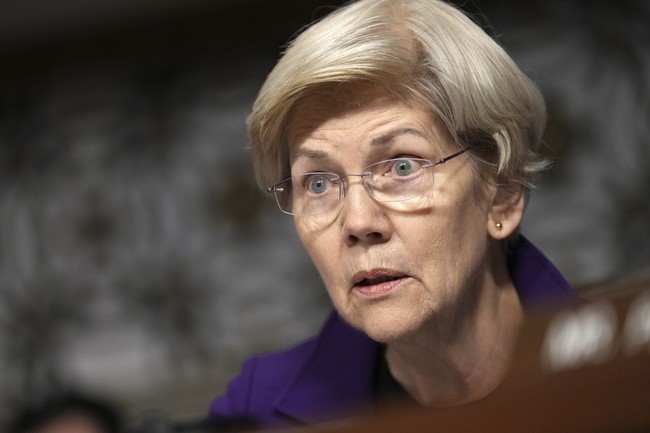
Sen. Elizabeth Warren (D-MA), who pushed for the CFPB’s creation while teaching at Harvard Law School and has been its loudest defender in Congress ever since, led the Democratic charge on the Senate floor.
“The Trump Administration is hell-bent on destroying the agency,” Warren said, adding that the administration had “abandoned consumers and is making life more expensive for them.”
She left out an inconvenient number. Democrats like to cite the CFPB’s own figure of $19.7 billion returned to consumers through enforcement actions and settlements since the bureau’s founding. According to a February estimate from the White House Council of Economic Advisers, the CFPB has cost consumers and lenders between $237 billion and $369 billion since its creation, largely by driving up borrowing costs through aggressive regulation. For every dollar the bureau clawed back in settlements, it may have taken ten from ordinary Americans in higher loan rates and fees.
Advertisement
Senate Banking Committee Chairman Tim Scott (R-SC) was blunt.
“I can’t think of a worse way to govern than the Biden administration’s approach to the CFPB and the playbook that they used time and time again, putting onerous pressure on small businesses,” Scott said.
Republicans have long argued the CFPB has too much power and too little accountability to Congress, a complaint that goes back to the agency’s founding.
One of the highest-profile votes was over overdraft fees. When customers overdraw their accounts, banks charge a fee, something customers agree to when they open the account. The Biden administration required banks to get explicit approval before charging those fees; Trump repealed it. Democrats said the repeal hurts people living paycheck to paycheck. Republicans said the federal government had no business setting terms between a bank and its customers. The Senate voted down the resolution 47-53.
Another resolution sought to restore a Biden-era rule that would have removed medical debt from credit reports. Sen. Raphael Warnock (D-GA) made the case on the floor.
“Medical debt leaves Americans in serious financial jams. It wrecks lives,” Warnock said. “Folks go to the doctor one day for a bandage or some minor injury, and end up leaving with a financial burden the size of a mortgage.”
Advertisement
What Warnock didn’t mention is that a Trump-appointed federal judge already struck down that rule last July, ruling it went beyond what the CFPB is legally allowed to do. Democrats were asking the Senate to vote on bringing back a rule the courts had already thrown out.
That resolution failed 50-50. Three Republicans voted with Democrats: Susan Collins (R-ME), Bill Cassidy (R-LA), and Josh Hawley (R-MO). Collins, who regularly breaks with her party on issues like this, also sided with Democrats on two of the three roll-call votes. Hawley is a different case. He has spent years arguing that big banks get too favorable a deal from Washington, and his vote here reflects that conviction, not an attempt to appeal to moderate voters.
Read More: Congress Must Rein in Another Obama-Era Abuse at CFPB
Trump’s Fed Chair Pick Has Fun at Elizabeth Warren’s Expense at Confirmation Hearing
The broader fight over the CFPB isn’t going away. An Obama-appointed federal judge ruled earlier this year that the administration has to keep requesting operating funds from the Federal Reserve. It can’t simply zero out the bureau’s budget. Vought has complied. He requested $145 million and $75.8 million for the next two quarters, a fraction of what the bureau was spending before Trump took office.
Advertisement
With the bureau’s budget shrinking, its staff sidelined, and 67 policies already off the books, the CFPB that Warren built looks less like a functioning regulator and more like a shell. Democrats can keep forcing votes and cutting ads. But unless they win back the Senate in November, the agency’s days as a serious regulator may already be numbered.
Editor’s Note: Thanks to President Trump’s leadership and bold policies, America’s economy is back on track.
Help us continue to report on the president’s economic successes and combat the lies of the Democrats. Join RedState VIP and use promo code FIGHT to receive 60% off your membership.